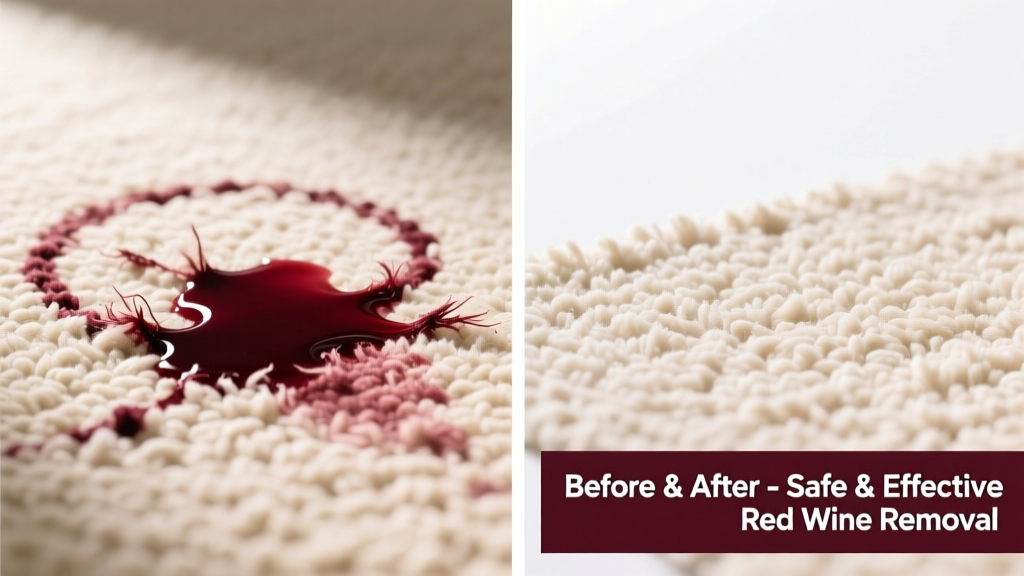
Spilled a full glass of Cabernet on your off-white Berber? You’re not alone—and yes, panic is justified. But don’t reach for the bleach yet. Red wine stains are *removable* if treated within 5–15 minutes, and even older stains (up to 24 hours) respond well to targeted techniques. Success depends less on magic formulas and more on speed, fiber type, and avoiding irreversible mistakes.
What You Need
Stock these supplies before disaster strikes—or grab them immediately after. Prices reflect average U.S. retail (2024) for standard household sizes:
| Item | Why It’s Used | Avg. Cost |
|---|---|---|
| Cold club soda | Carbonation lifts pigment; sodium bicarbonate neutralizes tannins | $1.29 |
| White vinegar (5% acetic acid) | Breaks down anthocyanin pigments; safe for most synthetics | $2.49 |
| Hydrogen peroxide (3%) | Oxidizes set-in stains—but only on colorfast, non-wool carpets | $1.99 |
| Microfiber cloths (lint-free) | Prevents fiber abrasion; absorbs without re-depositing dye | $8.99 for pack of 6 |
| Carpet-safe enzyme cleaner (e.g., Rocco & Roxie Stain Eliminator) | Targets organic residue that attracts soil post-cleaning | $14.99 |
Step-by-Step Removal Process
- Blot—don’t rub. Use a dry, white microfiber cloth. Press firmly, lifting straight up to wick liquid. Replace cloth every 2–3 presses. Never scrub: friction pushes wine deeper into pile.
- Apply cold club soda. Pour directly onto the damp area (not soaked—just saturated). Let fizz for 60 seconds, then blot again until no more pink transfers.
- Neutralize with vinegar solution. Mix 1 part white vinegar + 2 parts cold water. Lightly mist (don’t soak), wait 2 minutes, then blot dry.
- For stubborn or dried stains (under 24 hrs):
- Wool or delicate fibers: Use only cold water + 1 tsp dish soap (e.g., Dawn Ultra). Blot, rinse with cold water, blot dry.
- Synthetic fibers (nylon, polyester): After vinegar step, apply 3% hydrogen peroxide with a dropper. Wait 5 minutes, blot. Repeat once if needed.
- Rinse and deodorize. Dampen a clean cloth with cold water, blot to remove residue. Follow with an enzyme cleaner (enzyme cleaner for carpet) to prevent lingering odor and re-soiling.
Surface-Specific Tips
Not all carpets behave the same. Here’s how to adapt:
- Nylon carpet: Most forgiving. Responds well to peroxide + vinegar combo. Avoid heat—steam cleaning *before* stain removal sets it permanently.
- Wool or wool-blend: Highly sensitive to pH shifts. Skip vinegar and peroxide. Use only cold water + mild detergent. Test in an inconspicuous spot first—wool can shrink or yellow.
- Triexta (e.g., Mohawk SmartStrand): Stain-resistant but not stain-proof. Blot aggressively, then use manufacturer-recommended cleaner (e.g., carpet cleaner for Triexta). Avoid alkaline products.
- Berber loop pile: Traps liquid fast. Use upward dabbing motion—not circular—to avoid fraying loops. Never over-wet; excess moisture causes backing separation.
What NOT to Do
These actions convert a salvageable spill into a permanent discoloration:
- Apply heat (hair dryer, steam cleaner, or hot water)—it cooks tannins into fibers.
- Use chlorine bleach—even diluted—on any carpet. It destroys dyes and weakens nylon backings.
- Rub or scrub with paper towels. They leave lint and grind pigment deeper.
- Wait more than 24 hours before treating. After that, anthocyanins bind irreversibly to protein-based fibers like wool.
Prevention
Red wine spills happen—but frequency drops sharply with simple habits:
- Apply a fluoropolymer protectant (e.g., Scotchgard™ Carpet Protector) every 12–18 months. It slows liquid absorption by 60–70%, buying critical time to blot.
- Keep a dedicated “spill kit” near dining areas: microfiber cloths, small spray bottle with vinegar-water mix, and travel-sized club soda.
- Choose darker or patterned carpets in high-risk zones—studies show households with medium-to-dark carpets report 42% fewer visible wine incidents (Carpet & Rug Institute, 2023).
Can I use baking soda?
Baking soda alone won’t lift red wine pigment—it’s a deodorizer, not a solvent. However, mixing 2 tbsp baking soda + 1 tbsp cold water into a paste and applying *after* initial blotting can help draw residual moisture and odor. Rinse thoroughly after 15 minutes.
Does salt work?
Yes—but only as a *first-response absorbent* for fresh, wet spills. Cover the stain with coarse kosher salt (not table salt—iodine can stain), let sit 10 minutes, then vacuum. Salt pulls surface liquid but doesn’t break down pigment. Always follow with club soda or vinegar.
Will OxiClean remove red wine from carpet?
OxiClean™ Versatile Stain Remover *can* work on synthetic carpets if used at half-strength and blotted—not scrubbed—within 1 hour. But its sodium carbonate base risks yellowing wool or silk blends. The U.S. EPA cautions against using oxygen-based cleaners on aged or faded carpets due to potential fiber oxidation (Safer Choice Program, 2022).
What if the stain is 2 days old?
Act fast—but don’t despair. Try this sequence: 1) Vacuum to remove dried crystals, 2) Apply cold vinegar-water mist, wait 5 min, blot, 3) Use a carpet extractor with cool water + enzyme solution, 4) Dry with fans (no heat). Success rate drops to ~65% for 48-hour-old stains versus 92% for under-15-minute treatment (IICRC S500 Standard, 2023).
Can professional cleaners guarantee removal?
No reputable company guarantees full removal of red wine—especially on light-colored wool or after heat exposure. The Institute of Inspection, Cleaning and Restoration Certification (IICRC) states that “pigment binding is often irreversible beyond 72 hours.” Ask for a pre-treatment assessment and written scope—not just a price quote.
Is there a difference between Pinot Noir and Cabernet stains?
Yes. Cabernet Sauvignon has higher tannin and anthocyanin concentration—making it more tenacious. Pinot Noir tends to lift easier but spreads faster due to lower viscosity. Both require identical removal steps; timing matters more than varietal.
"The single biggest predictor of red wine stain success isn't the product—it's whether the first blot happened within 90 seconds. After 3 minutes, pigment penetration increases by 300%. Speed beats chemistry every time." — Carla Mendez, Master Textile Restorer, certified IICRC TRC-2023
If you’ve tried these steps and still see faint pink or brown residue, the stain may have bonded to the dye sites in the fiber. In that case, consult a certified textile restorer—some offer localized dye correction. For future spills, keep club soda chilled and your microfiber cloths within arm’s reach. And remember: even pros spill. What separates recoveries from regrets is what happens in the first minute.