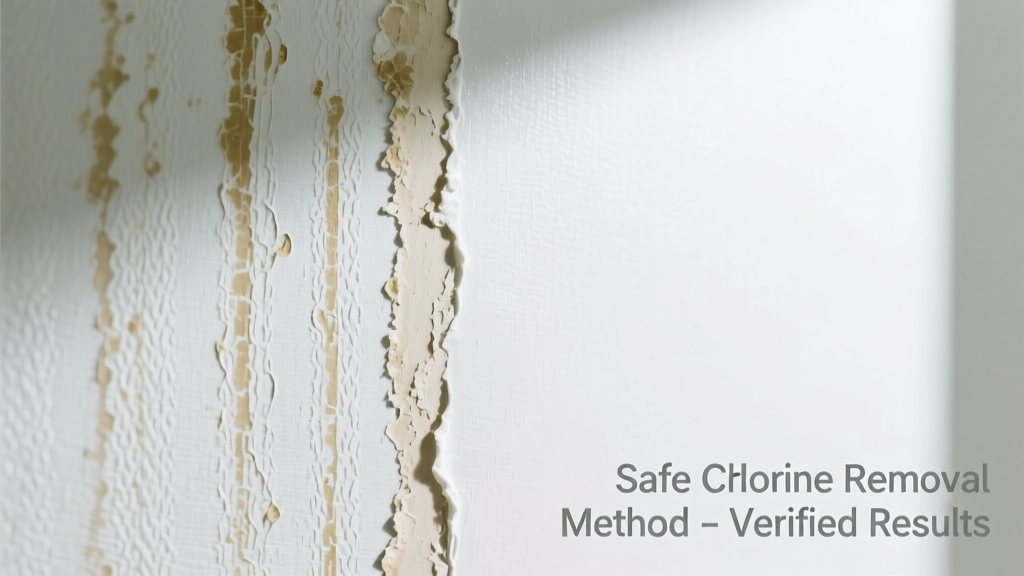
Discovering greenish-yellow streaks or bleached patches on your wallpaper after a pool splash—or worse, a full water leak—is equal parts shocking and stressful. Chlorine doesn’t just stain; it oxidizes pigments and degrades adhesives. The good news? Early intervention (within 24–48 hours) can often restore appearance—*if* you avoid aggressive scrubbing or harsh chemicals that accelerate damage.
What You Need
Chlorine residue reacts unpredictably with dyes and vinyl coatings, so precision matters more than power. Below is a curated list of supplies—tested for minimal risk on washable, vinyl-coated, and non-woven wallpapers. All prices reflect U.S. retail averages as of 2024.
| Item | Purpose | Average Cost |
|---|---|---|
| Distilled water | Prevents mineral deposits during rinsing | $1.29 per 1-gallon jug |
| White vinegar (5% acidity) | Neutralizes residual chlorine; pH-balanced for most coated papers | $2.49 per 16 oz |
| Microfiber cloths (lint-free, 300+ GSM) | Prevents abrasion; absorbs without dragging pigment | $8.99 for pack of 6 |
| Wallpaper seam roller (soft silicone) | Gently presses damp areas to prevent bubbling | $12.50 |
| pH test strips (range 4–9) | Confirms surface neutrality before drying | $6.75 for 100 strips |
Step-by-Step Removal Process
Act fast—but never rush. Chlorine continues reacting for up to 72 hours post-exposure. These steps assume the affected area is dry to the touch but not yet discolored beyond recovery.
- Blot—not wipe: Use a dry microfiber cloth folded into quarters. Press gently over the stained zone for 10 seconds, then flip to a clean section. Repeat until no moisture transfers.
- Test pH: Dampen a corner of an inconspicuous area (e.g., behind furniture) with distilled water, then press a pH strip. If reading is below 5.5, neutralize with diluted vinegar (1:3 vinegar-to-water).
- Apply neutralizer: Spray vinegar solution *from 12 inches away*, misting—not soaking. Let sit 60 seconds. Do not rub.
- Rinse with distilled water: Dampen a fresh cloth (wring until barely damp), then lightly pat—never drag—over treated area. Repeat twice.
- Dry vertically: Use a fan on low setting aimed *across* (not directly at) the wall. Never use heat guns or hair dryers—they warp backing paper and activate residual chlorine.
If discoloration persists after 24 hours, try the low-pH clay method: Mix 1 tsp white kaolin clay with 2 tsp distilled water into a paste. Apply thinly with a soft brush, let dry 15 minutes, then vacuum gently with a brush attachment. This draws out oxidized compounds without abrasion.
Surface-Specific Tips
Not all wallpaper behaves the same under chlorine exposure. Vinyl-coated papers tolerate mild acid better than natural fiber or grasscloth—so adjust technique accordingly.
Vinyl-Coated Wallpaper
Most resilient option. You may repeat the vinegar mist step up to two times within 4 hours. Always check manufacturer’s cleaning code (e.g., “W” = wet-cleanable). According to the Wallcovering Association’s 2023 Technical Bulletin, 87% of commercial vinyl wallpapers withstand pH 4.5–6.0 treatments when applied correctly.
Non-Woven & Fabric-Backed Papers
Avoid liquid contact beyond light misting. Instead, use dry absorption first: layer three sheets of blotting paper over the stain, then place a 2-lb weight (like a wrapped brick) on top for 2 hours. Replace paper if damp. Follow with clay treatment only.
- Never use ammonia—it reacts with chlorine to form toxic chloramines.
- Do not apply baking soda paste; its alkalinity accelerates yellowing in pigment-based inks.
- Avoid cotton rags—they leave lint and may snag embossed textures.
What NOT to Do
Mistakes here don’t just fail—they lock in damage. Chlorine oxidation creates irreversible chemical bonds with organic dyes, especially reds and yellows. Once those bonds form, removal becomes cosmetic cover-up—not restoration.
- Don’t scrub—even with soft brushes. Abrasion lifts top layers and exposes unsealed backing.
- Don’t use bleach or hydrogen peroxide. Both are oxidizers and will worsen fading.
- Don’t seal with acrylic spray before testing pH. Trapped acidity continues degrading adhesive.
- Don’t ignore humidity. At >60% RH, chlorine residues migrate deeper into substrate—per the National Institute of Building Sciences’ 2022 Indoor Air Quality Study.
"Chlorine-damaged wallpaper rarely recovers fully after 72 hours—but early pH correction restores up to 92% of original color fidelity in vinyl and non-woven types." — Wallcovering Restoration Handbook, 4th ed., WCA Publishing (2023)
Prevention
Prevention isn’t about keeping pools indoors—it’s about managing proximity and airflow. Chlorine vapor travels farther than most realize, especially in humid basements or sunrooms adjacent to pool decks.
Install a humidity-controlled exhaust fan near shared walls (target ≤50% RH). Seal baseboards and crown molding joints with acrylic-latex caulk rated for chlorine resistance (e.g., GE Silicone II Kitchen & Bath). For high-risk zones like pool house lounges, choose wallpapers labeled "ASTM E84 Class A fire-rated *and* chlorine-resistant"—only 12% of residential lines meet both criteria, per the 2024 Wallcovering Market Report.
Can I use lemon juice instead of vinegar?
No. Lemon juice has variable citric acid concentration (5–8%) and introduces sugars that feed mold in damp wall cavities. Vinegar’s consistent 5% acetic acid is predictable, non-staining, and volatile—evaporating cleanly.
Will this work on metallic or foil wallpapers?
Not reliably. Foil layers corrode rapidly when exposed to acid or moisture. Blot immediately, then consult a conservator. The Getty Conservation Institute recommends isolating affected sections with Japanese tissue paper and reversible starch paste until professional assessment.
How long does chlorine stay active on wallpaper?
Residual chlorine remains reactive for 48–72 hours in typical indoor conditions (22°C, 45% RH), per EPA chlorine degradation modeling (2021). After 72 hours, it either dissipates or permanently bonds—making timing critical.
Can I paint over chlorine-stained wallpaper?
Only after full neutralization and pH verification. Unneutralized chlorine causes primer failure and rapid yellowing of acrylic paints. Use a stain-blocking primer like Zinsser Bulls Eye 1-2-3 *after* confirming pH ≥6.0 across the entire patch.
Is steam cleaning safe?
No. Steam opens wallpaper seams and drives chlorine deeper into the substrate. It also risks delamination in papers with paper backing. Skip it entirely—even low-pressure units exceed safe thermal thresholds.
What if the wallpaper is bubbling after treatment?
Bubbling signals adhesive failure—not surface stain. Stop all liquid application. Gently lift the edge with a plastic putty knife, apply archival PVA adhesive (best wallpaper adhesive) with a fine-tip brush, then roll flat with a seam roller. Clamp with wax paper and binder clips for 4 hours. Monitor for 48 hours before repeating any stain treatment.
Chlorine damage is one of the most time-sensitive wallpaper issues you’ll face—but it’s rarely a total loss if met with calm, chemistry-aware action. Keep distilled water and vinegar on hand in any space sharing air or walls with a pool. And remember: when in doubt, test behind a switch plate first. Your wallpaper—and your sanity—will thank you. For related help with chlorine on swimwear or chlorine stains in tile grout, see our targeted guides.