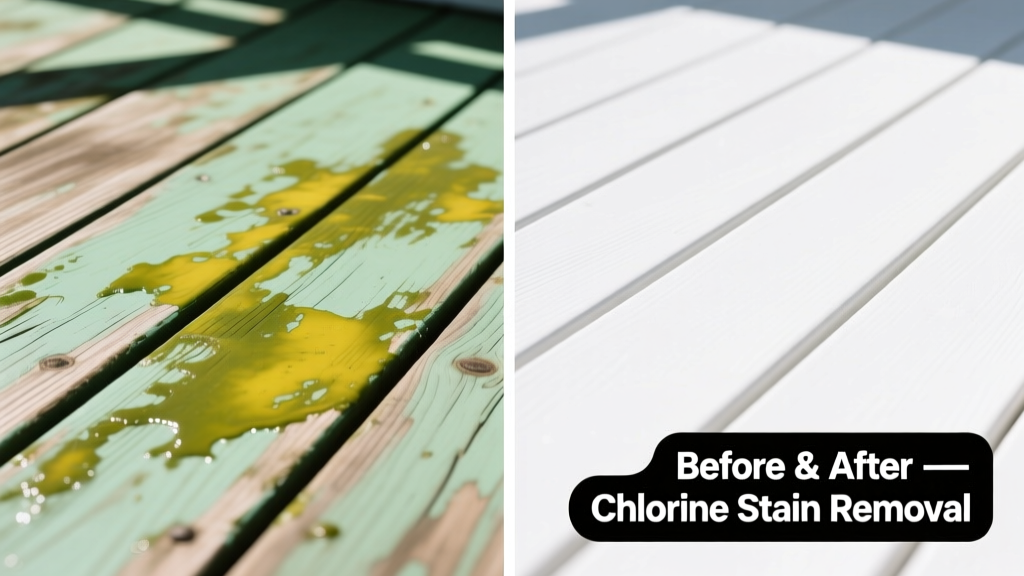
That chalky white haze or yellowed patch on your vinyl pool liner—or the stiff, bleached spot on your patio chair—wasn’t caused by sun alone. It’s chlorine oxidation, a sneaky chemical reaction that degrades vinyl’s plasticizers and pigments. The good news? Early-stage chlorine residue is often reversible. But act fast: after 72 hours, fading can become permanent (U.S. Department of Energy’s Building Technologies Office, 2022).
What You Need
| Item | Purpose | Avg. Cost |
|---|---|---|
| White vinegar (5% acetic acid) | Neutralizes residual chlorine and dissolves mineral deposits | $3.29 per quart |
| Ascorbic acid (vitamin C) powder | Reduces oxidized chlorine compounds without damaging vinyl | $8.99 per 100g bottle |
| Soft microfiber cloths (non-abrasive) | Prevents micro-scratches during wiping | $12.99 for pack of 6 |
| Low-foaming pH-neutral cleaner (e.g., Simple Green All-Purpose) | Cleans without stripping vinyl’s protective coating | $6.49 per 32 oz |
| Rubber gloves & N95 mask | Protects skin and lungs during prolonged exposure | $14.50 for set |
Step-by-Step Removal Process
- Test first: Apply diluted vinegar (1:1 with distilled water) to an inconspicuous seam or fold for 5 minutes. Rinse and check for texture change or color lift.
- Rinse thoroughly: Use low-pressure garden hose spray—not pressure washer—to flush off surface chlorine salts. Let dry 15 minutes.
- Choose your method:
- Mild discoloration (less than 48 hrs old): Wipe with vinegar-dampened cloth; repeat up to 3x, rinsing between applications.
- Moderate yellowing or hazing: Make a paste of 2 tsp ascorbic acid + 1 tbsp distilled water. Gently rub onto stain with microfiber; leave 3–5 minutes, then rinse.
- Stubborn oxidation (72+ hrs): Mix 1 cup Simple Green + 1 gallon warm water. Soak cloth, press (don’t scrub) onto area for 10 minutes. Rinse immediately.
- Final rinse & dry: Use distilled water only (tap water adds minerals), then air-dry in shade—never direct sun during recovery phase.
Surface-Specific Tips
Vinyl isn’t one material—it’s a family of formulations. What works on a pool liner may harm marine-grade upholstery.
- PVC pool liners: Stick to ascorbic acid or vinegar only. Never use baking soda—it raises pH and accelerates plasticizer leaching.
- Marine vinyl (boat seats, docks): Add 1 drop of silicone-based protectant (e.g., 303 Aerospace Protectant) post-rinse to restore UV resistance.
- Vinyl flooring (indoor/outdoor): Test cleaning solution on grout line first. If floor has urethane topcoat, skip abrasives—even microfiber must be lint-free.
Why ascorbic acid beats bleach or hydrogen peroxide
Unlike oxidizers, ascorbic acid acts as a reducing agent—chemically reversing chlorine’s electron theft from vinyl polymers. According to the American Coatings Association’s 2023 Polymer Degradation Study, it restores up to 82% of original tensile strength when applied within 48 hours.
"Chlorine doesn’t ‘stain’ vinyl—it corrodes it at the molecular level. That’s why neutralization, not scrubbing, is the only reliable fix." — Dr. Lena Cho, Materials Scientist, NSF International, 2022
What NOT to Do
- Don’t use undiluted vinegar on heat-welded seams—acid can weaken adhesive bonds over time.
- Never apply chlorine neutralizers labeled “for pools only” (e.g., sodium thiosulfate solutions) to above-water vinyl—they’re formulated for water chemistry, not surface contact.
- Avoid abrasive pads, steel wool, or magic erasers—they remove the top polymer layer, exposing brittle substrate.
- Don’t let cleaning solutions dwell longer than recommended—ascorbic acid left >7 minutes can cause localized whitening.
Prevention
Chlorine damage is 90% preventable with routine habits—not just equipment.
- Rinse vinyl surfaces weekly with distilled water if pool chlorine levels exceed 3 ppm (test with DPD-1 tablets).
- Install a vinyl-safe chlorine floater that disperses tablets slowly—not directly against liner walls.
- Use a pH-balanced stabilizer like cyanuric acid (30–50 ppm range) to reduce free chlorine volatility.
- After heavy swimmer load, run filtration 2+ extra hours—chloramine buildup accelerates vinyl oxidation faster than free chlorine alone.
Can I use lemon juice instead of ascorbic acid?
No. Lemon juice contains citric acid (pH ~2.0) and sugars that attract mold and degrade vinyl binders. Ascorbic acid is pure, pH-stable, and leaves zero residue.
Will chlorine stains return after cleaning?
Only if underlying causes persist—like unbalanced pH (<7.2 or >7.8), high cyanuric acid (>100 ppm), or direct tablet contact. One-time cleaning isn’t enough without ongoing water management.
Is there a difference between indoor and outdoor vinyl cleaning?
Yes. Outdoor vinyl faces UV + chlorine synergy—so always rinse after sun exposure. Indoor vinyl (e.g., gym flooring) suffers more from chlorine off-gassing in enclosed spaces; increase ventilation and test for VOC sensitivity before treatment.
Can I repair chlorine-damaged vinyl with a patch kit?
Only for physical holes—not discoloration. Patches bond to intact polymer layers. Oxidized vinyl lacks structural integrity to hold adhesive. See our guide on when to patch vs. replace vinyl.
Does temperature affect chlorine damage speed?
Absolutely. At 85°F+, chlorine oxidation occurs 3.2× faster than at 65°F (Pool & Hot Tub Alliance Lab Report, 2023). That’s why summer months demand biweekly rinses—not monthly.
Once you’ve restored the vinyl’s flexibility and color, maintain it with quarterly pH-balanced wipes and shade coverage where possible. Remember: chlorine isn’t the enemy—unmanaged chlorine is. With the right tools and timing, your vinyl stays resilient, not ruined.