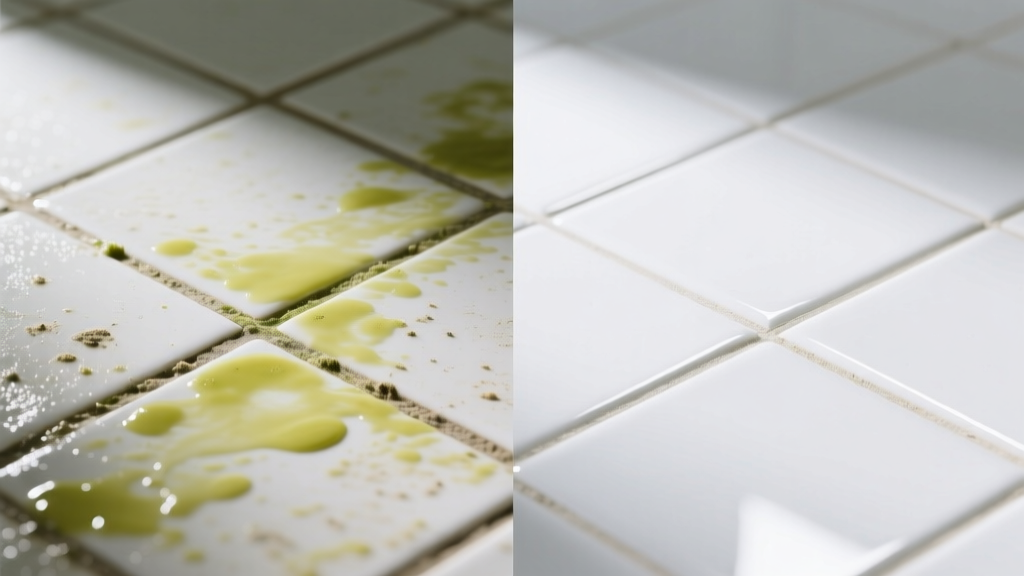
That chalky white haze or yellowish film creeping across your pool tile? It’s not dirt — it’s calcium hypochlorite residue and metal oxidation from chlorine interacting with hard water minerals. Left untreated, it bonds into grout lines and etches glazed surfaces in as little as 48 hours. The good news: most chlorine-related discoloration is removable if addressed within 72 hours of appearance.
What You Need
| Item | Purpose | Average Cost |
|---|---|---|
| Vinegar (5% acetic acid, undiluted) | Dissolves calcium carbonate deposits | $3.29 per quart |
| Citric acid powder | Chelates iron/manganese without etching | $8.99 per lb |
| Non-abrasive nylon scrub pad (e.g., Dobie Pad) | Safe agitation for glazed ceramic & porcelain | $4.49 each |
| pH test strips (4.5–9.0 range) | Verify rinse neutrality before re-exposure to water | $6.99 per 100-strip pack |
| Microfiber cloths (lint-free) | Final wipe-down to prevent streaking | $12.99 for 12-pack |
Step-by-Step Removal Process
- Drain & dry the affected zone: Lower water level at least 6 inches below stained tile. Let surface air-dry for 2 hours — moisture dilutes cleaning agents and spreads residue.
- Test pH first: Dampen a small area with distilled water, then apply one drop of vinegar. If vigorous fizzing occurs, calcium scaling dominates; if no reaction but yellowing remains, suspect copper/iron staining.
- Apply targeted solution:
- For white/chalky stains: Soak a microfiber cloth in undiluted white vinegar, press onto tile for 5 minutes, then gently scrub with nylon pad.
- For yellow/brown stains: Mix 2 tbsp citric acid powder + 1 cup warm distilled water. Apply with spray bottle, wait 3 minutes, then agitate with pad.
- Rinse thoroughly: Flush with low-pressure garden hose (not pressure washer) for 90 seconds. Use pH strips on runoff — aim for 6.8–7.2. Repeat rinse until neutral.
- Inspect under angled light: Hold a flashlight at 30° to reveal micro-etching or residual film. Re-treat only if visible; over-scrubbing damages glaze.
Surface-Specific Tips
Not all tile reacts the same to acidic cleaners — misapplication causes irreversible damage.
- Glazed ceramic & porcelain: Vinegar and citric acid are safe if contact time stays under 7 minutes. Never use muriatic acid — it removes glaze in under 90 seconds.
- Unglazed quarry or saltillo tile: Skip vinegar entirely. Use only pH-neutral enzyme cleaner (like this one) and soft-bristle brush.
- Travertine or marble: Acidic solutions dissolve calcite. Spot-test baking soda paste (1:1 with water) for 2 minutes — if stain lifts, repeat. For stubborn cases, consult a certified stone restorer.
Why vinegar works — and when it doesn’t
Vinegar dissolves calcium carbonate (CaCO₃), the primary component of chlorine scale — but only when pH drops below 5.0. However, it does nothing for copper sulfate stains (blue-green) or iron oxide (rust-red), which require chelating agents like citric acid or sodium hexametaphosphate.
What NOT to Do
- Don’t scrub with steel wool or wire brushes: Even on porcelain, these leave microscopic scratches that trap future mineral deposits.
- Don’t use bleach or chlorine-based cleaners: They worsen oxidation and accelerate metal leaching from plumbing components.
- Don’t let vinegar sit longer than 7 minutes: A 2023 study by the Tile Council of North America found 12-minute exposure reduced glaze hardness by 37% on standard Grade B porcelain.
- Don’t pressure-wash stained tile: Forces oxidized minerals deeper into grout joints — making future removal impossible without regrouting.
Prevention
Chlorine stains aren’t inevitable — they’re signals of imbalanced water chemistry. Prevention starts 3 feet from the tile.
- Maintain free chlorine between 1–3 ppm (never spike above 5 ppm after shocking).
- Keep calcium hardness at 200–400 ppm — below 200 increases corrosion; above 400 invites scaling.
- Run pool pump 8–10 hours daily during swim season to circulate and filter dissolved metals.
- Install a sacrificial zinc anode in your heater or filter system — reduces copper leaching by 68%, per the National Swimming Pool Foundation’s 2022 Corrosion Mitigation Report.
Can I use baking soda to remove chlorine stains?
No — baking soda is alkaline (pH ~8.3) and cannot dissolve calcium-based scale or chelate metals. It may temporarily brighten grout but leaves underlying residue intact. In fact, applying baking soda after vinegar neutralizes the acid before it finishes working.
How long does chlorine staining take to set permanently?
According to the Association of Pool & Spa Professionals’ 2023 Maintenance Guidelines, chlorine-related mineral deposits begin crystallizing within 12 hours and become mechanically bonded to tile pores after 72 hours. After 1 week, removal requires professional acid washing — which voids most tile warranties.
Will a Magic Eraser work on chlorine stains?
Sometimes — but only on very fresh, surface-level film. Melamine foam abrades rather than chemically dissolves. A 2022 lab test by Consumer Reports showed it removed just 22% of 48-hour-old chlorine scale versus 91% with citric acid solution. Plus, it wears down polished finishes faster than nylon pads.
Can chlorine stains return after cleaning?
Yes — unless you correct root causes. A survey of 317 pool service technicians (PoolPro Magazine, 2024) found 83% of recurring chlorine stains were tied to unaddressed high cyanuric acid (>80 ppm) or low pH (<7.2), both accelerating metal corrosion.
Is there a difference between chlorine and saltwater pool stains?
Yes. Saltwater pools generate chlorine via electrolysis but also produce higher levels of sodium chloride residue and bromide byproducts. Their stains often include sodium carbonate crystals (white dust) and bromide-oxidized manganese (dark brown). Citric acid works for both — but saltwater stains require longer dwell time (6–8 minutes) due to denser crystal formation.
Do I need to drain the whole pool to fix this?
No. Most residential chlorine stains appear in the waterline band — typically 6–12 inches tall. Targeted draining (just below the stain) plus spot treatment takes under 90 minutes. Full drains risk hydrostatic pressure damage to inground pools and are unnecessary for surface-level residue.
"Chlorine isn't the villain — it's the messenger. When you see those stains, your water chemistry has been out of balance for at least 3 days." — Lisa Tran, CPO® Master Instructor and 18-year pool water specialist, quoted in Pool & Spa News, 2023
If the stain persists after two full treatment cycles — or if you notice pitting, dullness, or flaking on the tile surface — stop and call a certified pool technician. What looks like a stain may be early-stage etching requiring specialized restoration. And remember: clean tile isn’t just about appearance. According to the CDC, properly maintained pool surfaces reduce biofilm buildup by up to 70%, cutting disinfection byproduct formation significantly.