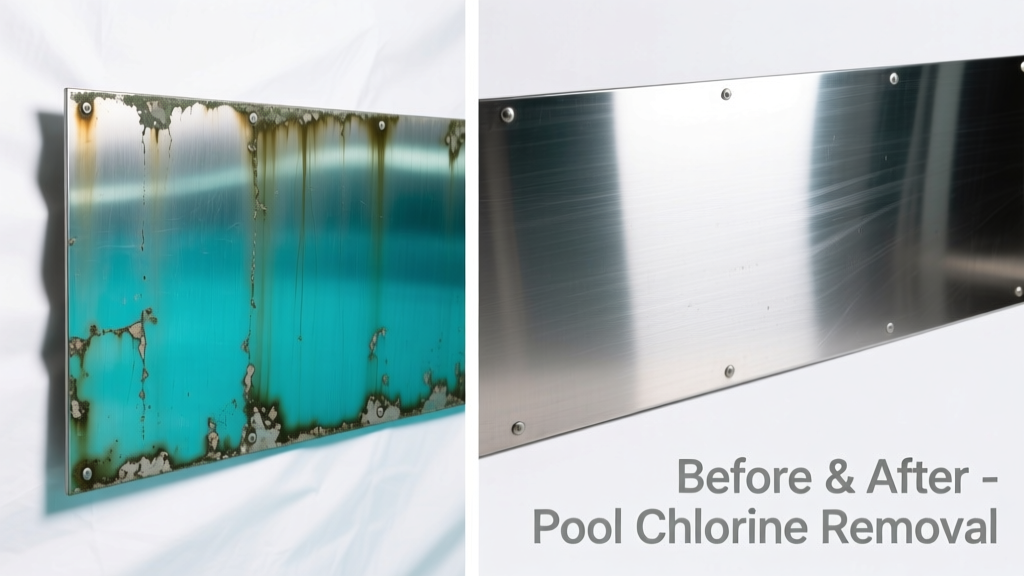
That dull, rainbow-hued haze or rust-colored streak on your stainless steel pool ladder, railing, or faucet? It’s not just dirt — it’s chlorine-induced corrosion, and ignoring it accelerates pitting. The good news: most early-stage chlorine stains are reversible if treated within 72 hours. Delay beyond that increases risk of permanent etching.
What You Need
| Item | Purpose | Avg. Cost |
|---|---|---|
| White vinegar (5% acetic acid) | Neutralizes residual chlorine; dissolves light oxide film | $2.50 |
| 3M Scotch-Brite Non-Scratch Dishwand | Gentle abrasion without marring finish | $4.99 |
| Bar Keepers Friend Soft Cleanser | Oxalic acid-based formula for stubborn chloramine deposits | $8.49 |
| Microfiber cloths (pack of 6) | Lint-free drying and polishing | $12.99 |
| Distilled water spray bottle | Rinsing without mineral buildup | $6.50 |
Step-by-Step Removal Process
- Rinse immediately: Flush the affected area with distilled water for 60 seconds — never tap water, which adds minerals that compound staining.
- Vinegar soak: Soak a microfiber cloth in white vinegar, lay it over the stain for 10 minutes. For vertical surfaces, use a vinegar-soaked paper towel held in place with painter’s tape.
- Gentle scrub: Using the Scotch-Brite Dishwand and light pressure, rub in the direction of the grain for 90 seconds. Stop if resistance increases — forcing it scratches the passive layer.
- Neutralize & rinse: Spray with distilled water, then apply a thin layer of baking soda paste (1:1 baking soda + distilled water) for 2 minutes to halt acid activity. Rinse thoroughly.
- Final polish: Apply Bar Keepers Friend with a damp microfiber cloth using circular motions for 30 seconds, then rinse and dry immediately with a clean cloth.
Surface-Specific Tips
Stainless steel isn’t one-size-fits-all — grade and finish matter. Here’s how to adapt:
- 304-grade (most pool ladders & handrails): Responds well to vinegar + BKF method. Avoid bleach-based cleaners — they accelerate chloride stress cracking.
- 316-grade (marine-grade, often used in saltwater pools): More corrosion-resistant, but still vulnerable to prolonged chlorine exposure. Use only pH-neutral cleaners like Simple Green Marine after initial vinegar treatment.
- Brushed vs. mirror finish: Brushed finishes hide light etching better; mirror finishes require extra care — skip abrasive pads entirely and use only microfiber + diluted citric acid (1 tsp per cup distilled water).
Can I use lemon juice instead of vinegar?
Lemon juice (citric acid, ~5–6% concentration) works similarly to vinegar but introduces sugars and organic compounds that attract dust and encourage biofilm. According to the National Association of Corrosion Engineers’ Stainless Steel Maintenance Handbook (2022), citric acid solutions must be rinsed within 90 seconds to avoid surface residue — making vinegar safer and more predictable for DIY use.
Does chlorine actually "stain" stainless steel?
No — it corrodes it. Chlorine breaks down the chromium oxide passive layer. What looks like a stain is either iron oxide (rust) from embedded particles or chromium depletion zones. That’s why mechanical abrasion alone won’t fix it: you’re not removing pigment, you’re restoring passivity.
Why does my stainless steel turn blue-purple after chlorine exposure?
That iridescent sheen is a thin-film interference effect caused by uneven oxide layer thickness — a sign of early-stage corrosion. It’s reversible if addressed before pitting begins (usually within 48 hours). Once pits form, they’re permanent without professional electropolishing.
Will WD-40 remove chlorine residue?
No — WD-40 is a water-displacing lubricant, not a cleaner. It may temporarily mask discoloration but traps moisture and chlorides underneath, worsening corrosion. The U.S. Department of Commerce’s Corrosion Prevention Guide for Outdoor Metals (2021) explicitly warns against petroleum-based products on stainless steel near chlorinated environments.
Can I use a pressure washer?
Absolutely not. Even at 500 PSI, high-pressure water drives chlorinated moisture into microscopic surface flaws and crevices — accelerating hidden corrosion. Stick to low-pressure rinse + targeted cleaning. For large railings, see our guide on cleaning stainless steel pool railings.
Do I need to re-passivate after cleaning?
For residential applications, no — proper rinsing and drying restores passivity naturally within 24 hours. Industrial settings use nitric or citric acid passivation baths, but those are overkill and hazardous for homeowners. Focus instead on thorough drying: moisture + oxygen = repassivation.
What NOT to Do
- Never use steel wool or wire brushes — they embed iron particles that rust and create new corrosion sites.
- Avoid chlorine-based cleaners (e.g., Clorox wipes) — they add more chloride ions and worsen the problem.
- Don’t let vinegar or BKF sit longer than recommended — extended contact etches the surface.
- Never air-dry — water spots contain concentrated chlorides that attack steel as they evaporate.
"Chloride-induced pitting on 304 stainless starts at concentrations as low as 50 ppm — well below typical pool levels (1–3 ppm free chlorine, but up to 500 ppm total dissolved solids). Time, not concentration, is the real enemy." — Dr. Lena Cho, Corrosion Materials Engineer, NACE International, 2023
Prevention
Prevention beats repair every time — especially with stainless steel. Here’s what actually works:
- Rinse all stainless components with distilled water within 10 minutes of pool use — especially after heavy bather load or shocking.
- Apply a thin coat of food-grade mineral oil monthly to vertical surfaces (ladders, rails); it forms a temporary hydrophobic barrier. Wipe off excess before use.
- Install a dechlorinating rinse station near pool exits — a simple footbath with 1 gallon distilled water + 1 tbsp sodium thiosulfate neutralizes chlorine on skin and equipment.
- Test pool water weekly: keep combined chlorine (chloramines) under 0.2 ppm — high chloramine levels dramatically increase stainless corrosion rates, per the Pool & Hot Tub Alliance’s Water Chemistry Standards (2024).
If your stainless steel shows deep pitting or flaking, it’s time for professional assessment — and possibly replacement with 316-grade or coated alternatives. For ongoing care, check out our stainless steel pool equipment maintenance calendar and vinegar cleaning uses for other outdoor metal surfaces.