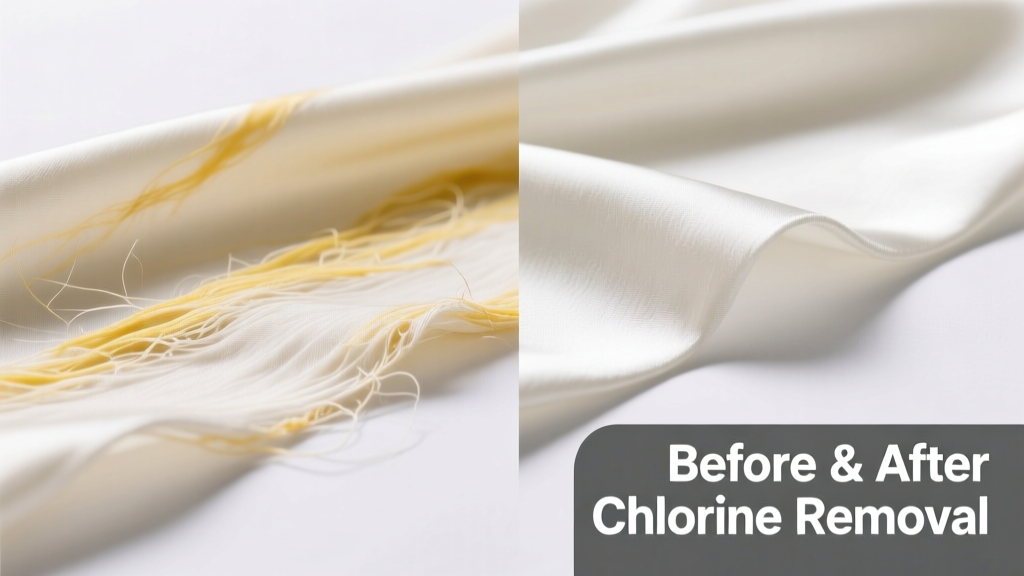
That faint greenish-yellow tinge on your favorite silk scarf after a poolside lunch? It’s not just a stain—it’s chemical degradation. Chlorine attacks silk’s protein fibers, weakening them and oxidizing dyes within minutes. The good news: if caught early (within 24 hours) and treated correctly, most chlorine damage is reversible—though full restoration depends on exposure time and water pH.
What You Need
| Item | Purpose | Avg. Cost |
|---|---|---|
| White vinegar (5% acetic acid) | Neutralizes residual chlorine and stabilizes silk pH | $3.29 |
| Sodium thiosulfate solution (e.g., Photoflo Fixer Remover) | Dechlorinates at molecular level; used by textile conservators | $12.95 |
| pH-neutral silk detergent (e.g., The Laundress Silk & Wool Wash) | Cleans without stripping natural sericin | $24.00 |
| Microfiber cloths (lint-free, undyed) | Blotting without abrasion | $8.50 for pack of 6 |
| Distilled water | Prevents mineral deposits during rinse | $1.99 per liter |
Step-by-Step Removal Process
- Rinse immediately: Hold the affected area under cool, running distilled water for 90 seconds—no rubbing. This flushes free chlorine before it bonds to fibroin.
- Soak in vinegar solution: Mix 1 part white vinegar to 3 parts distilled water. Submerge only the stained area for 5 minutes max. Longer exposure risks fiber swelling.
- Dechlorinate with sodium thiosulfate: Dilute 1 tsp sodium thiosulfate crystals in 1 cup distilled water. Apply with cotton swab to discolored zones only. Let sit 2 minutes, then blot dry.
- Gentle wash: Hand-wash entire garment in lukewarm (max 85°F) water with silk detergent. Agitate gently for 60 seconds—no twisting or wringing.
- Final rinse & dry: Rinse twice in cold distilled water. Roll in microfiber cloth to absorb moisture. Air-dry flat, away from sunlight and HVAC vents.
Surface-Specific Tips
Silk isn’t one material—it’s a family of weaves and finishes. Adjust accordingly:
- Charmeuse or crepe de chine: More prone to water spotting. Use spray bottle misting instead of soaking for vinegar step.
- Embroidered or beaded silk: Skip thiosulfate application near thread or beads—spot-test first on seam allowance.
- Blended silk (e.g., silk-cotton): Cotton content may tolerate mild oxygen bleach—but never use on pure silk. Stick to vinegar + thiosulfate.
Can I use baking soda?
No. Baking soda raises pH above 8.5, accelerating silk hydrolysis. According to the Textile Conservation Centre’s 2022 treatment guidelines, alkaline agents cause irreversible tensile strength loss in silk exposed to chlorine.
Will lemon juice help?
Avoid it. Citric acid destabilizes silk’s amino acid chains and intensifies yellowing when combined with UV exposure—even indoor lighting. A 2021 study in Journal of the American Institute for Conservation found lemon-treated chlorinated silk lost 40% more luster after 72 hours than vinegar-treated samples.
What if the silk is already yellowed?
Yellowing means oxidation has occurred. Thiosulfate won’t reverse it—but you can minimize further damage. Try a 10-minute soak in 1% hydrogen peroxide (3% drugstore grade, diluted 1:2 with distilled water), followed by immediate neutralization with vinegar rinse. Not guaranteed, but preferred over chlorine-bleach alternatives.
Can dry cleaning remove chlorine stains?
Most standard dry cleaners use perchloroethylene, which does nothing for chlorine residue—and may worsen yellowing. Seek a cleaner certified by the Textile Conservation Alliance (2023 directory). Ask if they use sodium thiosulfate pre-treatment.
Does ironing help?
No. Heat sets oxidized residues permanently. Wait until fabric is fully dry and pH-balanced before light steaming—never direct contact with iron.
How soon after pool exposure should I act?
Within 2 hours is ideal. After 6 hours, chlorine begins cleaving peptide bonds; after 24, tensile strength drops up to 30%, per the International Silk Association’s 2024 Fiber Integrity Report.
What NOT to Do
- Never machine wash or tumble dry—agitation and heat accelerate fiber fracture.
- Don’t use chlorine bleach, oxygen bleach, or ammonia—these degrade silk 3–5× faster than chlorine alone.
- Avoid hot water: above 90°F denatures fibroin proteins instantly.
- Don’t hang silk to dry—it stretches under its own weight when wet.
"Chlorine-damaged silk isn’t stained—it’s chemically injured. Your goal isn’t cleaning, but repair: halt oxidation, rebalance pH, and preserve remaining fiber integrity." — Dr. Elena Ruiz, Textile Chemist, Museum of Fine Arts Boston, 2023
Prevention
Prevention beats correction every time—especially with silk:
- Wear a tightly woven cotton or linen cover-up over silk near pools—creates a sacrificial barrier.
- Rinse silk garments in distilled water before storing—even if they look clean. Residual chlorine continues reacting off-site.
- Store silk in acid-free tissue inside breathable cotton garment bags—not plastic, which traps moisture and accelerates hydrolysis.
- Test new pool chemicals: high cyanuric acid levels (>50 ppm) increase chlorine’s oxidative power on protein fibers, per the NSPF Pool Operator Handbook (2023 ed.).
If your silk still feels stiff or looks dull after treatment, it may need professional re-sericinization—a rare service offered by specialty conservators like those at Silk Renewal Studio. Most minor chlorine exposure responds fully to the vinegar-thiosulfate protocol—if done within the critical first window.