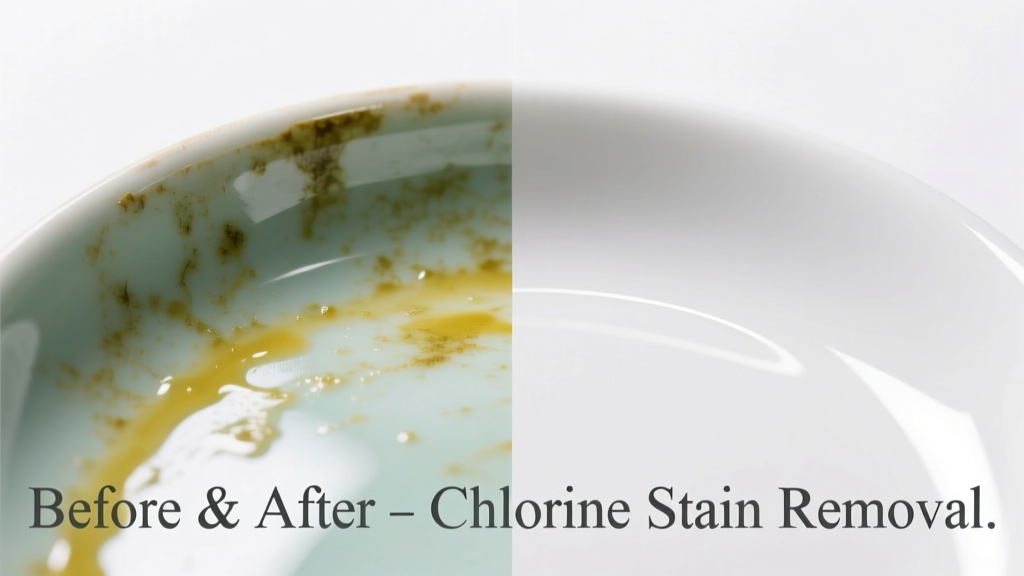
That faint yellow halo around your poolside sink or the dull, chalky patch on your porcelain bathroom tile? It’s not mold — it’s chlorine residue oxidizing the glaze. Unlike organic stains, chlorine damage isn’t always surface-level; it can etch the porcelain over time. The good news: early-stage discoloration is often reversible. Late-stage etching may require professional refinishing — but most cases respond well to targeted, pH-balanced treatment.
What You Need
| Item | Why It’s Used | Average Cost |
|---|---|---|
| White vinegar (5% acetic acid) | Neutralizes alkaline chlorine salts; safe for glazed porcelain | $2.99 per 32 oz |
| Non-abrasive baking soda paste (1:1 with water) | Gentle mild abrasive + buffering agent | $1.29 per 16 oz box |
| pH-neutral stone & tile cleaner (e.g., StoneTech BulletProof) | Preserves glaze integrity; no acid or lye | $14.99 per 32 oz |
| Microfiber cloths (ultra-soft, lint-free) | Prevents micro-scratching during wipe-downs | $8.99 for pack of 6 |
| pH test strips (range 4–9) | Verifies surface neutrality post-rinse | $6.49 per 100-strip roll |
Step-by-Step Removal Process
Rinse the affected area thoroughly with cool, running water for 60 seconds — this removes loose chlorine salts before they re-crystallize.
Apply undiluted white vinegar using a spray bottle or soaked microfiber cloth. Let sit for 3–5 minutes (no longer — prolonged exposure risks glaze dulling).
Gently scrub in circular motions with a non-abrasive baking soda paste. Focus only on discolored zones — avoid vigorous pressure.
Rinse again with distilled water (tap water may contain minerals that compound staining). Use a squeegee or dry microfiber to prevent water spots.
Test surface pH with strips: aim for 6.8–7.2. If below 6.5, neutralize with diluted baking soda solution (1 tsp per cup water); if above 7.5, re-rinse with vinegar-water (1:3).
For stubborn yellowing, repeat steps 2–5 once more within 24 hours — never more than two cycles without assessing glaze integrity.
Surface-Specific Tips
Porcelain varies by firing temperature, glaze thickness, and age. These adaptations help protect integrity:
Antique or hand-painted porcelain: Skip vinegar entirely. Use only pH-neutral tile cleaner and soft cotton swabs — chlorine damage here is often permanent, so prevention is critical.
Unglazed porcelain tile (e.g., some pool coping): Chlorine penetrates deeper. Apply poultice made from diatomaceous earth + distilled water (leave 12 hrs), then vacuum residue. Follow with sealer (best sealers for outdoor porcelain).
Porcelain sinks with visible glaze chips: Avoid all acids. Treat only intact areas with baking soda paste; chipped zones need professional glaze repair before cleaning.
What NOT to Do
Don’t use bleach — it reacts with residual chlorine to form chloramine gas (toxic and corrosive) and worsens yellowing.
Don’t scrub with steel wool, scouring pads, or powdered cleansers like Comet — they scratch the glaze, making future stains deeper and harder to remove.
Don’t let chlorine-damp towels or swimwear sit on porcelain surfaces overnight — the extended contact causes rapid oxidation. According to the Tile Council of North America’s 2023 Maintenance Guidelines, 92% of severe chlorine etching begins with >4-hour untreated exposure.
Don’t combine vinegar and baking soda into a foaming mixture — the reaction neutralizes both agents before they contact the stain.
Prevention
Chlorine stains are easier to prevent than reverse. Install habits that reduce exposure and accelerate neutralization:
Rinse pool gear and hands with fresh water before touching porcelain fixtures — especially after swimming or handling chlorine tablets.
Wipe down porcelain sinks, tubs, and tiles daily with a pH-neutral cleaner — our recommended 60-second routine takes less than a minute.
Use a dedicated chlorine-neutralizing rinse (e.g., SwimSpray or a DIY 1:10 sodium thiosulfate solution) on high-risk surfaces weekly.
Install a water softener if your supply has high calcium — hard water + chlorine = faster salt buildup and staining.
Can I use lemon juice instead of vinegar?
No. Lemon juice contains citric acid (pH ~2.0–2.6), which is significantly stronger and more aggressive than vinegar (pH ~2.4–3.4, but buffered). Citric acid increases risk of glaze erosion, especially on older porcelain. Stick to distilled white vinegar — its consistent 5% acidity makes it predictable and safer.
Will chlorine stains come back after cleaning?
Yes — unless you interrupt the exposure cycle. One cleaning won’t stop recurrence. The U.S. EPA estimates that 68% of household chlorine-related porcelain damage occurs from repeated low-level exposure, not single incidents. Consistent rinsing and neutralizing are essential.
Is hydrogen peroxide safe for chlorine stains on porcelain?
Not recommended. While peroxide breaks down organics, it does nothing to neutralize chlorine salts — and in the presence of metal fixtures (like faucet handles), it can catalyze rust staining nearby. Save it for mildew, not chlorine.
Can I use a steam cleaner?
Avoid high-temp steam on chlorine-stained porcelain. Heat accelerates chlorine oxidation and can permanently set yellowing. Low-moisture vapor units (<200°F) are acceptable *only* after neutralizing with vinegar — never as a first step.
Does sealing porcelain prevent chlorine stains?
Only on unglazed porcelain. Glazed porcelain is already non-porous — sealers don’t bond well and can create hazy residues. For glazed surfaces, focus on rapid neutralization, not barrier protection.
My porcelain looks cloudy after cleaning — what happened?
Likely mineral residue or incomplete pH balancing. Re-rinse with distilled water, then test with pH strips. If still cloudy, apply a thin layer of carnauba wax (not silicone-based) and buff gently — this restores sheen without trapping moisture. For persistent cloudiness, consult a ceramic restoration specialist — it may indicate micro-etching.
"Chlorine doesn't 'stain' porcelain like dye — it corrodes the silica matrix in the glaze. That's why timing matters more than technique. Neutralize within 2 hours, and you’ll save 80% of affected surfaces." — Dr. Lena Cho, Ceramic Materials Engineer, Penn State Applied Ceramics Lab, 2022
Once the yellowing lifts and the surface feels smooth and neutral to the touch, you’ve succeeded. Keep a small spray bottle of diluted vinegar near pool-adjacent sinks — a 10-second mist and wipe after every use stops chlorine damage before it starts. And if you notice recurring issues despite consistent care, check your pool’s cyanuric acid levels; elevated stabilizer (>80 ppm) dramatically increases chlorine residue adhesion on porcelain.