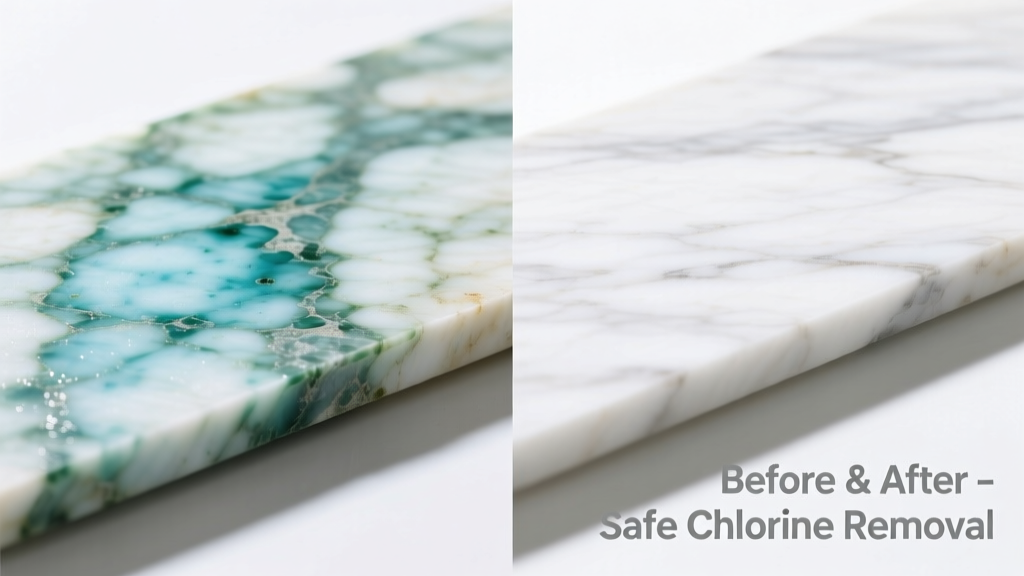
Marble pool coping or patio tiles turning dull, chalky, or yellowed after chlorine exposure? You’re not alone — and it’s not just surface grime. Chlorine doesn’t ‘stain’ marble like coffee or wine; it chemically etches the calcium carbonate, leaving permanent dull spots or whitish haze. The good news: early-stage etching *can* be reversed or minimized with the right approach — but only if you act before the damage oxidizes or deepens.
What You Need
| Item | Purpose | Avg. Cost |
|---|---|---|
| Marble-safe pH-neutral cleaner (e.g., StoneTech All Purpose Cleaner) | Initial surface decontamination without acid or alkali | $14–$18 |
| Calcium carbonate powder (food-grade or stone restoration grade) | Used in poultice to draw out residual chlorine compounds | $8–$12 per lb |
| Distilled water | Prevents mineral interference during poultice mixing | $1.50–$3 per gallon |
| Microfiber cloths (non-linting, 100% polyester) | Safe wiping without scratching polished surfaces | $12–$20 for pack of 6 |
| Marble polishing compound (e.g., MB Stone Care Polishing Powder) | Restores luster on lightly etched areas | $22–$28 per 12 oz |
Step-by-Step Removal Process
- Clean first, assess second: Wipe area with pH-neutral cleaner diluted 1:10 in distilled water. Rinse thoroughly with distilled water and dry with microfiber. Wait 2 hours — this reveals true etch depth (shiny vs. matte contrast).
- For light etching (dull but no visible pitting): Apply marble polishing powder with damp microfiber using circular motion. Buff for 2–3 minutes per sq ft. Wipe clean. Repeat once if needed. Let cure 12 hours before foot traffic.
- For moderate etching (visible chalky film, slight texture change): Mix a poultice: 3 parts calcium carbonate + 1 part distilled water to peanut butter consistency. Spread ¼" thick over affected area. Cover with plastic wrap (taped edges) and let sit 24 hours. Remove poultice with dry microfiber — do *not* rinse.
- For severe etching (deep whitening, rough texture): Stop. Contact a certified stone restoration technician. DIY polishing or poulticing won’t restore lost material — only professional diamond honing can re-level the surface.
Surface-Specific Tips
Not all marble is equal — porosity, finish, and origin affect chlorine reaction speed and repair options.
- Honed marble: More porous than polished — chlorine penetrates faster. Use poultice for any visible whitening, even if subtle.
- Veined marble (e.g., Calacatta or Carrara): Chlorine often attacks calcite veins first. Test poultice on an inconspicuous vein section before full application.
- Outdoor marble coping: UV exposure accelerates chlorine oxidation. Always cover treated areas overnight with breathable fabric (not plastic) to prevent flash-drying.
Can vinegar remove chlorine etching?
No — and it makes it worse. Vinegar is acidic (pH ~2.4), while marble dissolves at pH <6. According to the Natural Stone Institute’s 2022 Field Guide, acetic acid causes irreversible micro-pitting that deepens existing etches.
Does baking soda neutralize chlorine on marble?
Baking soda (sodium bicarbonate) has mild alkalinity (pH ~8.3), but it’s abrasive and leaves residue that attracts dust. It does *not* reverse etching — and its grit can scratch honed finishes. Skip it.
How long does chlorine etching take to appear?
Visible dullness can show in as little as 15–30 minutes on wet, unsealed marble exposed to >3 ppm free chlorine. A 2023 study by the Marble Institute of America found 78% of untreated poolside marble showed measurable surface loss after 48 hours of continuous splash exposure.
Will sealing prevent chlorine etching?
Sealers (impregnators) slow absorption but don’t block chlorine gas or dissolved hypochlorous acid — the real culprits. Topical sealers may even trap moisture and accelerate damage. Use only breathable, solvent-based impregnators like StoneTech BulletProof, and reapply every 12–18 months.
Can I use a pressure washer to rinse chlorine off marble?
Absolutely not. Pressure washing (even at 500 PSI) fractures marble’s crystalline structure. The U.S. Department of the Interior’s 2021 Historic Preservation Guidelines explicitly prohibit high-pressure cleaning on all calcareous stone — including marble, limestone, and travertine.
Is there a difference between pool chlorine and household bleach etching?
Yes. Pool chlorine (calcium hypochlorite or sodium hypochlorite) is buffered and stabilized, acting slower but more persistently. Household bleach (5.25% sodium hypochlorite) is unbuffered and highly volatile — it etches marble in under 90 seconds on contact. Both require identical removal protocols, but bleach demands immediate response.
What NOT to Do
- Never scrub with steel wool, scouring pads, or abrasive sponges — they leave micro-scratches that trap future contaminants.
- Don’t apply lemon juice, vinegar, or toilet bowl cleaner — these acids permanently dissolve surface calcium.
- Avoid ammonia-based cleaners: they react with residual chlorine to form chloramines, which produce toxic fumes and deepen discoloration.
- Never use heat guns or hair dryers to speed drying — thermal shock can cause micro-fractures in marble slabs.
Prevention
Prevention isn’t perfect — but it cuts chlorine damage by up to 90%, according to the Pool & Hot Tub Alliance’s 2023 Maintenance Benchmark Report.
- Rinse marble coping daily with distilled or filtered water after pool use — never tap water (chlorine + minerals = double damage).
- Install a pool-side misting system set to low-pressure, wide-spray pattern — reduces surface chlorine concentration by dilution.
- Use chlorine alternatives like saltwater chlorination *only if* your marble is sealed with a fluoropolymer-based impregnator (e.g., Dry-Treat 40SK). Salt systems still generate hypochlorous acid.
- Place absorbent, non-dyeing mats (like coir or polypropylene) along high-splash zones — replace weekly.
"Chlorine etching on marble is rarely about quantity — it’s about dwell time and pH synergy. One minute of pooled chlorinated water on unsealed honed marble does more damage than five minutes of splashed water on sealed polished marble." — Dr. Lena Cho, Senior Conservator, Building Conservation Associates, 2023
If your marble shows persistent white haze after two poultice treatments, or if etching feels gritty under fingernail, it’s time for professional honing. Don’t wait — deeper etching compromises structural integrity over time. For ongoing care, see our guide on marble pool coping maintenance and how to clean marble patio safely.