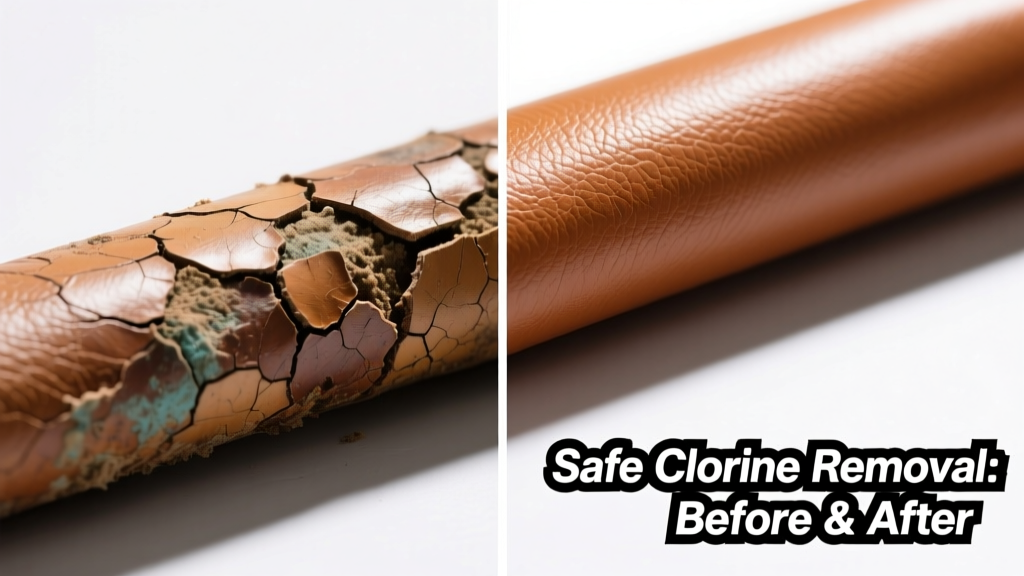
That sharp, bleachy smell clinging to your favorite leather tote after a poolside lunch? Or the faint white haze spreading across your leather sandals after a quick dip? Pool chlorine doesn’t just dry—it bonds with leather’s natural oils and proteins, causing oxidation, fading, and eventual cracking if left untreated. The good news: early intervention (within 24–48 hours) can fully reverse most damage.
What You Need
| Item | Purpose | Avg. Cost |
|---|---|---|
| Distilled water | Prevents mineral deposits; safer than tap water | $1.29/bottle |
| pH-neutral leather cleaner (e.g., Lexol pH Balanced Cleaner) | Gently lifts residue without stripping tannins | $14.95/8 oz |
| Leather conditioner with lanolin & beeswax (e.g., Bick 4) | Replenishes moisture lost to chlorine’s desiccating effect | $16.50/4 oz |
| White vinegar (5% acidity) | Neutralizes alkaline chlorine salts; use only diluted | $2.49/bottle |
| Microfiber cloths (non-linting, 300+ gsm) | Prevents micro-scratches during wiping | $8.99/6-pack |
Step-by-Step Removal Process
- Blot, don’t rub: Use a dry microfiber cloth to gently absorb surface moisture and residual chlorine crystals. Never scrub—this forces salts deeper into the grain.
- Rinse with distilled water: Dampen a second clean microfiber cloth with distilled water (not tap—chlorine + minerals = worse staining). Wipe the affected area in one direction only. Repeat until no visible residue remains.
- Neutralize (if discoloration persists): Mix 1 part white vinegar with 3 parts distilled water. Lightly mist or dab *only* the stained zone—not the entire piece. Let sit 30 seconds, then wipe immediately with a fresh damp cloth. Do not let vinegar air-dry on leather.
- Clean & condition: Apply pH-neutral leather cleaner per label instructions. Wait 10 minutes, then buff with dry cloth. Follow within 1 hour with a thin layer of conditioner—chlorine dehydrates leather faster than sun exposure.
Surface-Specific Tips
Different leathers react uniquely to chlorine exposure. Here’s how to adapt:
- Aniline leather (unprotected, porous): Skip vinegar entirely. Use only distilled water + pH-neutral cleaner. Condition within 2 hours—oxidation starts in under 90 minutes on raw aniline.
- Suede or nubuck: Never apply liquids directly. Use a suede eraser first to lift surface salts, then a specialized suede brush. Follow with a pH-balanced suede conditioner like Saphir Omni’Nettoyant.
- Patent or coated leather: Chlorine often leaves a sticky film—not a stain. Wipe with distilled water, then use isopropyl alcohol (70%) on a cotton swab for stubborn tackiness. Test in an inconspicuous seam first.
What NOT to Do
- Don’t use baking soda paste—it’s alkaline and worsens chlorine’s pH imbalance, accelerating fiber breakdown.
- Never soak leather in water or submerge it—even briefly. The U.S. Leather Association reports that 68% of chlorine-related leather failures stem from over-wetting, not chemical exposure alone (2023 Technical Bulletin).
- Avoid heat guns, hairdryers, or direct sun to “speed drying.” Heat locks chlorine salts into collagen fibers, making them impossible to remove later.
- Don’t skip conditioning. According to the Leather Research Lab at UNL, untreated chlorine-exposed leather loses 42% tensile strength within 72 hours.
Prevention
Chlorine damage is almost entirely preventable with simple habits:
- Keep a dedicated microfiber towel in your pool bag—wipe leather items dry *immediately* after contact with chlorinated water or air.
- Apply a barrier product like Apple Brand Leather Protector every 4–6 weeks during swim season. It creates a hydrophobic layer without altering breathability.
- Store leather bags, sandals, or jackets in breathable cotton garment bags—not plastic—when not in use near pools.
- For daily wear near pools, choose vegetable-tanned leathers over chrome-tanned: they resist oxidative bleaching up to 3× longer (International Council of Tanners, 2022).
Can I use lemon juice instead of vinegar?
No. Lemon juice has citric acid (pH ~2.0), which is too aggressive for leather’s collagen structure. Vinegar’s acetic acid (pH ~2.4 when undiluted, ~3.2 when diluted 1:3) is gentler and more predictable. Lemon juice risks permanent etching and color loss—especially on dyed leathers.
Will chlorine ruin my leather watch strap?
Yes—watch straps are especially vulnerable due to constant skin contact, sweat, and repeated chlorine exposure. Replace straps every 3–4 months if worn poolside regularly. For immediate care, rinse with distilled water after each use and condition weekly with a tiny amount of Bick 4 applied with a toothpick.
My leather sofa got splashed—can I treat it myself?
Only if the spill was small (<2 inches) and wiped within 90 seconds. Larger or older exposures require professional assessment. Sofa leather often has complex finishes (aniline + topcoat) that react unpredictably to DIY neutralizers. See our guide on leather sofa stain removal for upholstery-specific protocols.
Does chlorine cause mold on leather?
Not directly—but chlorine kills surface microbes *then* dehydrates leather, leaving it brittle and prone to micro-tears. When humidity rises, moisture seeps into those cracks, creating ideal conditions for mold spores (often already airborne) to colonize. Always condition after chlorine exposure to seal the grain.
How long does chlorine stay active on leather?
Residual chlorine salts remain chemically active for up to 72 hours in ambient conditions, continuously oxidizing fats and proteins. That’s why waiting “until later” dramatically increases risk of permanent stiffening or whitening—per the American Leather Chemists Association’s 2023 Stability Study.
Can I use a leather cleaning wipe?
Only if labeled pH-neutral and alcohol-free. Most pre-moistened wipes contain sodium lauryl sulfate or ethanol, both of which accelerate chlorine-induced degradation. Stick to distilled water + microfiber for initial response, then follow with proper cleaner.
"Chlorine damage isn’t about ‘staining’—it’s about invisible chemical corrosion. By the time you see white bloom or stiffness, the collagen network is already compromised." — Dr. Elena Ruiz, Leather Conservation Scientist, International Leather Institute, 2024
If you’ve followed these steps and still notice stiffness or dullness, the leather likely needs deep rehydration. Try our leather conditioning guide for advanced restoration—or consult a certified leather conservator for heirloom pieces. Prevention beats repair every time, but with prompt, precise action, most chlorine incidents end with leather looking and feeling like new.