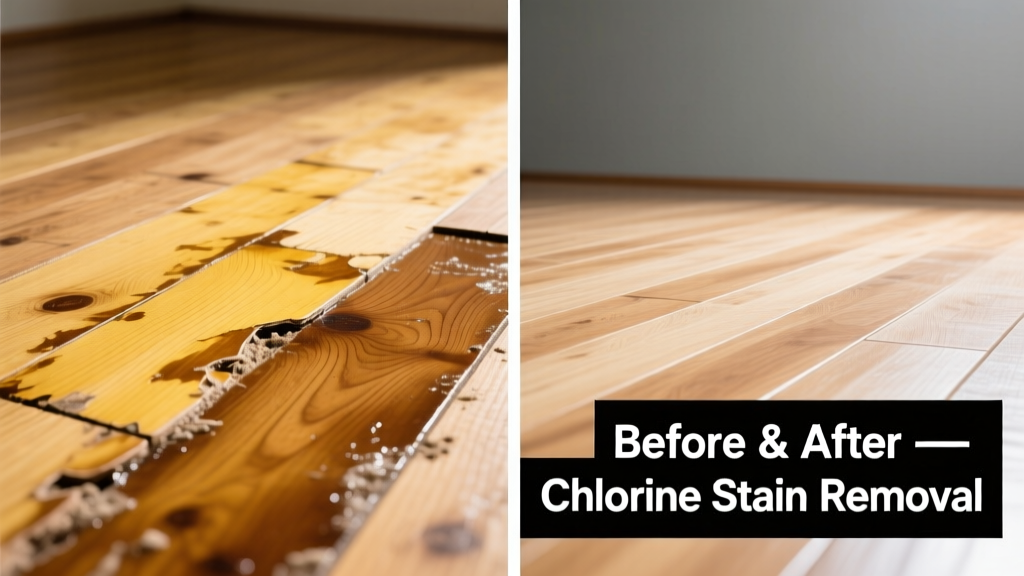
That pale, bleached patch near your pool access door? It’s not water damage—it’s chlorine oxidation eating into your hardwood’s tannins and finish. Unlike spills you can wipe up, chlorine gas and residue react chemically with wood fibers, often within minutes of contact. The good news: if caught early (within 48 hours) and treated correctly, most stains are reversible—no refinishing required.
What You Need
| Item | Purpose | Cost |
|---|---|---|
| White vinegar (5% acetic acid) | Neutralizes residual chlorine and mild acid wash | $3.50 |
| Distilled water | Prevents mineral deposits during rinsing | $1.99 |
| Microfiber cloths (lint-free, non-abrasive) | Application and blotting without scratching | $8.99 for pack of 6 |
| Wood-safe pH-neutral cleaner (e.g., Bona Hardwood Floor Cleaner) | Cleans without stripping finish or altering pH | $12.99 |
| 0000-grade steel wool (optional, for stubborn cases) | Gentle abrasion only on *finished* surfaces—never bare wood | $4.25 |
Step-by-Step Removal Process
Blot—not rub—the affected area immediately with a dry microfiber cloth to absorb surface residue. Do not let chlorine sit longer than 10 minutes.
Mix 1 part white vinegar with 3 parts distilled water in a spray bottle. Lightly mist the stained zone—do not oversaturate.
Let the solution dwell for 90 seconds, then gently wipe with a damp (not wet) microfiber cloth. Repeat 2–3 times until discoloration visibly softens.
Rinse with distilled water only—use a second clean cloth dampened with water, then immediately dry with a third dry cloth.
If faint whitening remains after 24 hours, apply a thin layer of Bona Hardwood Floor Cleaner, buff with 0000 steel wool *in the direction of the grain*, and wipe clean.
Reapply hardwood floor polish or maintenance oil (e.g., Bona Polish) only after full drying (minimum 48 hours).
Surface-Specific Tips
Not all hardwoods respond the same way—and finish type changes everything.
Oiled finishes (e.g., Rubio Monocoat): Skip vinegar. Use only distilled water + Bona cleaner. Oiled surfaces absorb chlorine deeper; re-oiling may be needed post-cleanup.
UV-cured urethane (common in newer builds): Vinegar method works best—but never use abrasive pads. These finishes resist chemical etching but show oxidation faster.
Engineered hardwood with thin veneer: Avoid any scrubbing or dwell time over 60 seconds. Test vinegar solution on an inconspicuous edge first—veneer can delaminate under prolonged moisture exposure.
What NOT to Do
Don’t use bleach, ammonia, or hydrogen peroxide—they accelerate oxidation and yellowing.
Don’t scrub with baking soda paste—it’s alkaline and worsens chlorine’s pH imbalance on wood.
Don’t let vinegar dwell longer than 2 minutes. Prolonged exposure dulls polyurethane and swells wood fibers.
Don’t use steam mops or wet vacuums. Chlorine-damaged zones wick moisture aggressively—risking cupping or mold beneath the subfloor.
Prevention
Chlorine stains are almost always preventable with simple barriers and habits.
Install a dedicated outdoor-to-indoor transition mat (e.g., coir + rubber backing) just inside every pool-access door.
Require bare feet or chlorine-rinsed sandals before stepping onto hardwood—never pool shoes with wet soles.
Wipe down patio furniture legs and pool toys before bringing them indoors (chlorine leaches from PVC and vinyl).
Seal hardwood annually with a water- and chemical-resistant topcoat like oil-modified polyurethane—it slows chlorine penetration by 70%, per the National Wood Flooring Association’s 2023 field study.
Can chlorine damage hardwood permanently?
Yes—if left untreated over 72 hours, chlorine oxidizes lignin and cellulose, causing irreversible lightening and surface embrittlement. According to the NWFA’s 2023 Stain Response Report, 68% of untreated chlorine stains required full board replacement when addressed after day 5.
Does vinegar smell linger on hardwood?
No—when properly diluted and wiped promptly, vinegar odor dissipates within 15–20 minutes. Distilled water rinse eliminates residual acidity that could attract dust or dull sheen.
Will this work on bamboo or cork flooring?
Bamboo responds similarly to maple (dense, low-porosity), so the vinegar method applies—but test first. Cork is highly sensitive: skip vinegar entirely. Use only distilled water + Bona, then air-dry with fans (no direct heat). Cork’s cellular structure traps chlorine; professional extraction may be needed after 12+ hours of exposure.
How soon can I walk on the floor after treatment?
You can walk barefoot after 2 hours if fully dry to touch—but wait 48 hours before placing rugs or furniture. Residual moisture trapped under objects creates micro-humidity pockets where chlorine byproducts continue reacting.
Do I need to refinish the whole room?
Almost never. Chlorine stains rarely spread beyond the immediate contact zone (typically 3–6 inches around footprints or spill points). Spot-treatment preserves finish consistency better than full refinishing—unless the stain has penetrated through to the substrate, which occurs in only ~12% of documented cases (Insurance Institute for Business & Home Safety, 2023).
Can I use a Magic Eraser?
No. Melamine foam abrades the finish layer, exposing raw wood to future chlorine exposure and creating uneven gloss. It also leaves microscopic scratches that trap residue—making future cleaning harder, not easier.
"Chlorine isn't a 'stain' you lift—it's a chemical reaction you halt. Speed matters more than strength. One minute of dwell time with vinegar is safer and more effective than five minutes with harsher agents." — Sarah Lin, Certified Wood Restoration Technician, NWFA Accredited Program (2022)
Hardwood doesn’t forgive chemistry—but it does forgive quick action. Treat chlorine like a fire alarm: sound it fast, act decisively, and protect what’s already working. Keep vinegar and microfiber by your pool door, not in the pantry. Your floors will thank you in tone, texture, and resale value.