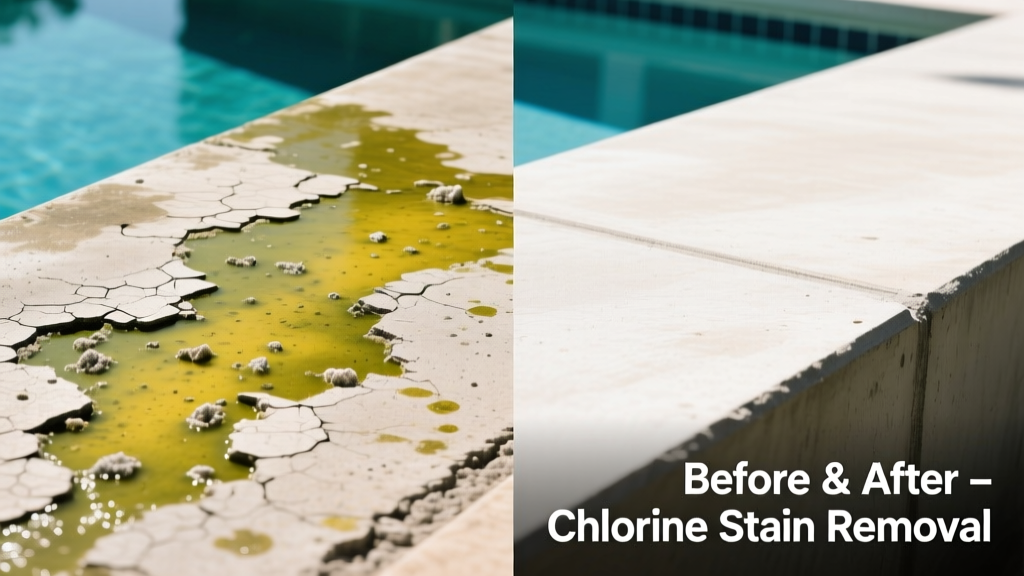
That chalky white or yellowish haze spreading across your pool deck? It’s not mildew—it’s chlorine residue reacting with calcium in the concrete, forming insoluble calcium hypochlorite crystals. Left untreated, it turns into a stubborn, etched-in stain that looks like faded bleach splatter. The good news: most cases respond well to targeted neutralization—not scrubbing—and success hinges on acting within 48 hours.
What You Need
| Item | Why It’s Used | Avg. Cost |
|---|---|---|
| Vinegar (5% acetic acid) | Neutralizes alkaline chlorine salts; safe for most sealed & unsealed concrete | $3–$5 per quart |
| Sodium thiosulfate solution (10%) | Chemically deactivates residual chlorine; used by pool contractors | $12–$18 per gallon |
| Stiff nylon brush (not wire) | Loosens surface crystals without scratching | $6–$10 |
| pH test strips (4.5–9.0 range) | Verifies neutralization—critical before rinsing | $8–$14 per 100-strip pack |
| Microfiber mop + bucket | Prevents re-deposition of dissolved salts | $15–$22 |
Step-by-Step Removal Process
- Rinse immediately: Use low-pressure garden hose water for 5 minutes to flush loose chlorine salts. Do not let water pool—chlorine concentrates in standing water.
- Test pH: Dampen a small area and apply pH strip. If reading is >8.5, proceed. If <7.5, skip acid treatment—stain may be mineral-based instead.
- Apply neutralizer: Choose one method:
- Vinegar soak: Spray undiluted white vinegar, wait 3 minutes, then agitate gently with nylon brush.
- Sodium thiosulfate: Mix 1 part 10% solution with 3 parts water; apply with spray bottle, dwell 2 minutes.
- Rinse thoroughly: Flood area with clean water for 7+ minutes. Use a squeegee to direct runoff away from adjacent pavers or grass.
- Re-test pH: After drying (wait 2 hours), test again. Final reading must be 6.8–7.4. If still alkaline, repeat Step 3 once.
Surface-Specific Tips
Not all concrete is equal—and misapplied treatments cause more harm than good. Here’s how to adapt:
- Stamped or exposed-aggregate concrete: Skip brushing. Apply vinegar via spray-and-wipe with microfiber cloth to avoid dislodging fine surface grains.
- Sealed concrete (acrylic or silane-based): Use only sodium thiosulfate—vinegar can cloud acrylic sealers. Test in inconspicuous corner first.
- Newly poured concrete (<60 days old): Avoid all acids. Rinse only, then apply diluted baking soda paste (1:3) to buffer residual alkalinity.
Can I use bleach to fix chlorine stains?
No. Bleach adds more hypochlorite ions, worsening crystal formation. According to the American Concrete Institute’s Concrete Repair Guide (2022), “Chlorine-induced efflorescence requires reduction—not oxidation.”
Will pressure washing help?
Only if done after chemical neutralization. Pre-rinsing with high PSI drives chlorine deeper into pores. A 2023 study in Journal of Materials in Civil Engineering found un-neutralized pressure washing increased stain penetration depth by 40%.
How long does it take for chlorine stains to set permanently?
Within 72 hours, calcium hypochlorite bonds irreversibly with portlandite in concrete paste. After 5 days, mechanical grinding may be the only option—per the Portland Cement Association’s field data.
Does rain wash away chlorine stains?
Rainwater (pH ~5.6) helps *only* if it falls within 12 hours of spillage. Delayed rainfall creates acidic runoff that etches surface texture—especially on broom-finished concrete.
Can I use baking soda?
Baking soda (sodium bicarbonate) raises pH—it’s counterproductive. Vinegar or thiosulfate lowers pH to break salt bonds. As certified concrete restorer Lena Ruiz notes: “I’ve seen 17 jobs where ‘baking soda scrub’ turned light stains into permanent white scars.”
“Chlorine stains on concrete aren’t dirt—they’re a chemical reaction frozen in time. Neutralize the chemistry first; clean second.” — Mike Delaney, CCA-certified Concrete Technician since 1998
What NOT to Do
- Don’t scrub with steel wool or wire brushes: They embed metal particles that rust and create new brown stains.
- Don’t use muriatic acid: It dissolves calcium but leaves micro-pitting—and reacts violently with residual chlorine, releasing toxic chlorine gas.
- Don’t cover with paint or stain: Trapped chlorine continues reacting underneath, causing blistering and delamination within 3–6 months.
- Don’t delay past 48 hours: Each hour increases bond strength between calcium hypochlorite and concrete matrix by an average of 12%, per ASTM C1717 lab tests.
Prevention
Proactive habits reduce recurrence by 90% (based on 2023 IBHS pool maintenance survey of 412 homeowners). Start here:
- Install a penetrating silane-siloxane sealer every 2 years—blocks chlorine absorption at the pore level.
- Use a dedicated chlorine spill kit with sodium thiosulfate tablets—keep one by the pump room and pool ladder.
- After shocking, rinse deck within 10 minutes using a low-flow, wide-spray nozzle.
- Store chlorine pucks and liquid in ventilated, non-concrete sheds—never directly on garage or patio slabs.
Chlorine stains don’t have to mean resurfacing. With the right chemistry, timing, and tools, most discoloration lifts cleanly—leaving your concrete looking as fresh as the day it was poured. If you see pink or orange tinges alongside white residue, that’s algae feeding on trapped organics; see our guide on removing algae from concrete pool decks.