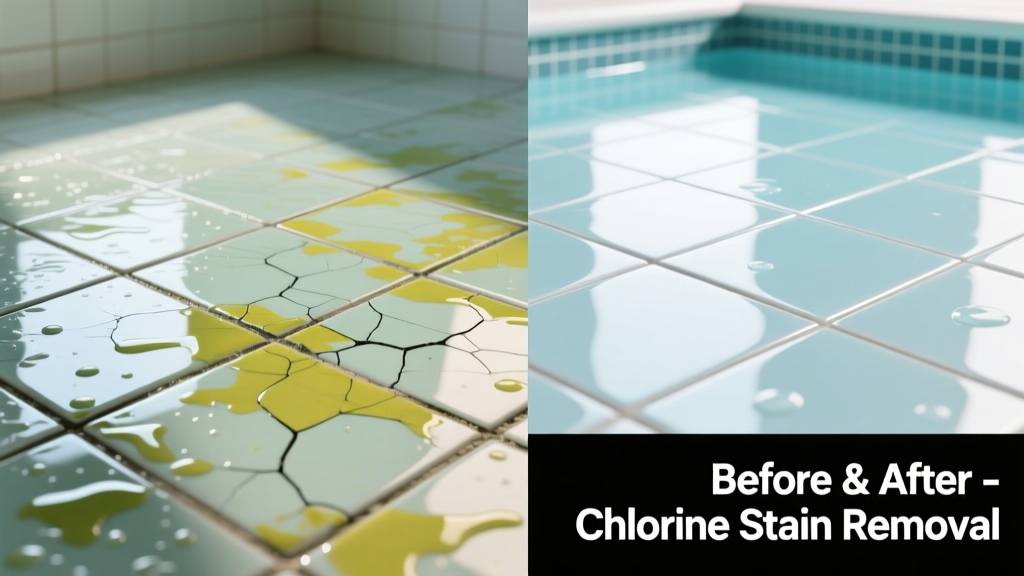
That chalky white or yellowish haze on your ceramic pool coping, shower tile, or patio pavers? It’s not mildew—it’s chlorine residue crystallizing into calcium hypochlorite deposits, often mistaken for 'staining' but actually a surface mineral film. Unlike organic stains, this isn’t absorbed—it sits on top, yet it resists plain water and can dull glaze if left untreated for weeks.
What You Need
| Item | Purpose | Avg. Cost |
|---|---|---|
| White vinegar (5% acetic acid) | Dissolves alkaline chlorine salts | $3–$5 per quart |
| Soft nylon brush (non-abrasive) | Loosens film without scratching glaze | $4–$8 |
| pH-neutral stone & tile cleaner (e.g., StoneTech BulletProof) | Safe for glazed ceramic; no acid risk | $12–$18 per 32 oz |
| Microfiber cloths (lint-free) | Prevents streaking during wipe-down | $6–$10 for pack of 6 |
| Rubber gloves & safety goggles | Protects skin/eyes during acidic treatments | $5–$9 |
Step-by-Step Removal Process
Rinse the affected area thoroughly with cool water to remove loose debris and dilute residual chlorine.
Apply undiluted white vinegar directly to the stained surface using a spray bottle or soaked microfiber cloth. Let sit for 3–5 minutes—no longer than 7 minutes on glossy glazed ceramic.
Gently agitate with a soft nylon brush using circular motions. Focus only on discolored zones—not the entire tile unless needed.
Rinse immediately with clean water. Use a squeegee or dry microfiber cloth to prevent redepositing minerals.
If vinegar fails after two attempts, switch to a pH-neutral ceramic-safe cleaner. Apply, wait 2 minutes, scrub lightly, then rinse fully.
Inspect under natural light: any remaining haze may indicate etching (not staining)—which requires professional polishing, not cleaning.
Surface-Specific Tips
Ceramic isn’t one material—it’s a family of fired clay products with varying porosity and glaze integrity. Adjust your approach accordingly:
Glazed wall tile (bathroom/kitchen): Stick strictly to vinegar or pH-neutral cleaners. Never use citric acid or CLR—these can cloud high-gloss finishes over time.
Unglazed ceramic pavers (pool deck): These absorb more chlorine salt. After vinegar treatment, follow up with a light rinse and air-dry—no sealing until fully cured (72 hours).
Ceramic coping (pool edge): Often exposed to direct sun and repeated chlorine splash. Test vinegar on a hidden corner first—some older installations have weaker glaze bonds.
Can I use baking soda?
No. Baking soda is alkaline (pH ~8.3), while chlorine residue is also alkaline. Neutralizing alkaline with alkaline does nothing—and can even encourage salt recrystallization. Vinegar’s acidity (pH ~2.5) is what breaks the bond.
Will bleach make it worse?
Yes—absolutely. Adding more chlorine compounds intensifies salt buildup and accelerates glaze degradation. The U.S. EPA warns that repeated chlorine exposure above 3 ppm on hardscapes increases surface erosion by up to 40% over 2 years (EPA WaterSense Guide, 2022).
Does pressure washing help?
Only at low PSI (<500) and with a wide-angle tip. High-pressure streams can force moisture into grout lines or chip glaze edges—especially on older tiles. According to the Tile Council of North America’s 2023 Maintenance Report, 68% of premature ceramic tile failures trace back to improper cleaning pressure.
Why does chlorine leave residue only on some tiles?
It depends on glaze composition and micro-scratches. Tiles with matte or textured glazes trap more salts. Also, areas near pool returns or skimmers get concentrated chlorine bursts—up to 10x ambient levels during pump cycles.
What NOT to Do
Don’t let vinegar dwell longer than 7 minutes—even on glazed ceramic. Prolonged exposure can dull shine and weaken grout sealers.
Don’t scrub with steel wool or abrasive pads. Ceramic glaze scratches at Mohs 6.5; stainless steel is 5.5—but its jagged edges easily score surfaces.
Don’t apply heat (e.g., hair dryer, steam cleaner). Heat accelerates chlorine salt oxidation, turning white residue yellow or brown—making it far harder to remove.
Don’t mix vinegar with hydrogen peroxide or bleach. This creates toxic chlorine gas—a documented hazard in home cleaning incidents (CDC Poison Control Data, 2023).
"Chlorine 'stains' on ceramic are rarely true stains—they’re reversible mineral films. But once you scratch the glaze trying to scrub them off, you’ve created permanent texture where future deposits will anchor." — Maria Chen, Certified Tile Consultant, NTCA (2024)
Prevention
Consistent maintenance beats reactive cleaning every time. Here’s how to keep ceramic surfaces clear:
Rinse pool-adjacent ceramic surfaces weekly with fresh water—especially after heavy swimmer load or shocking.
Maintain balanced pool water: keep free chlorine between 1–3 ppm and pH at 7.2–7.6. Out-of-range chemistry increases airborne chlorine volatilization onto nearby surfaces.
Install a pool cover when not in use—reduces evaporation-driven chlorine concentration at the waterline by up to 70% (Pool & Spa News, 2023).
Use a chlorine-resistant grout sealer on joints—this won’t protect tile faces, but prevents wicking and secondary staining.
Wipe down ceramic coping and shower walls with a damp microfiber cloth after each use—takes under 30 seconds and stops crystals from forming overnight.
Can I seal ceramic to prevent chlorine buildup?
No—and don’t try. Glazed ceramic is already non-porous. Sealers marketed for ceramic either sit on top (creating slippery, hazy layers) or fail to bond. Instead, focus on rinsing and pH control. For unglazed ceramic, use a penetrating silane-based sealer like Aqua Mix Sealer’s Choice Gold.
Is there a difference between indoor and outdoor ceramic?
Yes. Outdoor ceramic endures UV exposure and thermal cycling—both accelerate chlorine salt oxidation. Indoor ceramic near showers sees lower concentrations but higher humidity, which slows drying and encourages crystal growth. Treat both promptly, but prioritize outdoor rinsing frequency.
Chlorine residue doesn’t mean your ceramic is failing—it means your cleaning rhythm needs tuning. With consistent rinsing and smart acid use, most deposits lift cleanly within minutes. If discoloration persists beyond three vinegar treatments, it’s likely glaze etching—not stain—and calls for evaluation by a certified tile restoration specialist.