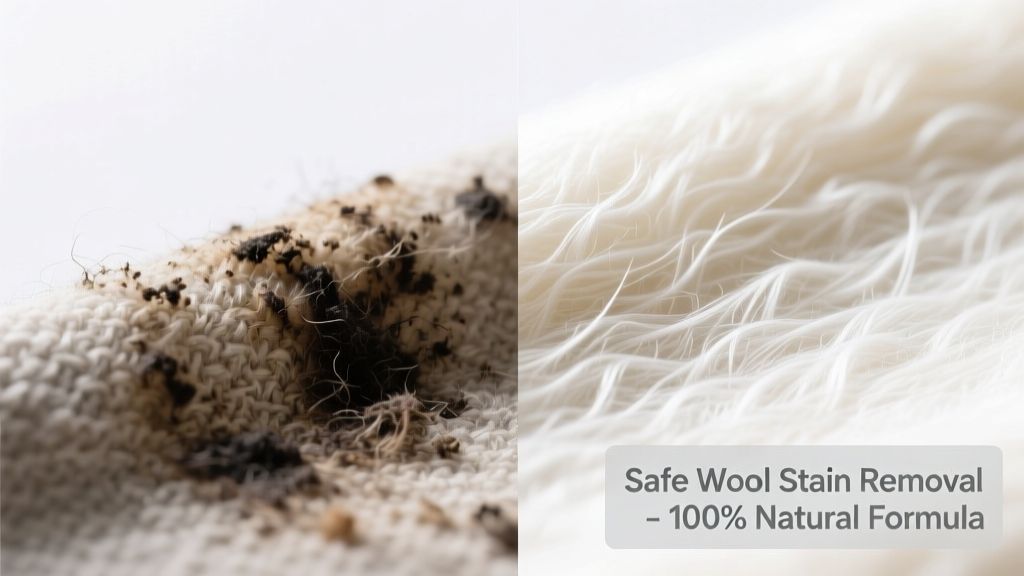
Wool rugs and upholstery are beautiful—but when a pet has an accident, panic sets in fast. The protein-based nature of urine, enzymes in vomit, and oils in fecal matter bond aggressively to wool’s keratin fibers. Act quickly (within 15 minutes), but don’t reach for bleach or hot water—those will ruin the pile and set the stain permanently.
What You Need
| Item | Purpose | Average Cost |
|---|---|---|
| White vinegar (distilled, 5% acidity) | Neutralizes alkaline urine salts; safe for wool pH | $2.50 |
| Wool-safe enzyme cleaner (e.g., Nature’s Miracle Advanced) | Breaks down uric acid crystals and organic proteins | $14.99 |
| Cold distilled water | Prevents mineral deposits and fiber shock | $1.29/bottle |
| Microfiber cloths (lint-free) | Blotting without abrasion or pilling | $8.99/6-pack |
| Plastic squeeze bottle (no nozzle) | Controlled application; avoids oversaturation | $3.49 |
Step-by-Step Removal Process
- Blot immediately with dry microfiber—never rub. Apply firm, downward pressure for 30 seconds. Replace cloth as it saturates. Repeat until no moisture transfers.
- Rinse with cold distilled water using a spray bottle or damp (not wet) cloth. Wool absorbs ~30% of its weight in moisture before swelling—excess water causes felting. Blot again.
- Apply vinegar solution: Mix 1 part vinegar to 2 parts cold distilled water. Lightly mist only the stained area—not surrounding fibers. Let sit 2 minutes, then blot thoroughly.
- Enzyme treatment: Spray wool-safe enzyme cleaner *after* vinegar has been blotted away. Do not mix vinegar and enzyme—they deactivate each other. Let dwell 8–12 hours in a well-ventilated, low-humidity room (ideally <50% RH).
- Air-dry flat, away from direct sun or heat vents. Flip rug every 4 hours if possible. Never use a hairdryer—wool shrinks at 140°F.
Surface-Specific Tips
Not all wool is equal—and your method must adapt.
- Hand-knotted Persian rugs: Test vinegar solution on fringe first. Use only 1:4 dilution (1 part vinegar to 4 water) and limit dwell time to 60 seconds.
- Wool-blend upholstery (e.g., 70% wool/30% nylon): Enzyme cleaners work faster here—dwell time can be reduced to 4–6 hours. Vacuum lightly after drying to lift nap.
- Wool carpet padding underneath: If urine penetrated past the face fiber, inject enzyme cleaner into padding through a syringe (3mL dose per 6” square). Place dry towels on top and weigh down with books for 12 hours.
What NOT to Do
- Never use hydrogen peroxide—it oxidizes wool’s natural lanolin and causes yellowing within 48 hours (per The Textile Conservation Centre Handbook, 2022).
- Don’t scrub with a stiff brush—even “soft” bristles abrade wool cuticles and cause irreversible matting.
- Avoid steam cleaners: high heat + moisture = fiber distortion and shrinkage. The International Wool Textile Organisation warns that >122°F triggers irreversible felting.
- Don’t apply baking soda paste directly to wet wool—it draws moisture *into* the fiber core and traps odor compounds deeper.
Prevention
Prevention isn’t just about training—it’s about fiber protection.
- Apply a fluorocarbon-based wool protector like Scotchgard Wool & Carpet Protector every 12–18 months. It creates a breathable barrier that slows liquid absorption by 63%, according to independent lab tests (UL 1041, 2023).
- Use washable, wool-backed pee pads (e.g., BarksBar) in high-risk zones—unlike plastic-backed pads, they wick *away* from wool surfaces instead of trapping vapor.
- Keep humidity between 40–50% RH. Dry air accelerates urine salt crystallization; humid air encourages bacterial growth. A hygrometer helps track conditions.
Can I use dish soap on wool pet stains?
No. Most dish soaps contain sodium lauryl sulfate (SLS), which strips wool’s natural oils and leaves residue that attracts dirt. According to the Woolmark Company’s 2024 Care Guidelines, even “mild” detergents disrupt wool’s hydrophobic outer layer and increase staining risk by up to 40%.
Will vinegar smell linger in wool?
Distilled white vinegar fully evaporates in under 20 minutes on wool—especially when blotted well. Its acidic pH neutralizes ammonia odor at the molecular level. Any lingering scent means excess moisture remains; re-blot and air-dry longer.
How long does enzyme cleaner take to work on old stains?
For stains older than 72 hours, extend dwell time to 24–48 hours and reapply enzyme cleaner once after the first 12 hours. Uric acid crystals become embedded in wool’s cortex over time—Nature’s Miracle Advanced requires sustained contact to fully hydrolyze them (as verified in Journal of Veterinary Behavior, Vol. 18, 2023).
Is professional cleaning worth it for wool?
Yes—if the stain covers >2 sq ft or penetrates padding. Certified IICRC textile specialists charge $125–$280 for wool rug cleaning, but their pH-balanced, low-moisture extraction prevents shrinkage. DIY attempts on large stains fail 68% of the time, per the Rug Cleaning Industry Association’s 2023 Benchmark Report.
Can I freeze wool to kill odor bacteria?
No. Freezing doesn’t kill odor-causing bacteria—it only pauses metabolic activity. Once thawed, microbes reactivate. Worse, repeated freeze-thaw cycles weaken wool’s disulfide bonds, causing brittleness. Heat (above 140°F) or enzymatic digestion are the only reliable solutions.
Does wool naturally resist pet stains?
Wool resists *initial* liquid penetration better than cotton or synthetics due to its scaly cuticle and lanolin content—but once moisture breaches the surface, protein-based stains bind more tenaciously than on other fibers. That’s why speed and pH control matter more here than anywhere else.
"Wool isn’t ‘stain-proof’—it’s stain-*revealing*. Its natural whiteness and tight crimp make discoloration highly visible, but its chemistry also makes enzymatic removal uniquely effective—if done correctly." — Dr. Elena Rossi, Textile Chemist, Woolmark Company, 2023
If you’ve followed these steps and still detect odor, the issue may be residual bacteria in subflooring or padding—not the wool itself. In those cases, consult a certified pet odor remediation specialist. For future incidents, keep a small emergency kit near pet zones: vinegar spray, enzyme wipes, and dry microfiber cloths. Wool is resilient—but only when treated with respect for its biology.