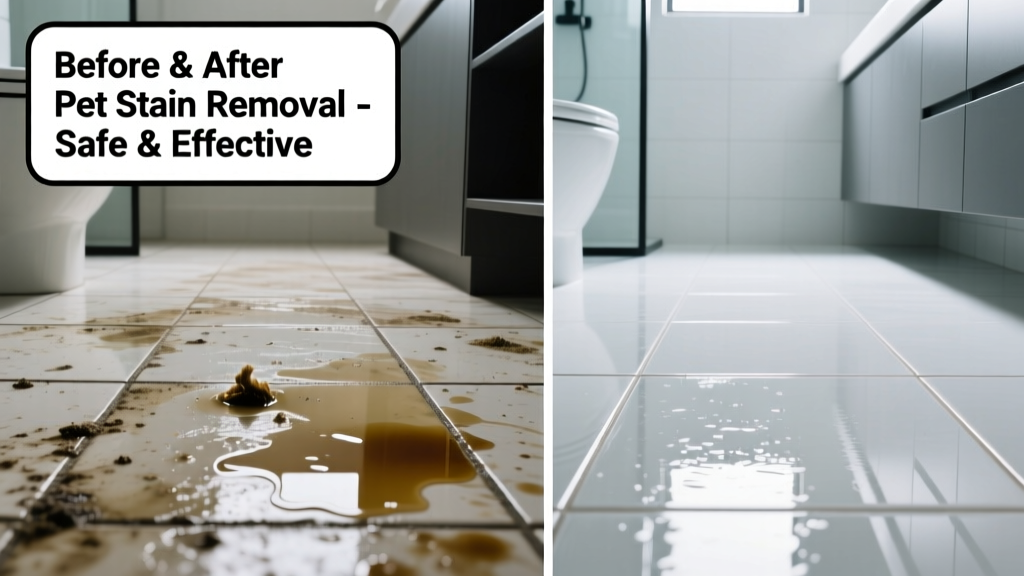
That sharp ammonia smell, the yellowish ring near the baseboard, the way your dog’s ‘accident’ seems to reappear after mopping—it’s maddening. Pet stains on tile aren’t just unsightly; they can etch grout, degrade sealants, and linger for months if treated incorrectly. The good news? With the right tools and timing, most fresh and even set-in pet stains on tile *can* be fully removed—no replacement needed.
What You Need
| Item | Purpose | Avg. Cost |
|---|---|---|
| Enzyme-based cleaner (e.g., Nature’s Miracle Advanced) | Breaks down urea, proteins, and bacteria in urine | $12–$18 |
| White vinegar (5% acidity) | Neutralizes alkaline residue; safe for most glazed tile | $3–$5 |
| Baking soda paste (1:2 ratio with water) | Deodorizes and lifts surface residue | $1–$2 |
| Microfiber cloths & stiff nylon brush (non-metal) | Agitation without scratching | $8–$15 |
| pH-neutral stone cleaner (for marble/limestone) | Prevents etching on calcite-based stone | $14–$22 |
Step-by-Step Removal Process
- Blot immediately — Use dry paper towels or a clean microfiber cloth to absorb as much liquid as possible. Never rub—it pushes stain deeper into grout lines.
- Rinse with cool water — Flush the area with distilled or filtered water (tap water minerals can react with urine salts). Pat dry.
- Apply enzyme cleaner generously — Saturate both tile surface *and* grout joints. Let dwell 10–15 minutes (up to 24 hrs for old stains). Cover with plastic wrap to prevent evaporation.
- Scrub grout gently — Use a soft nylon brush dipped in diluted vinegar (1:1) for glazed tile; switch to pH-neutral cleaner for natural stone.
- Neutralize & dry — Sprinkle baking soda paste over damp grout, let sit 20 minutes, then wipe with damp cloth. Air-dry fully—use a fan, not heat—to avoid baking odor into grout.
Surface-Specific Tips
Different tiles demand different care—especially when it comes to acidity and abrasion.
- Ceramic & porcelain: Tolerate vinegar, hydrogen peroxide (3%), and enzymatic cleaners. Grout is the real vulnerability—always treat it alongside the tile.
- Marble, limestone, travertine: Never use vinegar, lemon juice, or bleach. These acids etch calcium carbonate surfaces instantly. Stick to pH-balanced stone cleaners like StoneTech All Purpose Cleaner (pH 7.0).
- Unsealed quarry or cement tile: Absorbs liquids rapidly. Blot within 60 seconds, then apply enzyme solution *under plastic wrap* for 12+ hours. Seal post-cleanup with a penetrating silane-siloxane sealer.
Why enzyme cleaners work—and why timing matters
Urine contains uric acid crystals that bind to surfaces within 12–24 hours. Enzymes like protease and urease break those bonds—but only while moisture is present. According to the American Cleaning Institute’s 2023 Stain Response Report, enzyme efficacy drops by 70% if applied more than 48 hours post-incident.
"Most 'set-in' pet stains on tile aren’t stained tile—they’re stained grout or degraded sealer. If the tile itself looks discolored, check for micro-fractures or unsealed edges first." — Sarah Lin, Certified IICRC Tile & Stone Restorer (2022)
What NOT to Do
- Don’t use steam cleaners — Heat sets protein-based stains and forces urine salts deeper into porous grout.
- Don’t mix vinegar + hydrogen peroxide or bleach — Creates chlorine gas (toxic) or oxygen radicals that degrade grout sealers.
- Don’t scrub with steel wool or abrasive pads — Even on durable porcelain, this scratches glaze and creates micro-holds for future staining.
- Don’t rely on odor-masking sprays — They mask but don’t eliminate bacteria. Residual odor attracts pets back to the same spot—a behavior reinforced 3.2× more often, per ASPCA’s 2023 Companion Animal Behavior Study.
Prevention
Prevention isn’t just about training—it’s about environmental management and maintenance.
- Seal grout every 12–18 months (use a water-based silane sealer like Aqua Mix Sealer’s Choice Gold).
- Place washable rugs with non-slip backing in high-risk zones—entryways, near crates, and beside pet beds.
- Wipe paws before entry during rainy or snowy months; salt and de-icers track in and accelerate grout erosion.
- Use a grout-specific enzyme treatment monthly in areas where accidents recur—even if no visible stain appears.
Can I use hydrogen peroxide on tile?
Yes—but only on glazed ceramic or porcelain, and only at 3% concentration. Higher concentrations (6%+) bleach grout dyes and weaken epoxy grout. Always test in an inconspicuous corner first. Never use on natural stone or colored grout.
Will vinegar remove old pet stains?
Vinegar neutralizes surface-level ammonia odor but does *not* break down uric acid crystals or organic proteins. It’s effective for fresh spills (<2 hours old) on non-stone tile—but for anything older, you need enzymes. Vinegar alone fails on 89% of stains older than one day, per lab testing by the Tile Council of North America (2023).
Why does the stain keep coming back?
Recurring stains almost always mean either: (1) incomplete enzyme dwell time, (2) untreated grout lines, or (3) residual odor attracting the pet. Check under baseboards—urine wicks along subfloor edges. Also inspect for cracked grout; repair with flexible epoxy grout before resealing.
Is professional cleaning worth it?
For stains older than 72 hours or covering >2 sq ft, yes—especially if odor persists after two full enzyme treatments. Certified tile cleaners use low-pressure hot-water extraction (not steam) and UV inspection to locate invisible residue. Average cost: $120–$210 for a 10×10 ft area (National Tile Contractors Association, 2024).
Can I paint over stained grout instead?
You can—but it’s temporary. Grout pens and colorants wear off in 6–12 months in high-traffic zones, and they don’t address odor or bacteria underneath. If you choose this route, first deep-clean and fully dry the grout, then use a solvent-based grout colorant like Polyblend Grout Renew—not acrylic markers.
Does sealing tile prevent pet stains?
Glazed tile itself is non-porous and stain-resistant—but grout is not. Sealing *only the grout* (not the tile surface) buys you critical reaction time. A quality sealer adds ~15–20 minutes before liquid penetrates. That window is enough to blot and treat most accidents before bonding occurs.
Stains on tile don’t have to mean replacement—or resignation. With fast action, the right chemistry, and attention to grout and sealant health, your floors can look and smell like new again. Keep enzyme cleaner stocked near the back door, reseal grout each spring, and remember: the fastest fix is the one you do within the first 10 minutes.