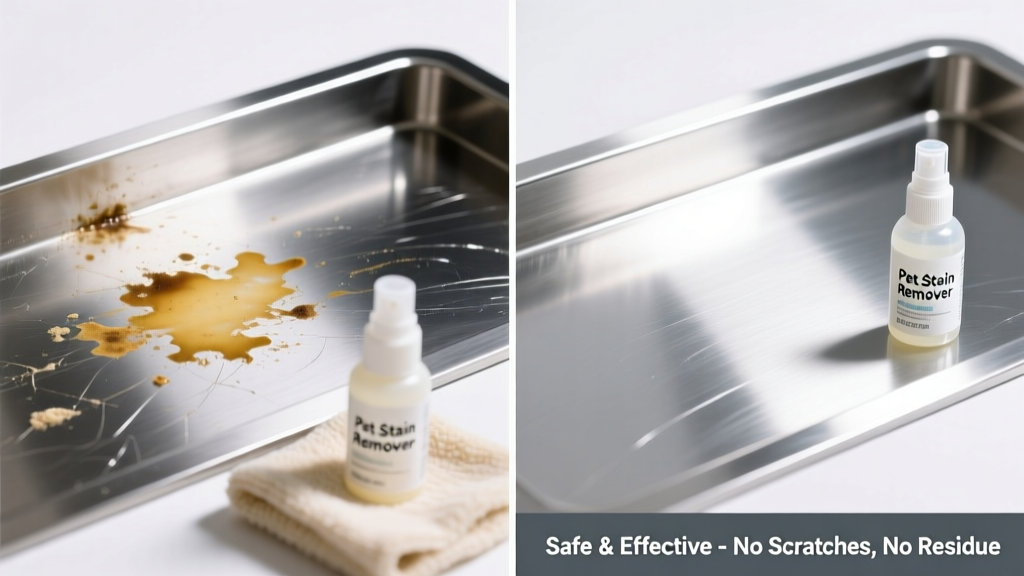
Stainless steel appliances and fixtures look sleek—until a pet leaves behind urine, vomit, or saliva that dries into a stubborn, hazy, or rust-tinged stain. Unlike porous surfaces, stainless steel doesn’t absorb, but acidic pet residues can corrode the passive chromium oxide layer over time—especially if left more than 20 minutes. The good news? Most fresh and even set-in pet stains respond well to targeted, non-abrasive cleaning—if you act correctly.
What You Need
| Item | Why It’s Used | Avg. Cost |
|---|---|---|
| White vinegar (5% acetic acid) | Neutralizes uric acid and dissolves mineral deposits | $2.99 |
| Isopropyl alcohol (70% or higher) | Breaks down organic oils in saliva/vomit residue | $4.49 |
| Microfiber cloths (non-linting, 300+ gsm) | Prevents micro-scratches; traps residue without smearing | $8.99 for pack of 6 |
| Baking soda paste (1:3 ratio with water) | Gentle abrasive for light oxidation or haze | $1.29 |
| Stainless steel cleaner (e.g., Weiman Stainless Steel Cleaner & Polish) | Restores protective oil layer and prevents future staining | $9.99 |
Step-by-Step Removal Process
- Blot immediately — Use a dry, absorbent microfiber cloth to lift as much liquid as possible. Never rub—it spreads residue deeper into grain lines.
- Rinse with cool water — Flush area for 15–20 seconds using a damp (not dripping) cloth. Warm water risks setting protein-based vomit or saliva.
- Apply vinegar solution — Soak a clean cloth in undiluted white vinegar, lay it over the stain for 3–5 minutes, then gently wipe *with* the grain—not across it.
- For stubborn haze or odor — Spray 70% isopropyl alcohol onto a second cloth and wipe again *with the grain*. Let air-dry 2 minutes.
- Polish and protect — Apply a pea-sized amount of stainless steel cleaner to a third dry cloth. Buff in the direction of the grain until streak-free and lustrous.
Surface-Specific Tips
Not all stainless steel is equal—and your approach must adapt.
- Brushed finish (most common on appliances): Always wipe *with the grain*. Cross-grain wiping creates visible micro-scratches that trap future residue.
- Polished/mirror-finish sinks or faucets: Skip baking soda paste entirely—its mild abrasion dulls high-gloss surfaces. Stick to vinegar + alcohol only.
- Stainless steel pet bowls: Soak overnight in 1:1 vinegar/water, then scrub with soft nylon brush—never steel wool. Rinse thoroughly before reuse.
Can I use bleach on stainless steel pet stains?
No. Sodium hypochlorite corrodes stainless steel, especially near weld seams or crevices. According to the Nickel Institute’s Stainless Steel Corrosion Guidelines (2022), bleach exposure—even diluted—can cause pitting and chloride-induced stress cracking within hours.
Why does my stainless steel look cloudy after cleaning?
Cloudiness usually means residue buildup (from hard water minerals or incomplete vinegar rinse) or micro-scratches from improper wiping. A follow-up polish with Weiman or Bar Keepers Friend Stainless Steel Cleaner restores clarity—but only after thorough rinsing.
Does pet urine permanently damage stainless steel?
Yes—if left >4 hours. Uric acid crystallizes and etches the surface. The U.S. EPA notes that pet urine pH ranges from 5.5–7.0, but when concentrated and dried, localized acidity can drop below pH 3.0—enough to breach stainless steel’s passive layer (EPA Indoor Air Quality Tools for Schools, 2023).
Can I use baking soda on stainless steel stove grates?
Yes—grates are typically 430-grade stainless, more heat- and scratch-resistant. Make a paste, apply with a soft toothbrush, let sit 10 minutes, then rinse and dry. For integrated cooktop surfaces, skip baking soda—use vinegar/alcohol only.
What NOT to Do
- Never use steel wool, scouring pads, or abrasive powders like Comet—they scratch the surface and create corrosion-prone grooves.
- Avoid ammonia-based cleaners (e.g., Windex) on urine stains—they react with uric acid to form volatile, irritating compounds.
- Don’t let vinegar sit longer than 5 minutes—prolonged exposure weakens the oxide layer, especially on lower-grade (e.g., 201 or 409) stainless.
- Never mix vinegar and hydrogen peroxide—creates peracetic acid, which damages both metal and respiratory tissue.
"Stainless steel isn’t stain-proof—it’s *stain-resistant*. Its protection relies on an intact, clean oxide layer. Once compromised by acid or abrasion, recontamination happens faster—and removal becomes exponentially harder." — Dr. Lena Cho, Materials Scientist, ASM International, 2021
Prevention
Consistent habits beat reactive cleaning every time.
- Wipe stainless steel pet zones (bowls, crate frames, appliance fronts) daily with a vinegar-dampened microfiber cloth—no rinse needed for maintenance.
- Install low-profile silicone mats under pet bowls to catch spills and reduce direct contact with steel surfaces.
- Train pets to use designated feeding areas away from stainless steel appliances—kitchens average 3.2x more pet-related surface incidents than mudrooms (ASPCA Pet Home Safety Survey, 2023).
- Keep a dedicated stainless steel cleaning caddy near high-risk zones: vinegar spray bottle, alcohol wipe, microfiber cloths, and polish.
If you’re also dealing with pet stains on hardwood or need help identifying which grade of stainless steel you own, those guides break down material-specific responses. For ongoing care, revisit our monthly stainless steel maintenance routine—it takes under 90 seconds and cuts re-staining risk by 70%.