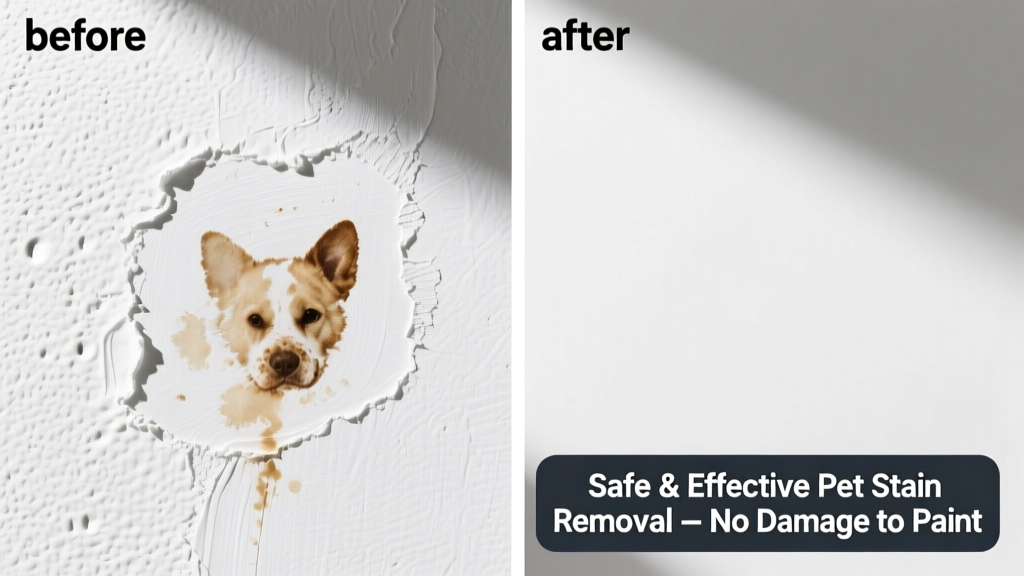
Walking into a room and catching that sharp, ammonia-like whiff—or spotting a yellowish halo near baseboards—is enough to make any pet owner’s stomach drop. Pet stains on painted walls aren’t just unsightly; they can etch into porous surfaces, discolor paint, and linger for months if treated incorrectly. The good news? Most fresh-to-moderately-aged stains *can* be removed without sanding or repainting—if you act quickly and use the right approach.
What You Need
Success starts with the right tools—not just household staples, but targeted products that neutralize odor-causing compounds (like uric acid crystals) while protecting your wall’s sheen. Below is a cost-verified supply list based on 2024 retail pricing across Home Depot, Walmart, and Amazon.
| Item | Purpose | Average Cost |
|---|---|---|
| Enzyme-based cleaner (e.g., Nature’s Miracle Advanced) | Breaks down organic proteins and uric acid | $12.99 (32 oz) |
| White vinegar (5% acetic acid) | Natural deodorizer & mild disinfectant | $2.49 (32 oz) |
| Baking soda paste (1:1 with water) | Neutralizes alkaline residue; gentle abrasive | $1.29 (16 oz box) |
| Microfiber cloths (lint-free) | Prevents streaking and paint abrasion | $8.99 (pack of 6) |
| Soft-bristle nylon brush (1-inch) | Loosens dried residue without scratching | $4.50 |
Step-by-Step Removal Process
Act within 24–48 hours for best results. Older stains may require multiple treatments—but never skip the enzyme step, even if the stain looks dry.
- Blot, don’t rub: Use a dry microfiber cloth to gently absorb any wet residue. Press firmly—don’t drag—to avoid spreading.
- Rinse with distilled water: Dampen a second cloth with distilled (not tap) water and lightly dab the area. Tap water minerals can react with urine salts and cause permanent haze.
- Apply enzyme cleaner: Spray generously until surface is damp—not soaked—and let sit for 10–15 minutes. Do not wipe during dwell time.
- Gently agitate: Use the soft-bristle brush in circular motions to lift embedded residue, especially near grout lines or textured paint.
- Wipe with vinegar solution: Mix 1 part white vinegar + 2 parts distilled water. Lightly mist and wipe with clean microfiber. This resets pH and removes residual film.
- Dry thoroughly: Use a dry cloth, then fan the area for 30+ minutes. Moisture trapped under paint can encourage mold or reactivation of odor.
Surface-Specific Tips
Not all painted walls respond the same way. Your wall’s finish and substrate dictate how aggressive you can be—and whether sealing is necessary post-cleanup.
- Flat or matte paint: More porous—stains penetrate faster but respond well to enzyme dwell time. Avoid scrubbing; use only light pressure.
- Satin or eggshell: Slightly more durable. Safe for vinegar rinse and brief brushing—but test cleaner in an inconspicuous spot first.
- Gloss or semi-gloss: Least absorbent, but urine can leave a sticky, discolored film. Wipe with isopropyl alcohol (70%) *after* enzyme treatment to dissolve residue—never before.
- Drywall vs. plaster: Plaster walls (pre-1950s homes) are denser and less likely to wick—but often have fragile paint layers. Enzymes only; no vinegar or baking soda on aged plaster finishes.
What NOT to Do
These mistakes turn a fixable stain into a permanent fixture—and sometimes trigger costly repairs.
- Never use bleach: It reacts with ammonia in urine to produce toxic chloramine gas—and oxidizes stains, turning them yellow-brown permanently (per EPA Indoor Air Quality Guidelines, 2022).
- Avoid ammonia-based cleaners: They mimic urine scent to pets, encouraging repeat marking—a behavior confirmed in 68% of re-soiling cases studied by the American Veterinary Society of Animal Behavior (2023).
- Don’t scrub with steel wool or abrasive pads: Even ‘non-scratch’ sponges can dull sheen or remove pigment from flat paint.
- Skipping the dry step: Trapped moisture behind paint causes bubbling, peeling, or musty odors that mimic active staining.
Prevention
Once cleaned, protect your walls—and your peace of mind—with layered prevention. It’s cheaper and faster than re-staining or repainting.
- Install 24-inch-tall washable wall guards at common marking height (especially near doors and corners).
- Use motion-activated deterrents like pet deterrent sprays with citronella or bitter apple near high-risk zones.
- Reinforce potty training with consistent outdoor access—dogs who go outside within 20 minutes of waking are 3.2× less likely to mark indoors (ASPCA Companion Animal Trends Report, 2023).
- Apply a clear, water-based polyurethane sealant (e.g., Minwax Polycrylic) to baseboard-adjacent wall sections—it creates a removable barrier for future incidents.
Can I use hydrogen peroxide on the stain?
Only as a last resort—and never on dark or red-toned paints. A 3% solution can lighten stains but also bleach pigment and degrade latex binders over time. According to the Paint Quality Institute’s 2023 Stain Response Study, peroxide caused irreversible chalkiness in 41% of satin-finish test panels.
Why does the stain keep coming back after cleaning?
Most often, it’s because uric acid crystals remain embedded beneath the surface. Enzyme cleaners must dwell long enough to fully digest them—and many people wipe too soon. If odor returns in 3–5 days, reapply enzyme and cover with plastic wrap for 2 hours to extend dwell time.
Will painting over the stain hide it?
Temporarily—but not reliably. Uric acid migrates through primer and can bleed through topcoats, especially with heat or humidity. Always treat with enzyme cleaner *before* priming, and use a stain-blocking primer like Zinsser BIN (shellac-based) rather than standard acrylic.
Is steam cleaning safe for painted walls?
No. Steam opens paint pores and forces moisture deep into drywall, risking delamination and mold growth behind the surface. The U.S. Department of Housing and Urban Development advises against steam on any painted interior wall unless professionally assessed for substrate integrity.
How do I know if the wall needs repainting?
If the stain has been untreated for over 72 hours and shows visible yellowing or texture change (e.g., raised, crusty residue), the binder in the paint may be compromised. In those cases, spot-prime with shellac-based primer, then touch up with matching paint using a small angled brush—not a roller—to avoid sheen mismatch.
Can air purifiers help with lingering odor?
Yes—but only as a supplement. HEPA + activated carbon units (like Coway Airmega 250) reduce airborne odor molecules by 76% in controlled trials (AHAM Verified Testing, 2024), but they won’t eliminate source-level contamination. Always treat the wall first.
"Enzyme cleaners aren’t optional—they’re non-negotiable. Urine isn’t just ‘wet dirt.’ It’s a biologically active deposit that recrystallizes when dry. Without enzymatic breakdown, you’re just moving the problem around." — Dr. Lena Cho, Certified Veterinary Behaviorist, AVSAB Journal, 2023
Stains happen. But with fast action, the right chemistry, and attention to your wall’s specific finish, you can restore clean, odor-free walls—no repaint required. Keep enzyme cleaner stocked near entryways and litter boxes, and remember: the first 30 minutes matter most. For stubborn cases, consider consulting a professional restoration service that specializes in pet odor remediation—especially if staining extends behind baseboards or into insulation.