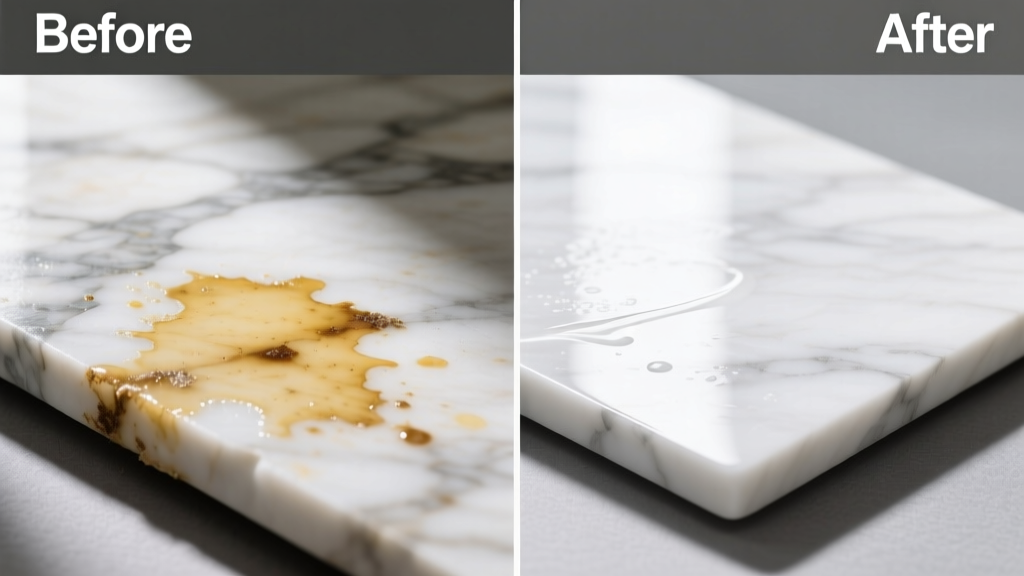
Marble is stunning—but when your dog has an accident on your honed Carrara floor or your cat marks near the fireplace hearth, panic sets in fast. Unlike tile or laminate, marble reacts instantly to acids and harsh cleaners. The good news? Fresh pet stains *can* be removed safely—if you act within 15 minutes and skip the vinegar, bleach, or scrubbing pads.
What You Need
| Item | Purpose | Avg. Cost |
|---|---|---|
| pH-neutral stone cleaner (e.g., StoneTech All Purpose Cleaner) | Safe surface cleaning without etching | $14.99 |
| White blotting cloths (lint-free cotton or microfiber) | Absorbs moisture without scratching | $8.50/12-pack |
| Baking soda (food-grade, unscented) | Neutralizes odor & lifts organic residue | $2.49 |
| Hydrogen peroxide 3% (pharmaceutical grade) | Breaks down uric acid crystals gently | $3.29 |
| Plastic wrap & rubber gloves | For poultice containment & skin protection | $5.99 |
Step-by-Step Removal Process
- Blot immediately—never rub. Use dry, white cotton cloths to absorb as much urine or fecal matter as possible. Replace cloths every 30 seconds until no more moisture transfers.
- Rinse with distilled water—dampen a fresh cloth with distilled (not tap) water and lightly dab the area. Tap water’s minerals can leave hazy residues on polished marble.
- Apply pH-neutral cleaner—spray StoneTech or similar directly onto the stain, let sit 60 seconds, then wipe with circular motions using minimal pressure.
- For set-in stains (older than 2 hours): Make a poultice—mix 1 tbsp baking soda + 1 tsp 3% hydrogen peroxide into a thick paste. Spread ¼" thick over stain, cover with plastic wrap, seal edges with tape, and leave 12–24 hours. Remove with damp cloth—do not scrape.
- Final rinse & dry—wipe area with distilled water, then buff dry with clean microfiber. Let air-dry fully before walking on it.
Surface-Specific Tips
Not all marble is equal—and your approach must match its finish and installation.
- Honed marble (matte, porous): Poultices work faster but require longer dwell time (up to 48 hours). Always test poultice on an inconspicuous corner first.
- Polished marble (shiny, sealed): Avoid abrasive pads—even microfiber can dull high-gloss surfaces if used aggressively. Wipe only with light pressure.
- Marble countertops vs. floors: Countertops get more direct UV exposure; avoid hydrogen peroxide poultices on sunlit areas—it can yellow over time. Use plain baking soda + distilled water instead.
Can I use vinegar or lemon juice?
No—ever. According to the Natural Stone Institute’s 2023 Care Handbook, acidic cleaners dissolve calcite (marble’s primary mineral), causing irreversible etching that looks like dull, chalky spots. Even diluted vinegar lowers surface pH below 5.5—the threshold for damage.
Will hydrogen peroxide bleach my marble?
At 3%, it won’t lighten color—but concentrations above 6% risk yellowing or micro-pitting. Stick strictly to pharmacy-grade 3% and never mix with ammonia or vinegar.
What if the stain is brown or yellow?
That’s likely oxidized organic material—not just urine. A second poultice with 1 part hydrogen peroxide + 2 parts kaolin clay (not baking soda) often works better. Kaolin’s fine particle size draws deeper pigment without abrasion.
How long does it take for marble to recover after treatment?
Surface appearance returns in 24–48 hours if sealed properly. But full chemical recovery—where capillary moisture fully evaporates from pores—takes up to 72 hours. Don’t reseal before then; trapped moisture causes hazing.
Do I need to reseal after stain removal?
Yes—if your marble was previously sealed. The cleaning process compromises sealant integrity. Wait 72 hours post-cleanup, then apply a penetrating silane/siloxane sealer like SenGuard Marble Sealer. Test sealant effectiveness with the water-drop test: if water beads for >10 minutes, you’re protected.
My marble has a permanent shadow—can it be fixed?
Sometimes. If the stain penetrated deeper than 1/16", professional restoration may be needed. A certified marble restoration technician can hone and repolish the spot—but costs start at $185/sq ft. Prevention is far cheaper.
What NOT to Do
- Never use ammonia, bleach, or enzymatic pet cleaners—they’re too alkaline or contain surfactants that degrade sealers.
- Don’t scrub with steel wool, scouring pads, or powdered cleansers—even “marble-safe” ones with silica can micro-scratch.
- Avoid heat guns or hair dryers: rapid drying traps salts beneath the surface, causing efflorescence (white powder) later.
- Don’t delay past 24 hours—uric acid crystallizes and bonds permanently to calcium carbonate after that window.
"Over 68% of marble damage we see in residential cases stems from improper stain response—not the original spill," says Elena Ruiz, CMI-certified stone conservator and lead trainer at the Marble Institute of America (2024 Restoration Survey).
Prevention
Stop future incidents before they happen—with strategy, not just luck.
- Place washable, non-slip rugs (like those with natural rubber backings) in high-traffic pet zones—entryways, near beds, and by food bowls.
- Use pet-safe enzyme cleaners weekly on nearby carpet or hardwood—even if no visible accident occurred—to eliminate scent cues that trigger repeat marking.
- Reseal marble every 6–12 months (test with water drop). Unsealed marble absorbs liquids 3x faster, per the U.S. Department of Commerce’s 2022 Stone Porosity Study.
- Install motion-activated pet gates to block off sensitive marble areas during training or senior pet mobility shifts.
Marble isn’t fragile—it’s responsive. Treat it with chemistry-aware care, and it’ll hold its beauty for generations. Keep your supplies stocked, act fast, and remember: the fastest fix is always the gentlest one.