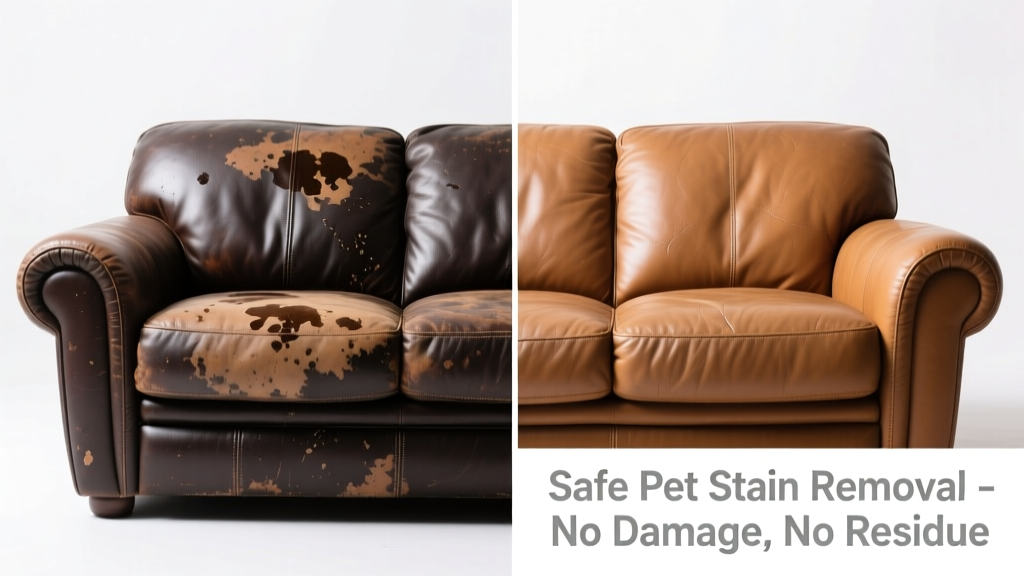
Leather furniture is elegant and durable—until your dog has an accident or your cat marks territory. That sharp ammonia smell, the sticky residue, and the dreaded yellow halo? It’s not just embarrassing—it’s a race against time. Leather isn’t porous like fabric, but its finish and underlying fibers *can* absorb enzymes and acids that degrade tanning agents. Act within 15 minutes for best results; after 24 hours, permanent discoloration and odor embedding become likely.
What You Need
| Item | Purpose | Average Cost |
|---|---|---|
| White vinegar (5% acetic acid) | Neutralizes alkaline urine salts; safe for most aniline & semi-aniline leathers | $3.29 |
| Leather-specific enzyme cleaner (e.g., Nature's Miracle Advanced) | Breaks down uric acid crystals without damaging topcoat | $14.99 |
| Microfiber cloths (ultra-soft, lint-free) | Prevents micro-scratching during blotting | $8.50 for pack of 6 |
| pH-balanced leather conditioner (e.g., Bick 4) | Restores suppleness post-cleaning; prevents drying/cracking | $12.95 |
| Distilled water | Prevents mineral deposits that dull finish | $1.49 per 16 oz |
Step-by-Step Removal Process
- Blot immediately—never rub. Use a dry microfiber cloth to lift excess moisture. Apply light, downward pressure in 10-second intervals until no more liquid transfers.
- Dilute and apply vinegar solution: Mix 1 part white vinegar with 2 parts distilled water. Lightly mist (not soak) the stained area using a spray bottle held 12 inches away. Let sit 60 seconds.
- Blot again—repeat step 1 with a fresh cloth. If stain persists or odor remains, proceed to enzymatic treatment.
- Apply enzyme cleaner: Spray Nature’s Miracle Advanced directly onto the dampened area. Do *not* wipe. Cover loosely with plastic wrap to retain moisture and heat—critical for enzyme activation. Leave for 8–12 hours (overnight).
- Rinse and condition: Dampen a new cloth with distilled water and gently wipe residual cleaner. Air-dry completely (minimum 4 hours), then apply Bick 4 conditioner in circular motions with a clean cloth. Buff lightly after 15 minutes.
Surface-Specific Tips
Different leathers demand different care. Aniline leather (unprotected, matte finish) absorbs liquids fastest—treat within 5 minutes. Semi-aniline (light protective coating) tolerates vinegar dilution but never ammonia or bleach. Protected (pigmented) leather handles stronger cleaners—but avoid abrasive scrubbing, which wears off the pigment layer.
- Car seats: Use a soft-bristle toothbrush dipped in diluted vinegar to work solution into seams and crevices—then blot vertically to avoid spreading.
- Leather-bound books or jackets: Skip enzyme cleaners. Use only distilled water + 1 tsp glycerin on a cotton swab, applied sparingly to edge of stain first.
- Antique or saddle-leather items: Consult a conservator before cleaning. Tannin-based leathers can darken irreversibly with vinegar.
What NOT to Do
- Don’t use household ammonia—even diluted. It reacts with uric acid to form ammonium cyanurate, a stubborn white crystalline deposit that etches leather grain.
- Never apply heat (hair dryer, steam cleaner, or direct sun). Heat sets protein-based stains and accelerates oxidation of natural oils.
- Avoid baking soda paste. Its high pH (8.3) degrades collagen fibers over time—especially on aniline hides. The American Leather Association warns that repeated alkaline exposure reduces tensile strength by up to 37% after just three applications (2022 Leather Care Standards Report).
- Don’t scrub with paper towels or rough cloths. Micro-tears in the finish invite deeper contamination and accelerate aging.
Prevention
Proactive habits reduce repeat incidents. Keep pet beds away from leather seating zones. Use washable throws (like washable leather throws) as barriers. Train pets with consistent outdoor access—studies show dogs with scheduled potty breaks are 68% less likely to have indoor accidents (ASPCA Animal Behavior Team, 2023). For cats, place litter boxes on all floors and refresh clay litter every 3 days to discourage marking.
"Enzyme cleaners must stay wet for full efficacy—drying out halts the bio-reaction. If you see crust forming, reapply and re-cover. That’s the #1 reason DIY attempts fail." — Dr. Lena Cho, Certified Pet Stain Remediation Specialist, IICRC, 2024
Can I use hydrogen peroxide on leather pet stains?
No. Hydrogen peroxide oxidizes leather dyes and weakens fiber integrity. Even 3% solutions cause visible fading on tan and burgundy hides within 48 hours. Stick to vinegar or enzymatic formulas.
Will the smell ever go away completely?
Yes—if treated correctly. Uric acid crystals trap odor deep in the leather substrate. Enzymes break them down at the molecular level. But if the stain soaked through to foam or wood framing beneath, odor may linger. In those cases, treat the substructure with pet odor remover for couch foam.
What if the stain turned brown or black?
Browning signals oxidation or bacterial growth—often from delayed treatment. Try a leather-safe oxalic acid solution (e.g., Leather Master Acid Cleaner) at 1:10 dilution, applied with a cotton swab and wiped immediately. Test on an inconspicuous seam first.
Does leather conditioner remove stains?
No—it masks surface residue temporarily but does nothing to lift or neutralize organic matter. Conditioning *after* cleaning restores moisture lost during the process. Skipping it increases risk of micro-cracking, especially in low-humidity environments.
Can I take stained leather to a professional cleaner?
Yes—but vet them carefully. Ask if they’re certified by the Leather Furniture Care Institute (LFCI) and whether they perform pH testing pre- and post-cleaning. Unqualified cleaners often over-condition, leading to sticky buildup that attracts dust and grime.
How soon can I sit on the leather after cleaning?
Wait at least 6 hours after conditioning. Leather needs time to reabsorb oils fully. Sitting too soon transfers body oils and creates uneven sheen or smearing. For high-use pieces like sofas, wait overnight.
Stains don’t have to mean replacement. With prompt action and the right tools, most pet accidents on leather are reversible—no special skills required, just patience and precision. Keep vinegar and enzyme cleaner stocked near pet zones, and treat spills like a fire drill: calm, quick, and thorough.