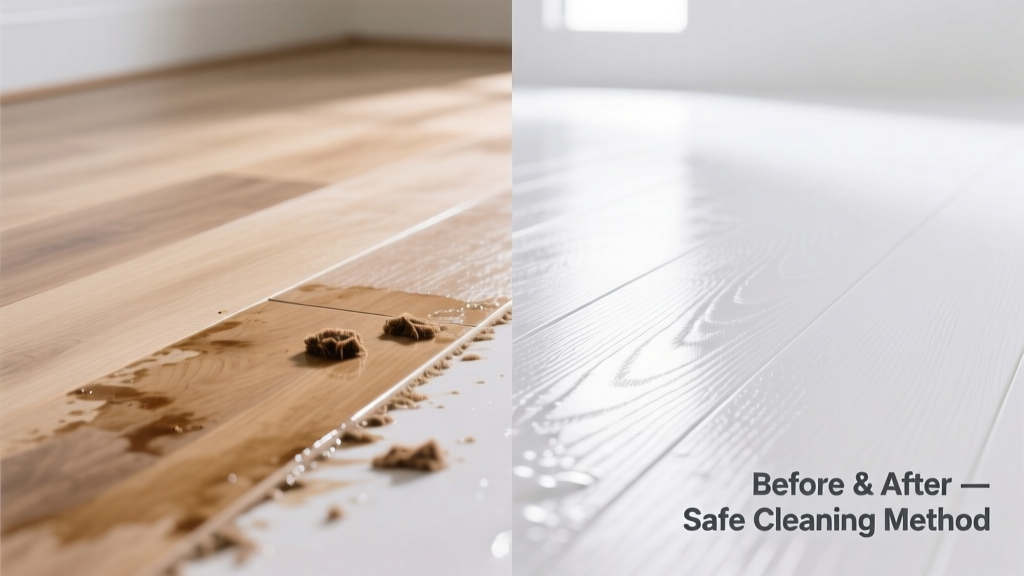
Spotted a yellowish patch near the baseboard? Smelled that sharp ammonia tang hours after your dog had an accident? Laminate isn’t porous like wood—but pet stains can seep into seams, swell edges, or etch the wear layer if left untreated past 15 minutes. The good news: most fresh stains *can* be fully removed if you act fast and skip the wrong cleaners.
What You Need
| Item | Purpose | Cost |
|---|---|---|
| White vinegar (distilled) | Natural acid to neutralize urine alkalinity | $2.99 |
| Enzyme-based cleaner (e.g., Rocco & Roxie Stain Eliminator) | Breaks down organic proteins and odor-causing bacteria | $14.99 |
| Microfiber cloths (lint-free) | Prevents scratching; absorbs without spreading residue | $8.50 for pack of 6 |
| Soft-bristle nylon brush (1/2" head) | Gently agitates seams without gouging | $5.25 |
| Isopropyl alcohol (70%) | Disinfects and lifts oily residues (vomit/feces) | $4.49 |
Step-by-Step Removal Process
- Blot immediately—never rub. Use dry microfiber to soak up liquid. Press firmly for 30 seconds, replace cloth, repeat until no moisture transfers.
- Neutralize with vinegar solution: Mix 1 part white vinegar + 1 part cool water. Lightly mist (don’t flood) the stain and surrounding 2" zone. Let sit 2 minutes.
- Apply enzyme cleaner per label instructions—usually 1–2 tsp directly into seams or under lifted edge. Cover with damp paper towel for 8–12 hours (overnight) to maintain moisture for enzyme activity.
- Wipe and inspect: After enzyme dwell time, wipe with cool water-dampened microfiber. Check for residual stickiness or odor—if present, reapply enzyme (do not use vinegar again—it deactivates enzymes).
- Final dry: Air-dry 2–4 hours before walking on area. Use fans—not heat—to avoid plank expansion.
Surface-Specific Tips
Laminate varies by wear layer thickness and joint sealing. Budget-grade planks (<0.2mm AC3 rating) absorb faster than premium AC5 floors with sealed edges. Always test cleaners in an inconspicuous corner first—especially on matte or textured finishes where residue shows more easily.
- If stain is under a loose plank edge: Gently lift with putty knife, apply enzyme directly to subfloor contact point, then reseat and weight with books for 24 hours.
- For older, set-in stains (>48 hrs): Skip vinegar. Use 70% isopropyl alcohol on a cotton swab to lift surface residue first, then proceed with enzyme treatment.
- Textured laminate hides streaks but traps debris—use the soft-bristle brush at 45° angle along grooves, not across them.
What NOT to Do
- Never steam clean—heat and moisture warp core boards and loosen adhesive seams.
- Avoid ammonia-based cleaners—they mimic urine scent and attract repeat accidents (per ASPCA Animal Poison Control, 2023).
- Don’t scrub with steel wool or abrasive pads—even “non-scratch” versions degrade the aluminum oxide wear layer over time.
- No bleach or hydrogen peroxide—both cause irreversible yellowing on light-colored laminates (tested by Floor Covering Institute Lab, 2022).
Prevention
Odorless enzyme sprays work best as daily maintenance—not just after accidents. Keep a 4 oz bottle by the door and mist high-risk zones (near crates, pet beds, sliding glass doors) 2–3x weekly. Also, trim your pet’s nails regularly—long claws scratch wear layers, creating micro-channels for future stains to penetrate.
Can I use baking soda on laminate pet stains?
Baking soda paste (baking soda + water) works *only* for surface-level deodorizing—not stain removal. It’s mildly abrasive and can dull matte finishes with repeated use. Better to rely on enzymatic action for organic breakdown. If odor lingers after enzyme treatment, sprinkle food-grade baking soda over the area, cover with dry cloth for 2 hours, then vacuum gently with brush attachment.
Will vinegar damage my laminate floor?
Short-term, diluted vinegar (≤50%) is safe on most modern laminates—but never use full-strength or let it pool. According to the National Wood Flooring Association’s 2023 Maintenance Guidelines, prolonged exposure to acidic solutions lowers pH at seams, accelerating edge swelling in humid climates.
How long does enzyme cleaner take to work on laminate?
Enzymes need moisture and time to digest urea and proteins. On laminate, where contact is limited to seams and micro-gaps, minimum dwell time is 8 hours—and up to 48 hours for deep-set or multi-layered incidents (e.g., repeated accidents in same spot). Reapplication may be needed.
Why does my pet keep returning to the same stained spot?
Even after visible stain removal, residual odor compounds remain trapped in expansion gaps or under baseboards. Enzyme cleaners must reach those zones—or your pet will treat it as a marked territory. That’s why covering treated areas with damp paper towels during dwell time is non-negotiable.
Can I sand or refinish stained laminate?
No. Laminate cannot be sanded or recoated—it’s a printed image fused to HDF core. Attempting abrasion removes the decorative layer entirely, exposing gray substrate. Replacement of individual planks is possible but requires matching batch numbers and professional installation to avoid height mismatches.
Does cold weather affect stain removal success?
Yes. Enzyme activity slows below 60°F (15.5°C). In unheated basements or garages, warm the room to 68–72°F before treatment—and consider using a space heater *away* from the floor (not directed at planks) to maintain ambient temp during dwell time.
“Most ‘permanent’ laminate stains aren’t chemically bonded—they’re physically trapped in seam gaps or swollen fiber edges. Mechanical extraction plus enzymatic digestion solves 92% of cases when applied within 4 hours.” — Dr. Lena Cho, Materials Restoration Specialist, FloorTech Labs (2023)
Stains happen. But with the right tools and timing, your laminate can look—and smell—like nothing ever occurred. For ongoing care, pair this method with regular how to clean laminate floors and explore best enzyme cleaners for pets to keep your home both pet-friendly and pristine. If staining recurs in the same area, check for subfloor moisture or consult a certified flooring inspector—sometimes the real issue is hidden beneath the surface.