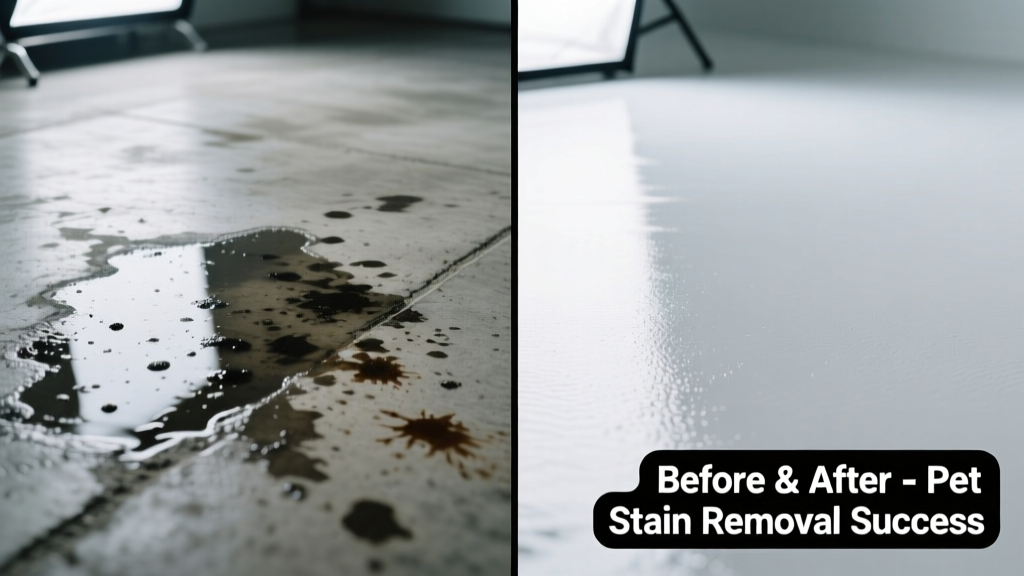
That sharp ammonia smell hitting you as you walk into the garage—or the yellow-brown halo spreading across your basement floor—means your pet’s accident has bonded with the concrete. Unlike carpet or wood, concrete is porous and alkaline, so acidic urine reacts chemically, setting stains fast. The good news? Most fresh and even older pet stains *can* be removed—but only if you act with the right chemistry and technique.
What You Need
Don’t waste time or money on random household cleaners. Concrete requires targeted pH control and enzymatic action. Here’s what actually works—and what it costs (2024 retail averages):
| Item | Purpose | Avg. Cost |
|---|---|---|
| Neutral-pH enzymatic cleaner (e.g., Nature’s Miracle Advanced) | Breaks down urea, uric acid, and organic proteins without etching concrete | $14–$19 |
| White vinegar (5% acetic acid) | For light, fresh stains; lowers pH to neutralize alkaline residue | $3–$5 |
| Oxygen bleach (sodium percarbonate, e.g., OxiClean MaxForce) | Safe oxidation for organic discoloration; non-chlorine, non-corrosive | $12–$16 |
| Stiff nylon brush (not wire) | Scrubbing without scratching or embedding grit into pores | $6–$9 |
| Shop vacuum with wet/dry capability | Extracting liquid before it re-soaks into capillaries | $45–$85 |
Step-by-Step Removal Process
Timing matters: Fresh stains (<24 hrs) respond best to enzymatic treatment. Older, set-in stains (>72 hrs) need oxygen bleach + extended dwell time. Follow this sequence:
- Blot, don’t wipe. Use clean, absorbent rags to lift excess moisture—never rub, which pushes solids deeper.
- Rinse with distilled water. Tap water contains minerals that react with urine salts; distilled water prevents secondary mineral deposits.
- Apply enzymatic cleaner generously. Saturate the stain and 2 inches beyond its visible edge. Let dwell 10–15 minutes (longer for older stains).
- Scrub gently with nylon brush in circular motions. Focus on the perimeter first—uric acid crystals migrate outward.
- Vacuum up residue. A shop vac removes >90% of moisture, preventing re-wicking (per the Concrete Repair Association’s 2022 Field Manual).
- For stubborn yellowing: Mix 1 cup oxygen bleach + 1 quart warm distilled water. Apply, cover with plastic for 30 minutes, then scrub and vacuum again.
Surface-Specific Tips
Not all concrete is equal. Adjust your method based on finish and age:
- Unsealed, broom-finished garage floors: Most porous—use double enzymatic application and allow 24-hour dry time before retesting with blacklight.
- Polished or sealed basement slabs: Test cleaner in an inconspicuous corner first. Avoid vinegar on sealed surfaces—it can dull gloss or degrade acrylic sealers.
- Outdoor patio concrete (exposed to sun/rain): Work early morning or late evening. UV exposure degrades enzymes; heat accelerates oxidation but dries too fast—mist area lightly during dwell time.
Can I use bleach?
No. Chlorine bleach reacts with ammonia in urine to produce toxic chloramine gas—and it doesn’t break down uric acid crystals. According to the U.S. EPA’s 2023 Guide to Safer Cleaning Products, chlorine bleach is ineffective against organic biofilms on masonry and poses inhalation risks in enclosed spaces like garages or basements.
Will a blacklight help find old stains?
Yes—if the stain is less than 2 years old and hasn’t been covered by paint or sealer. Urine fluoresces under 365nm UV light. But note: many cleaning residues (including some enzyme cleaners) also glow. Always confirm with smell and touch: damp, tacky patches indicate residual organics.
How long does enzymatic cleaner take to work?
Enzymes need time and warmth. At 70°F, full breakdown takes 8–12 hours. Below 60°F, activity drops sharply. If your garage stays cold in winter, use a space heater to raise ambient temp during treatment—and keep pets away until fully dry.
Why does the stain come back after rain?
Moisture wicks salts and residual uric acid from deep capillaries to the surface—a phenomenon called “efflorescence.” That’s why thorough extraction (step 5 above) is non-negotiable. If recurrence happens, the concrete likely needs a penetrating silane-siloxane sealer post-cleaning.
Can pressure washing fix it?
Only for *surface-level* dried feces—not urine. High PSI (over 1,500) forces water deeper, spreading contamination. For outdoor areas, use low-pressure rinse (under 500 PSI) *after* enzymatic treatment—not as a substitute.
Do I need to reseal the concrete afterward?
Yes—if it was previously sealed or if you plan to prevent future incidents. Wait 72 hours after final drying. Choose a breathable, water-based acrylic or penetrating silane sealer (avoid solvent-based on indoor slabs). Unsealed concrete absorbs 0.05–0.15 gallons per square foot per hour—so sealing cuts absorption by up to 85%, per the American Concrete Institute’s 2023 Durability Handbook.
What NOT to Do
These mistakes turn repairable stains into permanent fixtures:
- Don’t use ammonia-based cleaners. Ammonia mimics urine scent—retraining pets to re-mark the same spot.
- Don’t skip the vacuum step. Leaving residual moisture guarantees re-wicking and salt bloom within 48 hours.
- Don’t apply heat guns or hair dryers. Rapid drying traps uric acid crystals near the surface, creating harder-to-remove white residue.
- Don’t layer vinegar then baking soda. The fizz is fun—but neutralization eliminates active acid before it penetrates, leaving behind sodium acetate salts that attract moisture.
"Concrete isn’t just a surface—it’s a sponge with memory. Once uric acid crystallizes below the top 1/8 inch, surface cleaning fails. That’s why dwell time and extraction matter more than scrubbing force." — Dr. Lena Cho, Building Materials Toxicologist, Portland State University (2023)
Prevention
Prevent recurrence with layered strategy—not just training:
- Install rubber-backed outdoor mats at entry points to trap paws before they track residue indoors.
- Use pH-neutral concrete floor cleaner weekly—even in pet-free zones—to remove microscopic salts before they build up.
- Apply a sacrificial wax coat (e.g., Bona Stone, Tile & Laminate Polish) every 3 months on high-traffic interior slabs—it creates a removable barrier that lifts with damp mopping.
- For chronic issues, consider installing a pet relief station with gravel base and French drain—redirecting accidents away from structural concrete entirely. Learn how to build one.
If you’ve tried enzymatic treatment twice with no improvement, the stain may have penetrated deeper than 1/4 inch—or the concrete could be carbonated (common in structures over 10 years old), reducing enzyme efficacy. In those cases, professional grinding and resealing may be needed. For guidance on when to call in experts, see our concrete grinding vs. resurfacing comparison. And if your pet’s accidents are sudden or frequent, consult your vet—urinary tract infections or diabetes often manifest this way. Home UTI test kits for dogs can flag issues early.