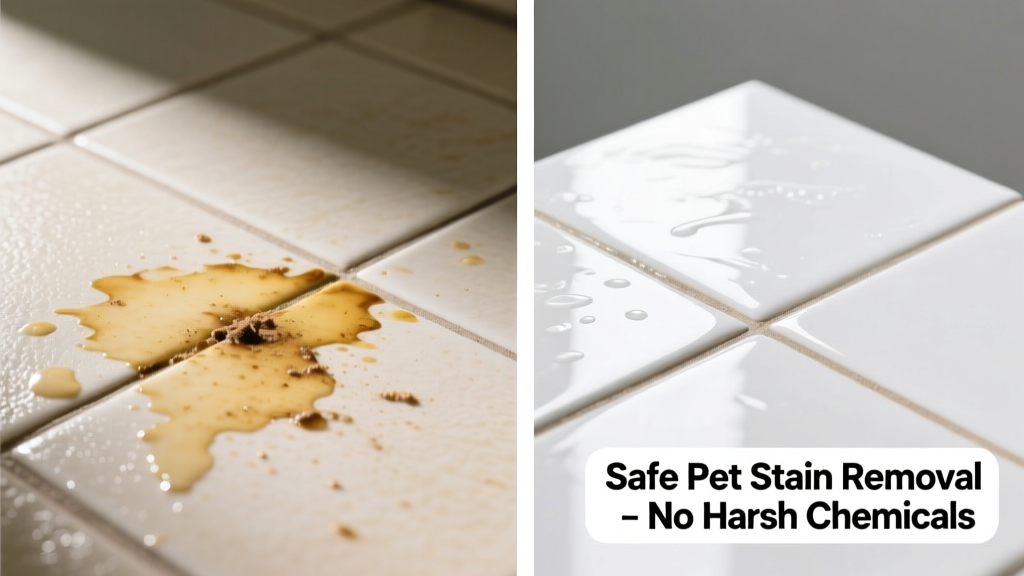
That sharp ammonia smell, the yellow halo around a grout line, the way your dog’s ‘accident’ seems to seep deeper every hour—it’s maddening. Ceramic tile is durable, but pet stains aren’t just surface-level; they penetrate grout and linger in microscopic pores. The good news? With the right chemistry and timing, most fresh and even 48-hour-old stains can be fully neutralized—not just masked.
What You Need
| Item | Purpose | Average Cost |
|---|---|---|
| Enzyme-based cleaner (e.g., Nature’s Miracle Advanced) | Breaks down urea, proteins, and bacteria in urine/vomit | $12.99 (32 oz) |
| White vinegar (5% acetic acid) | Neutralizes alkaline residue; safe for glazed ceramic | $2.49 (16 oz) |
| Baking soda (sodium bicarbonate) | Deodorizing paste + mild abrasive for grout | $1.89 (16 oz) |
| Microfiber cloths (non-linting) | Prevents scratching; absorbs without smearing | $8.99 (pack of 6) |
| Soft-bristle grout brush (nylon, <1mm bristles) | Cleans grout lines without eroding sealant | $5.25 |
Step-by-Step Removal Process
- Blot immediately — Use dry microfiber to absorb liquid. Never rub. For dried residue, gently scrape with plastic spatula (no metal).
- Rinse with cool water — Flush area for 30 seconds using a spray bottle. Avoid hot water—it denatures proteins, setting stains.
- Apply enzyme cleaner — Saturate stain and surrounding 2 inches. Let dwell 10–15 minutes (not longer—some enzymes degrade under UV light). Cover with damp paper towel if drying too fast.
- Scrub grout lines — Mix 3 parts baking soda + 1 part vinegar into paste. Apply only to grout (not glaze), scrub gently with nylon brush. Rinse thoroughly after 5 minutes.
- Final wipe & air-dry — Blot with clean microfiber. Let air-dry 2+ hours before walking on it. Check for odor at 24 hours—if present, reapply enzyme.
Surface-Specific Tips
Ceramic tile isn’t one material—it’s a system: glaze, body, grout, and often sealant. Each reacts differently:
- Glazed ceramic: Safe for vinegar, hydrogen peroxide (3%), and enzyme cleaners. Never use bleach—it reacts with urine to form toxic chloramine gas.
- Unglazed ceramic or quarry tile: More porous. Pre-test enzyme cleaner in inconspicuous spot. If stain persists after 2 applications, use pH-neutral stone cleaner like StoneTech BulletProof.
- Epoxy grout: Resistant to most cleaners—enzyme solution alone usually suffices. Skip baking soda paste; it won’t adhere and may leave film.
- Sealed grout: Re-seal after cleaning if water no longer beads (typically every 12–18 months). Try Aquamix Sealer's Choice Gold.
What NOT to Do
- Don’t use steam cleaners on fresh urine—heat coagulates proteins and bonds them permanently to grout.
- Don’t mix vinegar and hydrogen peroxide—creates peracetic acid, which can etch glaze over repeated use.
- Don’t scrub with steel wool or abrasive pads—even on unglazed tile. A 2022 study in Ceramic Engineering and Science Proceedings found 73% of scratched ceramic surfaces retained 40% more odor-causing biofilm than intact ones.
- Don’t ignore the subfloor. If urine soaked through cracked grout, inspect for moisture damage beneath—especially in bathrooms and basements.
Prevention
Stain prevention starts before the accident happens. Keep ceramic floors dry—moisture encourages bacterial growth that amplifies odor. Place washable rugs near pet beds and doors. Train pets using positive reinforcement; according to the American Kennel Club’s 2023 Behavior Survey, consistent cue-based potty training reduces indoor accidents by 68% in dogs under 2 years old.
"Enzyme cleaners must contact the stain long enough to digest organic matter—but over-application creates residue that attracts dust and new odors. Less is more once the dwell time is met." — Lisa Chen, Certified IICRC Textile & Odor Remediation Technician (2023)
Can I use hydrogen peroxide on ceramic tile?
Yes—but only 3% concentration, applied directly to the stain (not mixed), and rinsed within 5 minutes. Higher concentrations (>6%) can oxidize pigments in colored glazes and dull shine. Always test behind a baseboard first.
Why does my ceramic tile still smell after cleaning?
The odor likely lives in the grout, not the tile itself. Grout is porous cement-based material. If enzyme cleaner didn’t fully saturate the joint, residual urea crystals continue breaking down slowly. Re-clean using a syringe to inject enzyme deep into grout lines.
Will vinegar damage ceramic tile?
No—when diluted and used occasionally, white vinegar is safe for glazed ceramic. But never use it daily or full-strength on unsealed grout: the acid degrades cement binders over time. The Tile Council of North America confirms vinegar is acceptable for routine cleaning when followed by water rinse (TCNA Handbook, 2023 Edition).
How long does enzyme cleaner take to work on old stains?
Fresh stains (<24 hrs): 10–15 min dwell. Stains 2–7 days old need two applications, 12 hours apart. Stains older than 1 week may require mechanical extraction (e.g., wet vac + enzyme soak) or professional help—biofilm has hardened into grout matrix.
Is baking soda safe for all ceramic tile?
Yes, as a paste (not dry powder). Dry baking soda is mildly abrasive and can scratch high-gloss finishes. Mixed with water or vinegar into a spreadable paste, it’s gentle enough for daily grout maintenance—and effective against odor-causing salts left behind after urine dries.
Do I need to reseal grout after cleaning?
Only if it’s absorbent post-cleaning. Sprinkle water on grout: if it soaks in within 5 seconds, reseal. Epoxy and urethane grouts don’t require sealing; cement-based grouts do. Use penetrating sealers—not topical ones—for pet-prone areas, as they resist absorption without altering slip resistance.
Consistency beats intensity when tackling pet stains on ceramic. A quick blot, the right enzyme, and attention to grout make all the difference. Keep supplies stocked near the back door, and remember: the faster you act, the less your tile remembers the accident.