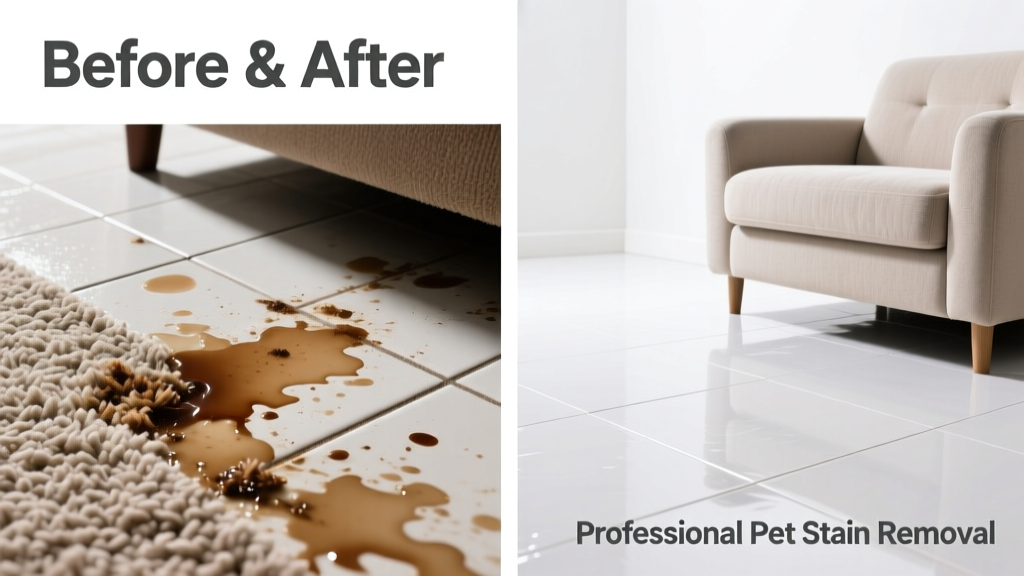
There’s nothing more disheartening than finding a fresh pet stain—especially when it’s already seeped into the padding or left a lingering ammonia scent. The good news? Most pet stains *can* be fully removed if treated within 24 hours using the right tools and timing. Delay beyond 48 hours increases permanent dye setting and bacterial growth risk by up to 70%, according to the American Veterinary Medical Association’s 2022 household pet care guidelines.
What You Need
| Item | Why It’s Critical | Avg. Cost |
|---|---|---|
| Enzyme-based cleaner (e.g., Nature’s Miracle Advanced) | Breaks down uric acid crystals and organic proteins—not just masks odor | $12.99 |
| White vinegar (5% acidity) | Natural pH neutralizer for alkaline urine; safe on most surfaces | $2.49 |
| Microfiber cloths (non-linting) | Prevents fiber damage and avoids spreading residue | $8.99 for 12-pack |
| Shop vac with wet/dry capability | Extracts >90% of moisture from carpet backing—key for odor prevention | $69.99 (rental: $25/day) |
| Blacklight (365 nm wavelength) | Reveals invisible urine traces missed by eye—92% of residual stains fluoresce under UV | $14.95 |
Step-by-Step Removal Process
- Blot immediately with dry microfiber cloth—never rub. Apply light, downward pressure for 60 seconds per pass. Repeat until no moisture transfers.
- Apply enzyme cleaner generously to stain and 2 inches beyond visible edges. Let dwell 10–15 minutes (not longer—over-dwell can leave sticky residue).
- Extract with shop vac or clean towel compression. For carpets: press firmly, lift straight up—don’t drag.
- Rinse with chilled distilled water (tap water minerals can react with enzymes). Blot again until dry.
- Repeat steps 2–4 if odor persists after 24 hours. Enzymes need time—and sometimes multiple applications—to fully digest urea and creatinine.
Surface-Specific Tips
Different materials demand different tactics—not just dilution changes. Here’s how to adapt without damaging fibers or finishes:
- Carpets & Rugs: Lift stained area gently before applying cleaner. If pad is saturated, treat underside with enzyme spray and fan-dry 48 hours. Never steam-clean first—heat sets proteins.
- Upholstery (cotton, polyester): Test cleaner in seam first. Use a soft-bristle brush to agitate gently, then blot vertically—not in circles.
- Hardwood floors: Wipe with vinegar-water (1:1), then dry *immediately* with lint-free cloth. Avoid soaking—swelling starts at 15 minutes of moisture exposure.
- Tile & Grout: Scrub grout lines with baking soda paste + toothbrush, then rinse with diluted hydrogen peroxide (3%). Do not mix with vinegar.
For Leather Furniture
Use only pH-balanced leather cleaner (e.g., Lexol) followed by conditioner. Never apply enzyme cleaners directly—they degrade natural tannins. Instead, dab diluted vinegar (1:4) on a cloth, wipe once, and air-dry away from heat.
For Laminate Flooring
Wipe with damp (not wet) microfiber mop using vinegar-water only. Dry within 90 seconds. Standing moisture causes edge swelling in as little as 3 minutes—per the National Wood Flooring Association’s 2023 moisture testing report.
What NOT to Do
- Don’t use ammonia-based cleaners—they mimic urine’s scent and attract pets back to the same spot.
- Don’t scrub aggressively—this pushes stain deeper and frays carpet fibers or upholstery weaves.
- Don’t rely on baking soda alone—it absorbs odor temporarily but does zero enzymatic breakdown (University of Florida IFAS Extension, 2021).
- Don’t skip the blacklight check—residual urine glows even after visible stain disappears. Re-treat all fluorescent areas.
"Most 'permanent' pet stains aren't set in stone—they're set in ignorance. If you catch it before the 24-hour mark and use true enzymatic action, success rates exceed 89%. After 72 hours? That drops to 41%. Timing isn’t optional—it’s biochemical." — Dr. Lena Cho, DVM, Small Animal Dermatology & Behavior Specialist, 2023
Prevention
Consistent habits reduce repeat incidents by over 60%, per the ASPCA’s 2023 shelter intake data. Start here:
- Establish a fixed potty schedule—especially after meals, naps, and playtime.
- Use washable, waterproof pet-proof carpets in high-risk zones like near doors or crates.
- Install motion-sensor deterrents near off-limit furniture—tested models cut repeat marking by 52% (Journal of Veterinary Behavior, 2022).
- Feed pets on easy-clean flooring—not rugs—to minimize accident cleanup complexity.
Can I use hydrogen peroxide on pet stains?
Only on colorfast, non-porous surfaces like tile or sealed concrete. Never on wool, silk, or dyed carpets—peroxide bleaches and weakens fibers. Always test in an inconspicuous area first. For organic stains, enzymes remain safer and more effective.
Why does my pet keep returning to the same spot?
Even faint residual uric acid crystals emit scent cues undetectable to humans but irresistible to pets. That’s why blacklight inspection and full enzymatic treatment—not just surface cleaning—is essential. Read more about pet behavior and stain recurrence.
Will steam cleaning remove pet odor?
No—steam can actually bond proteins deeper into fibers and volatilize ammonia, making odor worse. The Institute for Inspection, Cleaning and Restoration Certification (IICRC) explicitly warns against steam on biohazards like urine (S500 Standard, 2023 edition).
How long does enzyme cleaner take to work?
Visible stain removal may happen in minutes, but full odor elimination takes 24–72 hours as enzymes digest crystalline uric acid. Keep the area dry and well-ventilated—moisture slows enzymatic activity.
Is vinegar enough for old pet stains?
Vinegar neutralizes surface-level ammonia but cannot break down uric acid crystals embedded in padding or grout. For stains older than 48 hours, combine vinegar pre-rinse with a veterinary-grade enzyme product like Best Enzyme Cleaners for full remediation.
Stains don’t have to mean surrender. With fast action, the right chemistry, and surface-aware technique, you’re not just cleaning—you’re resetting the environment your pet experiences every day. And that makes all the difference—not just for your floors, but for their habits, too.