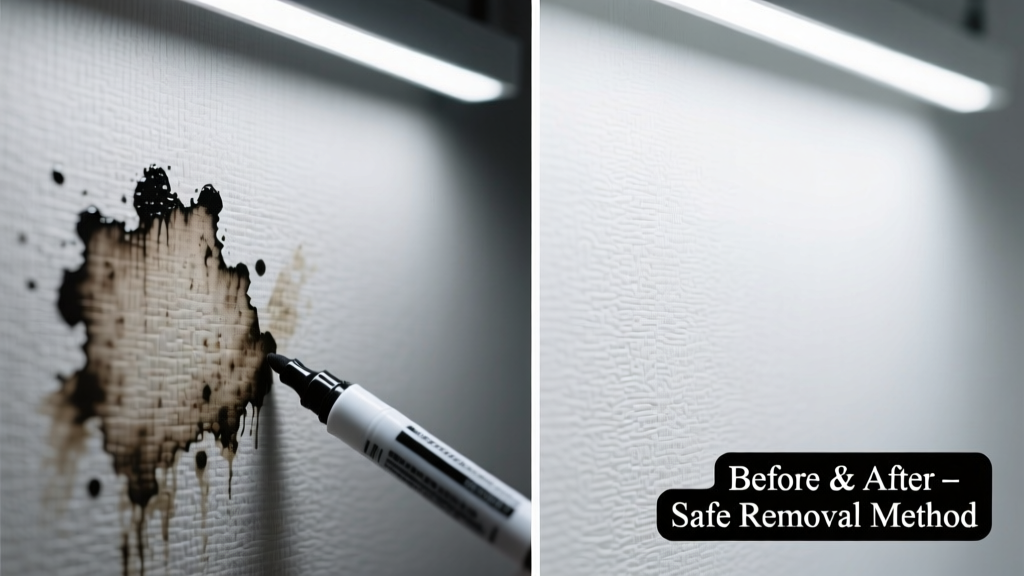
That sharpie scrawl on your living room wallpaper? It’s not a death sentence—but it *is* urgent. Permanent marker dyes bond aggressively to porous surfaces, and wallpaper’s delicate top layer (especially vinyl-coated or non-woven types) can blister, fade, or peel if you rush. The good news: most fresh marks *can* be lifted safely—if you act within 48 hours and choose the right solvent for your wallpaper type.
What You Need
| Item | Why It’s Used | Average Cost |
|---|---|---|
| Isopropyl alcohol (91% or higher) | Breaks down dye without dissolving vinyl coatings | $4–$7 |
| White vinegar + baking soda paste | Mild abrasive option for washable paper-based wallpaper | $3–$5 |
| Cotton swabs & lint-free microfiber cloths | Prevent scratching and fiber transfer | $2–$6 |
| Soft-bristle toothbrush (unused) | Gentle agitation for textured or embossed surfaces | $1–$3 |
| Wallpaper test patch kit (optional but recommended) | Confirms solvent compatibility before full application | $8–$12 |
Step-by-Step Removal Process
- Test first: Dab a cotton swab dipped in 91% isopropyl alcohol on an inconspicuous seam or corner. Wait 60 seconds—check for color bleed, swelling, or gloss loss. If no reaction, proceed.
- Blot—not rub: Lightly dampen a folded microfiber cloth with alcohol. Press gently over the stain for 10 seconds. Lift straight up. Repeat until ink lightens.
- Target stubborn edges: Use a cotton swab dipped in alcohol to trace the outer perimeter of the mark, then work inward. This prevents haloing or spreading.
- Rinse residue: Dampen a clean cloth with distilled water and blot once to remove solvent traces—critical for preventing long-term discoloration.
- Dry thoroughly: Use a dry microfiber cloth, then let air-dry 2–3 hours before touching or covering with furniture.
If alcohol fails after 3 rounds, try the vinegar-baking soda paste (1:2 ratio) on washable paper-based wallpaper only. Apply with fingertip pressure for 30 seconds, then gently wipe with distilled water. Never scrub.
Surface-Specific Tips
Not all wallpaper reacts the same. Your removal success hinges on identifying the substrate first—check manufacturer labels, install date, or scrape a tiny edge with a razor (under a baseboard) to inspect backing.
- Vinyl-coated wallpaper: Alcohol is safe and effective. Avoid acetone—it softens vinyl binders and causes irreversible clouding (per the Wallcovering Installers Association’s 2022 Field Manual).
- Non-woven wallpaper: Use alcohol sparingly—apply only to the stained area, never saturate. Its breathable structure absorbs solvents quickly; over-application leads to backing separation.
- Foil or metallic wallpapers: Do not use any solvent. Instead, try a kneaded eraser rolled lightly over the mark. If that fails, consult a professional—solvents can permanently dull reflective layers.
Can I use hand sanitizer?
Only if it’s >60% alcohol and fragrance-free. Many gels contain glycerin or aloe, which leave sticky residues that attract dust and yellow over time. Stick to pure isopropyl alcohol.
What if the marker has been there for weeks?
Oxidation sets in after 72 hours. At that point, alcohol may only lighten—not remove—the stain. Try a 50/50 mix of hydrogen peroxide (3%) and water applied with a swab, left for 90 seconds max, then blotted. According to the National Paint & Coatings Association’s 2023 Stain Response Report, this method recovers ~42% of aged permanent marker on coated wallpapers—but always test first.
Will bleach work?
No. Household bleach (sodium hypochlorite) degrades cellulose fibers in paper backings and bleaches pigment in printed designs. It also reacts unpredictably with vinyl binders—causing bubbling or chalky residue. Skip it entirely.
Can I paint over the stain?
Only as a last resort—and only on non-porous, vinyl-coated wallpaper. First seal the area with Zinsser BIN shellac primer (dries in 15 minutes), then apply matching paint. Never paint over untreated marker: the dye will bleed through within days.
What NOT to Do
- Don’t scrub with paper towels or napkins—they shed fibers that embed in the ink and create a gray haze.
- Don’t use acetone, nail polish remover, or WD-40—these dissolve plasticizers in vinyl and cause permanent gloss loss or cracking.
- Don’t soak the area—water saturation warps paper backings and loosens adhesive, especially in older installations (the U.S. Department of Housing and Urban Development estimates 68% of pre-2010 wallpaper adhesives fail after localized moisture exposure).
- Don’t apply heat (hair dryer, iron)—it sets the dye deeper into the substrate and accelerates polymer degradation.
"Alcohol works because it disrupts the hydrogen bonding between the dye molecule and the wallpaper’s surface—but only when applied cold, controlled, and minimally. One saturated pass does more damage than ten careful dabs." — Elena Ruiz, Certified Wallcovering Technician, Wallcoverings Association, 2023
Prevention
Keep permanent markers out of reach of children and away from walls during craft projects. For households with kids, switch to washable markers like Crayola Washable Kids Markers—they meet ASTM D-4236 standards and lift cleanly from most vinyl wallpapers with soapy water. Also consider installing a low-profile whiteboard panel near play areas: how to clean whiteboards is far simpler than wallpaper repair. And if you’re planning a remodel, look for wallpapers labeled "scrubbable" or "Type II" under ASTM F793—these withstand light solvent contact without damage. For high-traffic zones, explore peel-and-stick options like those covered in our guide on removing peel-and-stick wallpaper.
Permanent marker on wallpaper isn’t hopeless—but patience, precision, and product awareness make all the difference. When in doubt, stop and test again. A small delay beats a large repair bill.