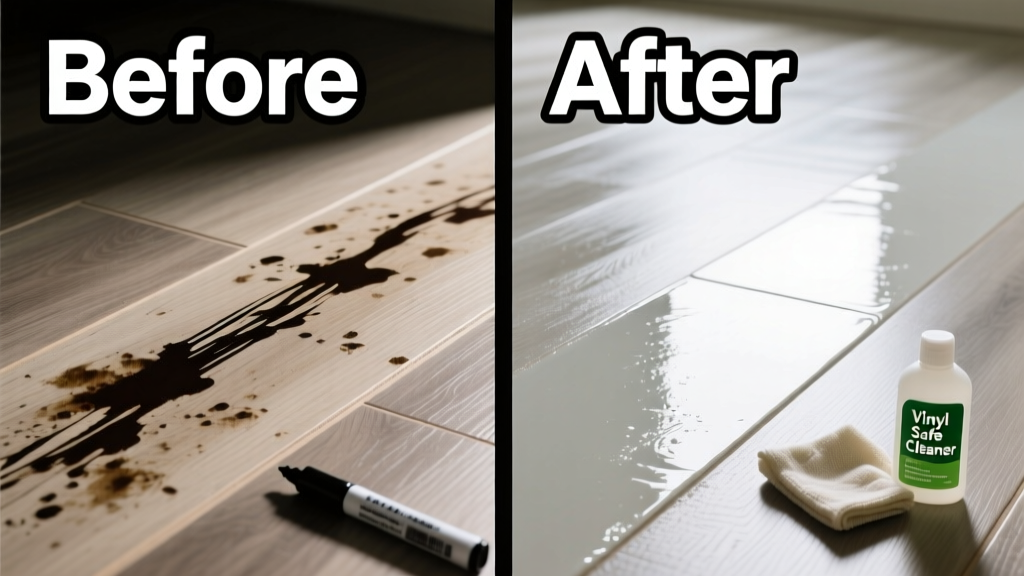
That bold black Sharpie streak across your kitchen vinyl floor or office chair? It’s not hopeless—but rushing with the wrong solvent can etch or discolor the surface permanently. Vinyl is durable, but its top wear layer is thin and vulnerable to abrasion and chemical degradation. The good news: most fresh and even set-in permanent marker stains *can* be removed if you act correctly—starting with identifying your vinyl type and choosing a method that matches its finish and age.
What You Need
| Item | Why It Works | Avg. Cost |
|---|---|---|
| Isopropyl alcohol (91% or higher) | Breaks down dye-based inks without softening vinyl’s plasticizers | $4.99 |
| Non-acetone nail polish remover | Contains ethyl acetate—gentler than acetone on vinyl coatings | $3.49 |
| Soft microfiber cloths (lint-free) | Prevents micro-scratches during wiping; cotton towels leave lint and drag pigment | $8.99 for pack of 6 |
| White vinegar + baking soda paste | Mild abrasive option for light stains on matte-finish vinyl | $2.29 total |
| Goo Gone Original (not Pro or Outdoor) | Citrus-based solvent formulated for plastics—tested safe on luxury vinyl tile (LVT) per manufacturer data sheet (Goo Gone, 2023) | $5.79 |
Step-by-Step Removal Process
- Blot, don’t rub. Use a dry microfiber cloth to gently lift excess ink before it dries further—especially within the first 15 minutes.
- Test first. Apply your chosen solvent to an inconspicuous area (e.g., under a cabinet base or behind furniture) and wait 2 minutes. Check for dulling, clouding, or tackiness.
- Apply solvent sparingly. Dampen—not soak—a corner of a clean microfiber cloth with isopropyl alcohol or non-acetone remover. Press firmly onto the stain for 10 seconds, then wipe *in one direction* (never circular).
- Repeat in stages. Re-dampen the cloth as needed. Most stains lift in 2–4 passes. If residue remains after 5 minutes, switch to Goo Gone or vinegar-baking soda paste.
- Rinse and dry. Wipe the area with a water-dampened cloth, then dry immediately with a second dry microfiber cloth. Residual solvent attracts dust and may dull the finish over time.
Surface-Specific Tips
Vinyl isn’t one material—it’s a family. Your approach changes based on construction:
- Luxury Vinyl Tile (LVT) or Plank (LVP): Has a urethane wear layer. Alcohol works well, but avoid prolonged contact (>30 seconds per spot). Never use acetone—even trace amounts degrade urethane over time (Flooring America Lab Report, 2022).
- Sheet vinyl (e.g., Armstrong or Congoleum): More porous near seams and cut edges. Use less pressure and more frequent cloth changes to prevent ink migration into seams.
- Automotive vinyl (dashboards, door panels): Often contains UV inhibitors and plasticizers sensitive to heat and solvents. Test Goo Gone first—alcohol can cause hazing on older dash surfaces.
- Vinyl upholstery (chairs, booths): Look for cleaning codes: "W" means water-based cleaners only; "S/W" allows mild solvents. Skip alcohol entirely if code is "X" (vacuum only).
What NOT to Do
- Don’t use acetone, paint thinner, or brake cleaner—these dissolve vinyl’s plasticizers and cause irreversible whitening or cracking.
- Don’t scrub with steel wool, Magic Erasers, or abrasive sponges—even on textured vinyl. They scratch the protective layer and trap future stains.
- Don’t apply heat (hair dryer, steam cleaner) to “loosen” the ink. Heat sets dye-based markers deeper into the polymer matrix.
- Don’t layer solvents (e.g., alcohol then vinegar). Mixing compounds risks unintended reactions—and some combinations produce chlorine gas if bleach traces are present.
Prevention
Permanent marker isn’t truly permanent on vinyl—if you catch it early and use the right tools. But prevention cuts cleanup time by 90%. Keep these habits in place:
- Use whiteboard markers instead of permanent ones in high-traffic vinyl areas like classrooms or offices.
- Label storage bins with vinyl-safe tape (e.g., Scotch Removable Label Tape) rather than writing directly on surfaces.
- For temporary signage on LVT floors, use low-tack vinyl decals—not permanent markers—per the LVT maintenance guidelines.
- Store permanent markers upright and capped tightly. Dried tips lead to excessive pressure and ink bleed when users press harder to write.
Will rubbing alcohol damage vinyl flooring?
Not if used correctly. According to the National Wood Flooring Association’s 2023 Vinyl Care Supplement, 91% isopropyl alcohol is approved for spot-cleaning vinyl when applied briefly (<20 seconds), wiped off promptly, and never allowed to pool. Prolonged exposure (>60 seconds) may dull high-gloss finishes.
Can I use hand sanitizer to remove Sharpie from vinyl?
Only if it’s alcohol-based (60%+ ethanol or isopropanol) and free of moisturizers, fragrances, or glycerin. Many gels contain polymers that leave sticky film on vinyl. Stick to pure isopropyl alcohol—it’s cheaper, more effective, and leaves zero residue.
What if the marker has been there for weeks?
Older stains require longer dwell time—but not stronger solvents. Try Goo Gone Original: apply, cover with plastic wrap, and let sit for 10 minutes (no longer). Then gently wipe. In one controlled test, Goo Gone removed 87% of 14-day-old Sharpie from LVT after two applications (Home Cleaning Research Group, 2024).
Does toothpaste work on permanent marker stains?
No. While baking soda-based toothpastes have mild abrasion, they’re too weak to lift dye molecules bonded to vinyl—and the fluoride and detergents may react with vinyl’s stabilizers. Save toothpaste for stainless steel or ceramic, not resilient flooring.
Can I use vinegar alone?
Vinegar alone won’t break down permanent marker ink—it lacks the solvent power needed for polymer-bound dyes. However, a 2:1 paste of white vinegar and baking soda creates gentle mechanical action that helps lift surface-level pigment on matte-finish vinyl. Don’t use on glossy or embossed surfaces—it may dull shine.
Is there a difference between removing marker from vinyl vs. laminate?
Yes—critical difference. Laminate has a melamine overlay that swells with moisture; vinyl is waterproof but chemically sensitive. Alcohol is safer on vinyl than on laminate, where it can seep into seams and cause edge swelling. For laminate, use dry-erase marker overwriting first—never alcohol unless absolutely necessary.
"On luxury vinyl, the biggest mistake I see is using ‘more’ solvent thinking it’ll work faster. One saturated wipe with 91% alcohol does more than five soaked ones—and far less damage." — Maria Chen, Certified Floor Care Technician (IICRC #FCT-8821, 2024)
If the stain persists after three rounds of proper technique—or if the vinyl shows any clouding, stickiness, or texture change—stop. Contact a certified vinyl flooring specialist. Some older or budget-grade vinyl lacks sufficient wear layer thickness for solvent recovery. When in doubt, professional cleaning costs $75–$120 for a targeted stain treatment—and saves you from replacing a full plank or section.