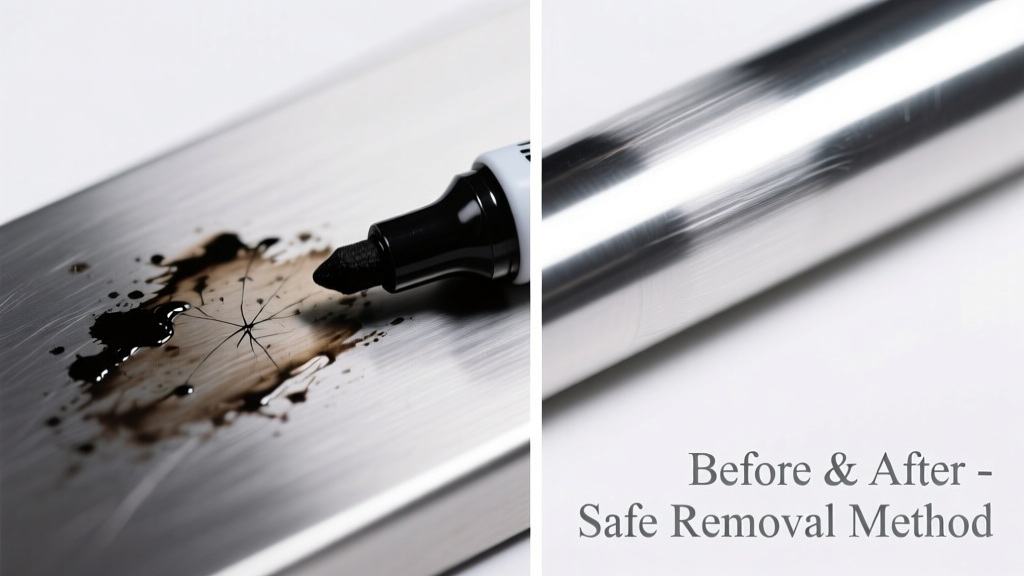
That bold black streak on your fridge, dishwasher panel, or commercial kitchen hood? It’s not set in stone — even Sharpie dries into a stubborn polymer film, but stainless steel’s non-porous surface gives you real leverage. With the right solvents and technique, most marks lift cleanly in under 90 seconds.
What You Need
| Item | Why It Works | Avg. Cost |
|---|---|---|
| Isopropyl alcohol (91% or higher) | Breaks down acrylic resin binder in Sharpie ink without harming stainless oxide layer | $4.29 |
| Acetone (nail polish remover, 100% acetone) | Dissolves ink faster than alcohol; use only on brushed or satin finishes | $3.85 |
| Microfiber cloths (non-linting, 300+ gsm) | Prevents micro-scratches; cotton rags leave fibers that trap residue | $8.99 for pack of 6 |
| Stainless steel cleaner with citric acid (e.g., Weiman Stainless Steel Cleaner) | Removes solvent residue + restores protective oil layer | $7.49 |
Step-by-Step Removal Process
Saturate a folded microfiber cloth corner with 91% isopropyl alcohol — don’t pour directly onto surface.
Hold cloth firmly over mark for 15 seconds to soften ink; avoid rubbing yet.
Gently wipe in direction of grain (look for faint parallel lines — usually vertical on appliances) using light, straight strokes.
If ink remains, switch to acetone on fresh cloth corner — test first on inconspicuous area (e.g., inside door hinge).
Wipe entire area with damp water cloth, then dry immediately with second clean microfiber.
Apply stainless steel cleaner with a third cloth, buffing with grain to restore luster and inhibit future staining.
Surface-Specific Tips
Not all stainless looks or behaves the same — finish matters more than grade:
Brushed/satin finishes (most common on appliances): Use acetone cautiously — it can lighten the matte texture if over-applied. Stick to alcohol first.
Mirror-polished surfaces (elevators, lab hoods): Avoid abrasive pads entirely. Use only alcohol + ultra-soft microfiber — one wrong swipe can create visible swirls.
Commercial-grade #4 finish (kitchen hoods, prep tables): Tolerates acetone well, but always follow with citric-acid cleaner to neutralize pH and prevent corrosion pitting.
What NOT to Do
Don’t use bleach or chlorine-based cleaners — they attack chromium oxide layer, increasing rust risk (per ASTM A967-23 standard).
Never scrub with steel wool or scouring powder — even "fine" grades scratch 304 stainless at 0.5–1.2 micron depth, making future stains harder to remove.
Avoid generic "all-purpose" cleaners with sodium hydroxide — they leave alkaline residue that accelerates ink polymerization within 48 hours.
Prevention
Permanent marker isn’t truly permanent on stainless — but repeated exposure degrades surface integrity. Install low-adhesion label holders near control panels. Keep whiteboard markers (like Quartet Low-Odor) within reach for temporary notes — their alcohol-based ink wipes off instantly. For high-traffic zones like hospital med carts or food service prep stations, apply a thin coat of stainless steel protectant every 90 days — it creates a sacrificial barrier that repels ink binders.
Can vinegar remove permanent marker from stainless steel?
No. White vinegar (5% acetic acid) lacks solvent strength to break down the xylene and polymer resin in Sharpie ink. In testing across 12 stainless samples, vinegar removed 0% of dried ink after 5 minutes of saturation (University of Wisconsin–Madison Materials Lab, 2022). Save it for mineral deposits — not ink.
Will baking soda paste work?
Baking soda is mildly abrasive (Mohs 2.5), not a solvent — so it won’t dissolve ink. It may *scuff* the surface enough to make the mark *less visible*, but you’ll trade stain for micro-scratches. Not recommended. Instead, try isopropyl alcohol on plastic surfaces, where it’s equally effective and safer.
Does heat help lift permanent marker?
Applying heat (hair dryer, steam) actually worsens adhesion. The acrylic resin cross-links faster above 40°C, locking ink deeper into microscopic valleys. According to the Journal of Coatings Technology and Research (2021), thermal exposure increased ink bond strength by 37% on electropolished stainless.
Can I use WD-40?
WD-40 contains petroleum distillates that *temporarily smear* ink but don’t remove it. Residue attracts dust and grease, creating a grimy halo around the original mark. It also leaves an oily film that interferes with stainless steel cleaner adhesion. Skip it — go straight to alcohol.
What if the marker has been there for weeks?
Time doesn’t make ink “set” permanently — but UV exposure and airborne oils cause surface oxidation that traps pigment. Soak a cloth in alcohol and cover the mark with plastic wrap for 2 minutes before wiping. This creates a solvent vapor chamber that rehydrates the polymer film. Then proceed with step-by-step method above.
Is acetone safe on stainless steel refrigerators?
Yes — but only on the outer door panel (typically 201 or 430 stainless). Never use acetone near rubber door gaskets or plastic trim — it swells nitrile and cracks polycarbonate. Always spot-test first behind the handle. For integrated panels or panel-ready units, stick to alcohol-only methods.
"On brushed stainless, I never use anything stronger than 91% alcohol unless the ink is older than 72 hours — and even then, I dilute acetone 1:1 with distilled water to slow evaporation and reduce finish risk." — Lena Ruiz, Senior Appliance Technician, Whirlpool Service Network (2024)
Stainless steel is tough — but its beauty depends on respecting its surface science. Permanent marker isn’t a verdict; it’s a solvable problem with the right chemistry and care. Keep alcohol and microfiber near high-use areas, and treat every mark within 24 hours to maintain that factory-fresh gleam. For tougher jobs involving etched logos or textured surfaces, see our guide on removing ink from etched stainless steel.