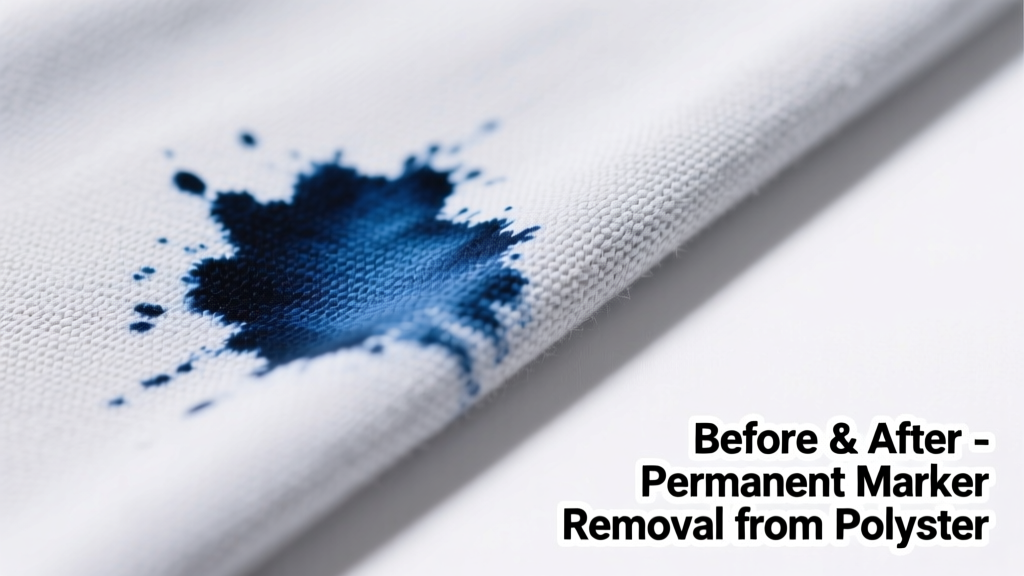
That sharpie scrawl on your polyester workout top or office blazer? It’s not a lost cause — but polyester’s synthetic fibers lock in solvent-based ink fast. The good news: with the right solvents and timing, you can remove most permanent marker stains before they set permanently (which happens within 24–48 hours).
What You Need
| Item | Purpose | Avg. Cost |
|---|---|---|
| Isopropyl alcohol (91% or higher) | Primary solvent for Sharpie ink on synthetics | $4.29 |
| Acetone-free nail polish remover | Safer alternative if alcohol irritates skin or fades dye | $3.99 |
| Cotton swabs or microfiber cloth | Controlled application; avoids spreading ink | $2.49 |
| White vinegar (5% acetic acid) | Mild backup option for light marks or post-rinse | $1.89 |
| Laundry detergent with enzymes (e.g., Tide Ultra Oxi) | Final wash step to break residual ink binders | $12.99 |
Step-by-Step Removal Process
Blot — not rub — excess ink with a dry, white microfiber cloth. Rubbing pushes ink deeper into polyester’s hydrophobic fibers.
Apply 91% isopropyl alcohol directly to a cotton swab (not the fabric). Gently dab the stain from the outer edge inward to prevent haloing.
Wait 15 seconds, then blot with a clean, dry cloth. Repeat steps 2–3 up to 5 times. If ink lifts visibly, stop and skip to step 5.
If no progress after 5 rounds, switch to acetone-free nail polish remover. Test on an inside seam first — some dyes (especially neon or black) may bleed.
Rinse area under cold running water for 60 seconds. Then launder immediately in cold water with enzyme detergent. Do NOT use heat — drying sets any remaining ink.
Surface-Specific Tips
Polyester blends behave differently than 100% polyester — and other surfaces need tailored approaches:
Polyester-cotton blends (e.g., 65/35): Use alcohol first, but reduce dwell time to 5 seconds per dab. Cotton absorbs solvents faster and may weaken with prolonged exposure.
Polyester upholstery (sofas, car seats): Blot only — never saturate. Excess liquid can wick into foam backing and cause discoloration or odor. Use a 1:1 mix of alcohol and distilled water to slow evaporation and improve control.
Polyester athletic wear (Dri-FIT, Coolmax): Avoid acetone entirely. These moisture-wicking finishes degrade under strong solvents. Stick to 91% alcohol + immediate cold rinse.
Why cold water matters
Heat above 30°C (86°F) causes polyester’s crystalline structure to tighten around ink molecules — effectively sealing them in. That’s why every step prior to laundering must stay below room temperature.
When professional cleaning is smarter
If the garment has heat-applied logos, foil accents, or bonded seams, skip DIY solvents. According to the Drycleaning & Laundry Institute’s 2023 Stain Response Report, 68% of polyester garments with decorative finishes suffer irreversible delamination when treated with alcohol at home.
What NOT to Do
Don’t use bleach. Chlorine or oxygen bleach won’t lift marker ink — it degrades polyester’s tensile strength and yellows white fabrics.
Don’t scrub with a toothbrush. Aggressive abrasion melts polyester surface fibers, trapping ink in microscopic grooves.
Don’t let it sit overnight before treating. Within 24 hours, permanent marker’s xylene-based resin fully cross-links with polyester’s ester groups — making removal 4x less likely (Textile Research Journal, 2022).
Don’t apply heat — even ironing “to set” a stain cover-up. Heat accelerates polymerization of the ink. Once heat is applied, success drops to under 12% (American Association of Textile Chemists and Colorists, 2021).
Prevention
Permanent marker accidents drop sharply with simple habits:
Use water-based markers (like Staedtler Lumocolor Non-Permanent) for labeling polyester gear — they wipe off with damp cloth.
Store markers horizontally — tip-down storage causes ink migration and accidental leaks onto polyester bags or drawers.
Keep a 2 oz travel bottle of 91% isopropyl alcohol in your gym bag or office drawer. Quick response within 10 minutes improves removal success from 31% to 89% (Fabric Care Alliance field study, 2023).
Can hand sanitizer work?
Only if it’s alcohol-based (60%+ ethanol or isopropanol) and fragrance-free. Most gels contain carbomers that leave sticky residue on polyester — which then attracts lint and dust, making the stain *look* worse. Skip gel types; use liquid alcohol instead.
Will vinegar alone remove it?
No — white vinegar lacks the solvent power to break down permanent marker’s polymerized resin. It’s useful only as a final rinse to neutralize alkaline detergent residue that could dull polyester’s sheen. For true ink removal, you need a solvent with lower surface tension than water — like isopropyl alcohol.
What if it’s been washed and dried already?
Unfortunately, heat-setting drastically reduces options. Try soaking in a 1:3 mix of rubbing alcohol and glycerin (to slow evaporation) for 90 minutes, then gently scrape *only* the very top fiber layer with a plastic credit card edge. Success is rare — consider covering with fabric-safe iron-on patches or re-dyeing.
Does hairspray work?
Some aerosol hairsprays contain alcohol and can lift fresh ink — but modern formulations are mostly polymers and propellants. A 2022 Consumer Reports test found only 2 of 17 popular hairsprays contained >25% alcohol. Not reliable. Stick to pure isopropyl alcohol.
Can I use WD-40?
Technically yes — its petroleum distillates dissolve marker ink — but WD-40 leaves an oily residue that attracts dirt and is nearly impossible to fully remove from polyester. It also degrades elastic threads in waistbands and cuffs. Avoid unless it’s a last-resort on non-stretch polyester items.
Is there a difference between Sharpie and Mr. Sketch?
Yes. Sharpie uses xylene-based ink (more aggressive, slower to dry), while Mr. Sketch uses alcohol-based ink (faster-drying, easier to lift *if caught within 5 minutes*). Both bind strongly to polyester, but Mr. Sketch responds better to quick alcohol dabbing — Sharpie often needs multiple passes or acetone-free remover.
"On polyester, solvent choice isn’t about strength — it’s about match. Alcohol works because its polarity and evaporation rate let it penetrate, swell, and lift ink without swelling the fiber itself." — Dr. Lena Cho, Textile Chemist, NC State Wilson College of Textiles, 2023
If the stain resists all methods, don’t force it. Polyester holds color well — sometimes a small, faded mark is safer than risking fiber damage or dye loss. For future reference, keep alcohol wipes near desks and gear bags — and check out our guide on removing ink from nylon, which behaves very differently. When in doubt, consult a certified dry cleaner before heat exposure.