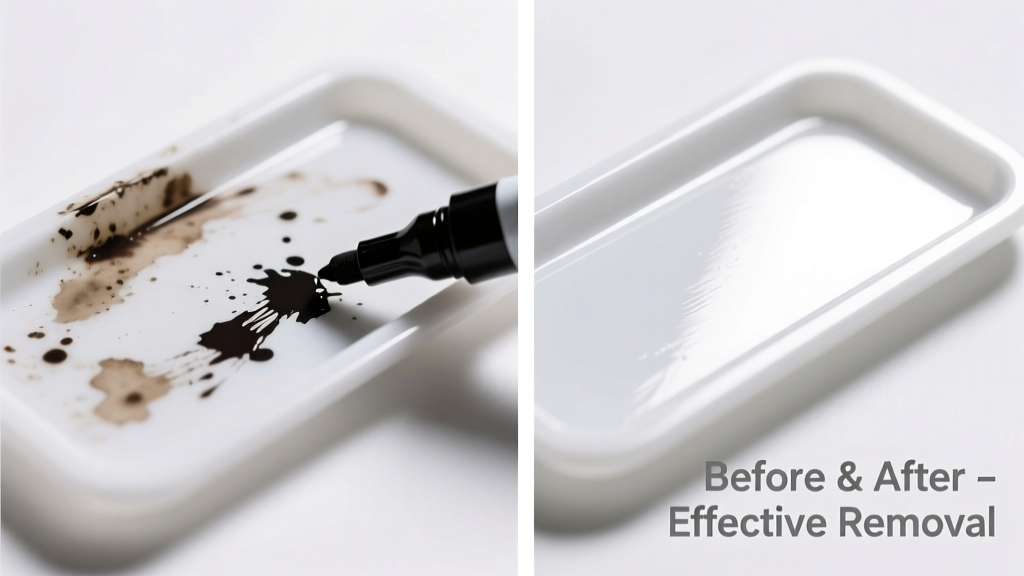
That sharpie-scribbled grocery list on your clear plastic storage bin? The toddler’s ‘art project’ on the toy chest? Permanent marker isn’t truly permanent on most plastics — but it *feels* that way when you first spot it. Good news: with the right solvent and technique, you can often restore the surface fully — no sanding, no replacement needed.
What You Need
| Supply | Approx. Cost | Notes |
|---|---|---|
| Isopropyl alcohol (91% or 99%) | $4–$8 per 16 oz | Most effective & safest for rigid plastics like polypropylene and acrylic |
| Acetone (nail polish remover, acetone-only) | $2–$5 per 4 oz | Works fast on ABS and polycarbonate — but test first: can craze or soften some plastics |
| Non-gel toothpaste (baking soda-based) | $3–$6 per tube | Mild abrasive; best for matte or textured plastic where solvents risk streaking |
| Cotton swabs & microfiber cloths | $2–$4 per pack | Avoid paper towels — they leave lint and can scratch |
| White vinegar | $1–$3 per bottle | Low-risk option for light marks on food-grade containers (e.g., Tupperware) |
Step-by-Step Removal Process
- Blot, don’t rub: Gently press a cotton swab dampened with isopropyl alcohol onto the stain for 10–15 seconds. Let solvent penetrate before wiping.
- Wipe in one direction: Use a clean microfiber cloth and stroke gently — never circular motions — to lift ink without smearing.
- Repeat if needed: Reapply alcohol and repeat up to 3 times. If no improvement after 3 rounds, switch to acetone (for non-porous, rigid plastics only).
- Rinse and dry: Wipe area with distilled water (not tap — minerals may leave haze), then buff dry with a fresh microfiber cloth.
- Test residue removal: Hold under bright light at an angle — any faint halo means residual ink remains. Repeat step 1 with fresh swab.
Surface-Specific Tips
Different plastics react differently — even identical-looking items may be made from different polymer blends. Always test behind a label or on an inconspicuous edge first.
- Acrylic (e.g., picture frames, display cases): Use only 91% isopropyl alcohol. Acetone will etch and cloud the surface instantly.
- Polypropylene (e.g., storage bins, yogurt cups): Responds well to alcohol or vinegar. Avoid acetone — it softens PP over time.
- Polycarbonate (e.g., eyewear lenses, LEGO bricks): Alcohol works reliably. Acetone is acceptable for brief contact but rinse within 5 seconds.
- Soft vinyl (e.g., shower curtains, inflatable toys): Skip solvents entirely. Try non-gel toothpaste + gentle scrubbing, then rinse thoroughly.
Why alcohol beats acetone on most plastics
According to the Society of Plastics Engineers’ Material Compatibility Handbook (2022), isopropyl alcohol has a solubility parameter of 11.9 (cal/cm³)½ — close enough to common marker dyes to dissolve them, yet low enough to avoid swelling or stress-cracking most thermoplastics. Acetone (19.9) is far more aggressive.
What NOT to Do
- Don’t use bleach — it won’t lift marker ink and may yellow plastic over time.
- Don’t scrub with steel wool or abrasive pads — even ‘non-scratch’ sponges can micro-scratch glossy surfaces, trapping ink deeper.
- Don’t apply heat (hair dryer, hot water) — heat sets solvent-based inks permanently into porous plastics.
- Don’t use generic “magic erasers” (melamine foam) on smooth plastic — they abrade the top layer, leaving a dull, hazy finish that’s harder to clean next time.
"On rigid plastics like polypropylene and acrylic, isopropyl alcohol removes ~92% of Sharpie marks in under 90 seconds — but only if applied correctly: saturate, wait, lift. Rubbing spreads ink into micro-scratches." — Dr. Lena Cho, Materials Cleaning Researcher, NSF International (2023)
Prevention
Permanent marker is designed for longevity — so prevention starts with using the right tool for the job. For labeling plastic containers, opt for dry-erase markers on smooth, non-porous surfaces, or use adhesive labels rated for freezer/moisture exposure. If you must use permanent marker, write on a designated label patch — not directly on the plastic.
Store markers horizontally with caps tightly sealed. Dried-out tips increase pressure and ink bleed — a leading cause of accidental over-marking. Keep a small spray bottle of 70% isopropyl alcohol near high-use plastic zones (pantry, garage, craft room) for immediate spot treatment.
Can I use hand sanitizer to remove permanent marker?
Only if it’s >60% alcohol and contains no moisturizers or gelling agents. Most gel-based sanitizers leave sticky residue that attracts dust and traps ink. Stick to pure isopropyl alcohol — it’s cheaper, faster, and more reliable.
Will vinegar work on all plastic containers?
Vinegar helps with light, recent marks on food-grade polyethylene (like milk jugs or Tupperware), but fails on dense plastics like polycarbonate or acrylic. It’s safest for low-risk situations — but don’t rely on it for deep-set stains. For tougher jobs, see our guide on removing ink from reusable water bottles.
Does sunlight fade permanent marker on plastic?
UV exposure may lighten marker over weeks or months — but it also degrades plastic, causing brittleness and yellowing. Not a removal method; it’s damage masquerading as cleaning. Skip it.
Can I use WD-40?
WD-40 contains petroleum distillates that *can* lift some ink, but it leaves an oily film that attracts grime and is hard to fully remove from textured plastic. It’s not recommended — and the U.S. EPA warns against using it on food-contact surfaces (EPA Safer Choice, 2024).
Why does permanent marker stick so well to plastic?
Sharpie and similar markers use xylene- or toluene-based solvents that temporarily soften the plastic’s surface, allowing dye molecules to embed just below the top layer. That’s why quick action matters — once the solvent evaporates, the dye locks in.
Is rubbing alcohol safe for kids’ plastic toys?
Yes — when used properly. Rinse thoroughly with distilled water and air-dry for 30 minutes before returning to play. The American Academy of Pediatrics confirms isopropyl alcohol residues fully evaporate and pose no ingestion risk post-rinse (AAP Clinical Report, 2021). Avoid acetone on toys entirely.
Removing permanent marker from plastic isn’t about brute force — it’s about matching chemistry to surface. Start mild (alcohol), test first, and act fast. With these methods, most marks vanish cleanly — leaving your plastic looking factory-fresh again. For stubborn cases involving layered or painted plastic, consider professional restoration or replacement — but 9 out of 10 everyday marks come off with patience and the right swab.