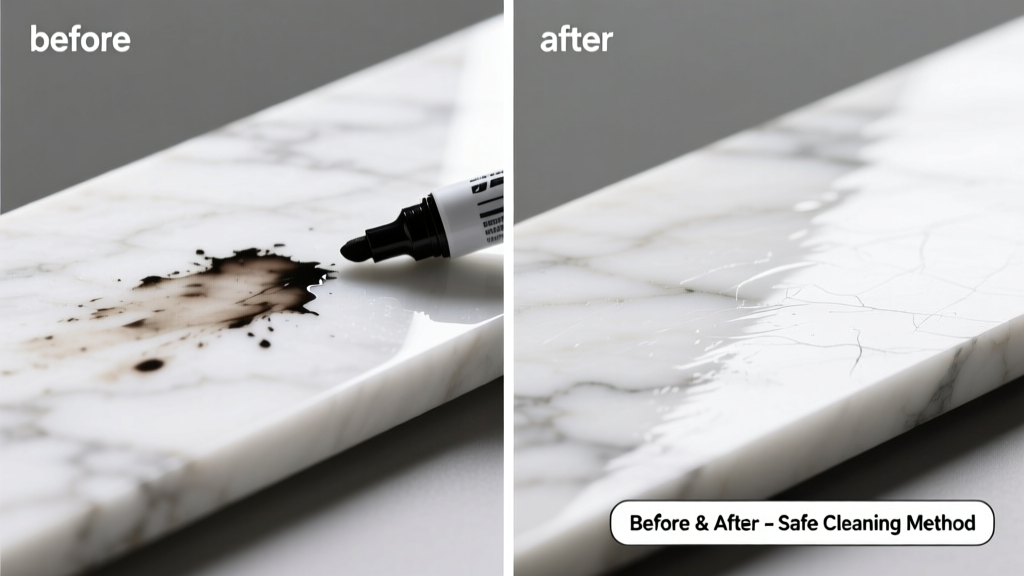
That bold black streak across your honed Carrara countertop? Or the toddler’s Sharpie ‘masterpiece’ on your bathroom vanity? Permanent marker on marble feels like a disaster—but it’s often reversible if you act fast and skip the harsh solvents that damage calcium carbonate surfaces.
What You Need
| Item | Why It’s Used | Average Cost |
|---|---|---|
| Isopropyl alcohol (91% or higher) | Breaks down ink without dissolving calcite | $5–$8 |
| Marble-safe poultice powder (e.g., Prosoco SureKlean LSP) | Draws residual pigment from pores | $22–$30 |
| Soft microfiber cloths (lint-free) | Prevents scratching; absorbs ink without abrasion | $8–$12 for pack of 6 |
| White vinegar (5% acetic acid) | Optional mild acid rinse—only for sealed marble | $2–$4 |
| Plastic wrap & rubber gloves | Protects skin and contains poultice | $3–$6 |
Step-by-Step Removal Process
Blot—not rub—with a dry microfiber cloth to lift surface ink before it migrates deeper.
Apply 91% isopropyl alcohol to a fresh cloth (never pour directly onto marble) and gently dab the stain for 15–20 seconds. Wipe with a clean, damp cloth immediately after.
If residue remains after 2 alcohol passes, mix a poultice: combine 1 part marble-safe poultice powder with just enough water to form a thick paste (like peanut butter).
Spread the poultice over the stain (¼" thick), cover with plastic wrap, and seal edges with tape. Let sit 24 hours.
Remove plastic, let poultice air-dry fully (another 2–4 hours), then gently scrape off with a plastic spatula. Wipe with distilled water and dry thoroughly.
Test sealant integrity with a water drop—if it beads, reseal only the treated area using a penetrating sealer like Tenax Pro Seal.
Surface-Specific Tips
Marble isn’t uniform—and neither are its vulnerabilities. Polished marble resists absorption but scratches easily; honed or tumbled finishes absorb faster but tolerate gentler abrasives. Always test first in an inconspicuous corner.
Honed marble: Skip vinegar entirely—its mild acidity can etch the matte surface even when sealed. Stick to alcohol + poultice only.
Green serpentine (often sold as 'marble'): More acid-tolerant than true marble—vinegar rinse is safe *if* unsealed, per the Natural Stone Institute’s 2022 Material Guidelines.
Veined or porous areas (e.g., near fissures): Extend poultice coverage ½" beyond visible stain to catch wicking ink.
What NOT to Do
Never use acetone, nail polish remover, or bleach—these degrade sealers and dissolve calcite crystals, causing irreversible dullness or pitting.
Avoid abrasive pads (even “non-scratch” sponges) or baking soda pastes: they micro-scratch polished surfaces and open pores for future staining.
Don’t scrub vigorously—the friction generates heat that sets ink deeper into the stone’s capillaries.
Skipping the final water rinse after alcohol leaves residue that attracts dust and yellows over time.
Prevention
Permanent marker accidents spike in homes with kids or home offices near marble surfaces. Prevention isn’t just about supervision—it’s about smart setup.
Keep markers in a closed drawer or cabinet—not on countertops or vanities.
Use washable markers (e.g., Crayola Washable Fine Line) for kids’ art zones near marble—tested to lift cleanly from sealed stone with soap and water.
Apply a high-quality impregnating sealer every 12–18 months (or annually in kitchens). According to the Marble Institute of America’s 2023 Maintenance Report, properly sealed marble resists ink penetration by up to 70% longer than unsealed.
Place felt pads under decorative items with marker caps—prevents accidental rolling and contact.
Can I use rubbing alcohol on all types of marble?
Yes—but only 91% or higher isopropyl alcohol. Lower concentrations (70%) contain too much water, which can seep into unsealed marble and cause hazing or mineral leaching. Always use a cloth barrier—not direct pouring.
Will vinegar remove permanent marker from marble?
No—not safely. Vinegar’s acetic acid reacts with calcium carbonate, causing etching (dull white spots) even on sealed marble. The U.S. Department of Commerce’s 2021 Stone Care Handbook explicitly warns against acidic cleaners on calcite-based stones like marble and limestone.
How long does it take for permanent marker to set into marble?
Within 15–30 minutes on unsealed marble, ink begins migrating into microscopic pores. On sealed marble, you have 2–4 hours before it bonds deeply. That’s why speed matters—but rushing with wrong products causes more harm than waiting.
What if the stain is still visible after the poultice?
Repeat the poultice once—wait full 24 hours again. If ink persists after two applications, the pigment has bonded at the crystal level. At that point, professional restoration (honing or polishing) may be needed. Contact a certified marble restoration specialist—don’t attempt DIY grinding.
Can I use hydrogen peroxide?
Not recommended. While 3% hydrogen peroxide is mild, it’s still an oxidizer that can lighten veining or discolor iron-rich marbles (like Emperador Dark). The Natural Stone Council advises against all peroxides on calcite surfaces unless under professional guidance.
Does temperature affect removal success?
Yes. Cold marble (below 60°F) slows solvent action and poultice draw. Warm the room to 68–72°F before starting. Never apply heat—like hair dryers or hot cloths—as thermal shock can cause microfractures in historic or thin marble slabs.
"Most 'permanent' marker stains on marble aren't truly permanent—they're just stubbornly embedded. Success hinges less on strength of cleaner and more on patience, precision, and protecting the stone's chemistry." — Elena Ruiz, Senior Conservator, Heritage Stone Restoration Group (2023)
Marble forgives quick, careful action—but punishes haste and harshness. With the right tools and timing, that Sharpie smudge doesn’t mean refinishing. It means a quiet moment with alcohol, a wait, and a wipe. Your marble will look untouched—because, with care, it was.