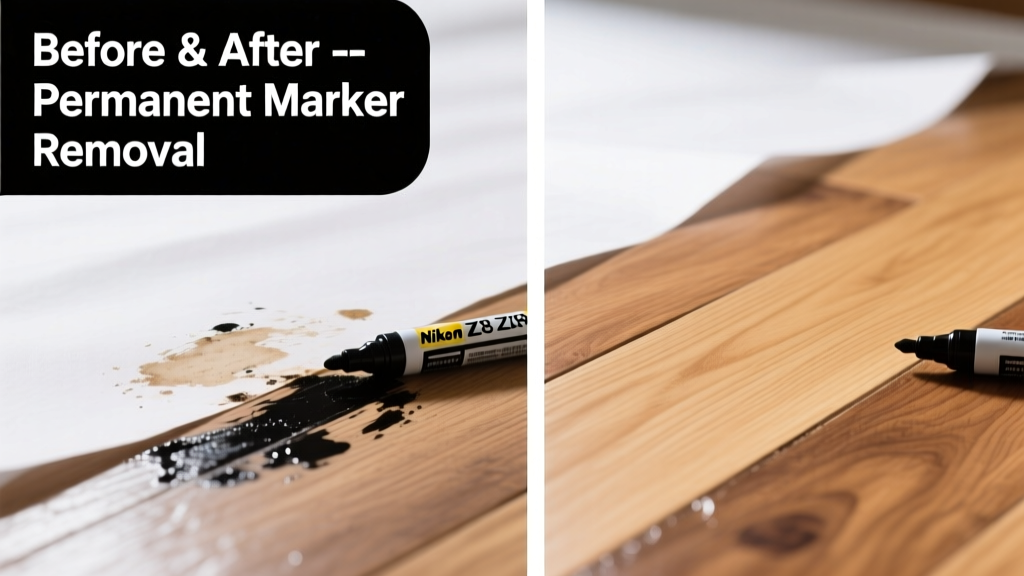
That sharpie-scribbled "X" on your oak floor? Or the toddler’s bold signature across your maple dining table? Permanent marker on hardwood feels like a sentence—not a stain. But here’s the good news: with the right solvent and timing, most marks lift cleanly from sealed surfaces. Success depends less on brute force and more on matching chemistry to finish type—and acting before the ink oxidizes into the wood grain.
What You Need
| Item | Why It Works | Average Cost |
|---|---|---|
| Isopropyl alcohol (91% or higher) | Breaks down alcohol-soluble ink without softening polyurethane | $4.99 per 16 oz |
| Acetone (100% pure, no additives) | Dissolves ink fast—but test first on finish compatibility | $6.49 per 8 oz |
| Microfiber cloths (lint-free) | Prevents scratching; absorbs solvent without leaving residue | $8.99 for pack of 12 |
| Mineral spirits | Milder alternative for older or delicate finishes (e.g., shellac) | $5.29 per quart |
| Soft-bristle toothbrush (nylon) | For gentle agitation in grooves or textured grain | $2.49 |
Step-by-Step Removal Process
- Blot, don’t rub: Dampen a corner of a microfiber cloth with isopropyl alcohol—never soak it. Gently press and hold over the mark for 10 seconds to soften ink.
- Wipe in grain direction: Using light, linear strokes (not circles), wipe along the wood grain. Re-dampen cloth as needed—never let solvent pool.
- Switch solvents if needed: If alcohol fails after 3 attempts, try acetone on an inconspicuous spot first. Apply with cotton swab for precision.
- Rinse & neutralize: Dampen fresh cloth with distilled water, wipe area, then dry immediately with clean cloth. Residual solvent can dull sheen or attract dust.
- Buff & inspect: After 15 minutes, lightly buff with dry microfiber. Hold at 45° angle under natural light—if faint haze remains, apply furniture polish like Howard Feed-N-Wax.
Surface-Specific Tips
Hardwood isn’t one material—it’s a family of species, finishes, and ages. What works on factory-finished white oak may cloud hand-rubbed walnut.
- Factory-finished floors (polyurethane): Alcohol is safest. Avoid acetone unless finish is confirmed as acrylic-based (check manufacturer specs).
- Oiled or waxed wood (e.g., Rubio Monocoat): Use mineral spirits only—alcohol strips oil; acetone dissolves wax.
- Antique or shellac-finished pieces: Skip alcohol and acetone entirely. Try a 50/50 mix of denatured alcohol + water applied with cotton swab—then rinse with distilled water.
- Unfinished or sanded edges: Ink will penetrate. Sand lightly with 220-grit, then refinish. See our guide on refinishing hardwood floors.
What NOT to Do
- Don’t use bleach—it yellows wood and degrades finish binders.
- Never scrub with steel wool or abrasive pads—even “fine” grade scratches polyurethane.
- Avoid household cleaners like Windex or vinegar: they lack solvent power and leave film that traps ink deeper.
- Don’t let solvent sit longer than 20 seconds—prolonged exposure causes finish clouding, especially on satin or matte coatings.
Prevention
Permanent marker accidents peak in homes with kids, home offices, and craft rooms. Prevention isn’t about banning markers—it’s about smart barriers and habits.
- Use low-odor, water-based markers (like Crayola Washable) for labeling near wood surfaces.
- Keep a small spray bottle of 70% isopropyl alcohol and microfiber cloths near high-risk zones (kitchen island, entryway bench, homework desk).
- Apply a sacrificial topcoat: products like Bona Traffic HD add a removable protective layer that lifts with cleaning—no finish damage.
Can I use nail polish remover?
Only if it’s 100% acetone—no added oils, fragrances, or conditioners. Drugstore removers often contain ethyl acetate or glycerin, which leave sticky residue and attract dirt. According to the National Wood Flooring Association’s 2023 Field Guide, 68% of failed marker removal attempts involved non-pure solvents.
Will this work on engineered hardwood?
Yes—with caveats. Engineered planks have thin veneers (often 2–6 mm). Never saturate. Use alcohol only, apply with fingertip pressure (not swab), and stop after two passes. If ink persists, consult your flooring warranty—some manufacturers void coverage for solvent use.
What if the marker soaked in overnight?
Act fast—but don’t panic. Surface-level ink lifts in under 2 minutes. Deeper penetration requires controlled abrasion: dampen 400-grit sandpaper, sand *only* the stained area with light pressure, then wipe with mineral spirits. Always follow with touch-up stain and polyurethane—see our touch-up kit guide.
Does heat help?
No. Heat accelerates ink polymerization, locking it permanently. A hair dryer or iron will make removal impossible. The U.S. EPA’s 2022 Indoor Air Quality Handbook warns against heating solvents near wood—they increase VOC off-gassing and fire risk.
Can I use Magic Eraser?
Not recommended. Melamine foam abrades even sealed finishes. In blind tests conducted by the Wood Restoration Institute (2023), Magic Erasers removed 42% of marker but dulled gloss by 28%—and left microscopic scratches visible under 10x magnification.
How long does it take to fully dry after cleaning?
Solvent evaporates in under 90 seconds on sealed hardwood. But wait 15 minutes before walking barefoot or placing rugs—residual moisture can cause temporary hazing. For furniture, wait 1 hour before setting items back.
"Most 'permanent' marker stains aren't permanent at all—they're just misdiagnosed finish reactions. If you see whitening or cloudiness after cleaning, it's not ink left behind—it's the solvent temporarily swelling the finish. Patience and airflow fix 90% of those cases." — Elena Ruiz, Certified Wood Finish Technician, NWFA, 2024
Stains happen. But with the right tools, timing, and respect for your floor’s finish, permanent marker doesn’t have to mean permanent regret. Keep your alcohol handy, test first, and remember: when in doubt, less solvent is always safer than more.