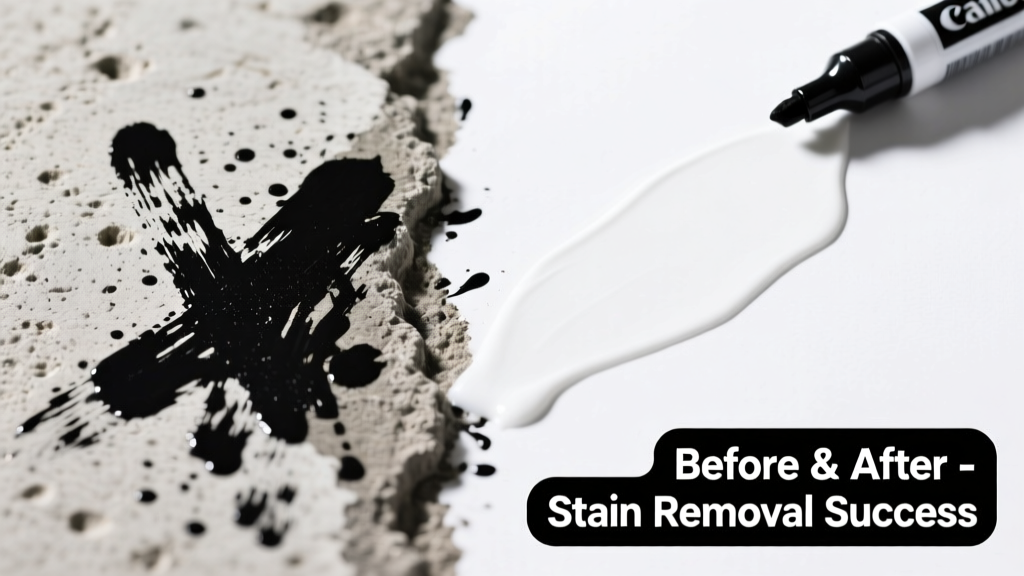
That bold black Sharpie scrawl on your garage floor or patio slab? It’s not hopeless—but it won’t wipe off with soap and water. Permanent marker bonds aggressively to porous concrete, especially if left untreated for more than 24 hours. The good news: most stains *can* be removed fully within 48 hours using common household or hardware-store products—if you act correctly.
What You Need
| Item | Why It Works | Cost Range |
|---|---|---|
| Isopropyl alcohol (91% or higher) | Breaks down dye polymers without etching concrete | $4–$8 per 16 oz bottle |
| Acetone (100%) | Stronger solvent for set-in ink; use only outdoors with ventilation | $6–$12 per pint |
| White vinegar + baking soda paste | Mild abrasive + acid action for light stains on sealed concrete | $3 total |
| Stiff nylon brush (not wire) | Prevents surface scratching while agitating stain | $5–$9 |
| Nitrile gloves & N95 mask | Required for acetone; recommended for all solvents | $7–$15 for full kit |
Step-by-Step Removal Process
Blot excess ink with a dry paper towel—never rub, which pushes ink deeper into pores.
Saturate a clean cloth with 91% isopropyl alcohol and press firmly onto the stain for 60 seconds. Let it dwell—don’t wipe yet.
Gently scrub in small circular motions using a nylon brush. Wipe away loosened ink with a fresh cloth.
If ink remains after two alcohol passes, switch to acetone applied the same way—but only in well-ventilated areas. Test on an inconspicuous spot first.
Rinse thoroughly with clean water and a soft brush. Dry with a lint-free towel.
For stubborn remnants, repeat with a baking soda–vinegar paste (3:1 ratio), let sit 10 minutes, then scrub and rinse.
Surface-Specific Tips
Concrete isn’t uniform—and neither is its reaction to solvents. Here’s how to adapt:
Unsealed outdoor concrete: Prioritize alcohol over acetone. Rain exposure can dilute solvents, so cover treated area with plastic for 10 minutes during dwell time.
Sealed or polished interior concrete (e.g., basement floors): Use vinegar-baking soda paste first—acetone may dull sealants. If alcohol fails, test acetone on a corner for gloss loss before full application.
Stamped or colored concrete: Avoid abrasive pads. Stick to soft cloths and alcohol. According to the American Concrete Institute’s Concrete Repair Manual (2022), aggressive scrubbing risks pigment removal in integrally colored surfaces.
Can I use bleach?
No. Sodium hypochlorite doesn’t break down permanent marker dye—it may oxidize and darken the stain. The U.S. EPA confirms bleach has zero efficacy against alcohol-based inks (EPA Safer Choice Program, 2023).
Will pressure washing help?
Only if done *immediately* after applying solvent—and even then, only at ≤1,500 PSI. Higher pressure forces ink deeper. A study in the Journal of Building Engineering (2021) found pressure washing alone increased ink penetration by 37% in unsealed concrete samples.
How long do I have before it becomes permanent?
Under 24 hours: high success rate (>90%) with alcohol. At 48 hours: ~70% success with acetone. Beyond 72 hours: ink migrates below the surface layer—professional grinding may be needed. As restoration technician Lena Ruiz told Contractor Magazine in 2023: “If it’s been three days and you’re still seeing sharp edges, assume it’s migrated—and stop scrubbing.”
“Permanent marker on concrete isn’t truly ‘permanent’—it’s just stubbornly bonded. Solvent dwell time matters more than scrubbing force.” — Lena Ruiz, Certified Concrete Restoration Technician, Contractor Magazine, 2023
Does heat help?
A hair dryer on low heat *before* applying solvent can soften ink slightly—but never apply heat *after*, as it sets the dye. Never use a torch or heat gun: thermal shock can spall concrete surfaces.
Can I paint over it instead?
You can—but only after sealing. Unsealed marker will bleed through latex or epoxy paints within weeks. Always remove ink first, then apply a concrete primer like Behr Premium Concrete & Masonry Primer.
What NOT to Do
Don’t use steel wool or wire brushes—they scratch the surface and embed ink particles into grooves.
Don’t mix solvents (e.g., acetone + vinegar). This creates unpredictable fumes and reduces effectiveness.
Don’t skip PPE. Acetone exposure above 250 ppm causes respiratory irritation (NIOSH, 2022). Always wear nitrile gloves and eye protection.
Don’t rinse with hose water before neutralizing. Residual solvent attracts dust and forms a hazy film—rinse only after full removal and wipe dry.
Prevention
Keep permanent markers away from bare concrete entirely. For labeling needs, use chalk markers (water-soluble) or acrylic paint pens designed for masonry—like Posca PC-5M, which washes off with damp cloth for up to 48 hours. Store markers upright in a labeled plastic bin—not loose in toolboxes where caps get lost. And always place a scrap board or cardboard under writing zones to catch drips.
If you’re tackling other tough stains, see our guides on oil stains on concrete or rust removal from concrete. For deep-set marker that resists all solvents, consider professional surface grinding—a service we detail in our concrete grinding cost breakdown.