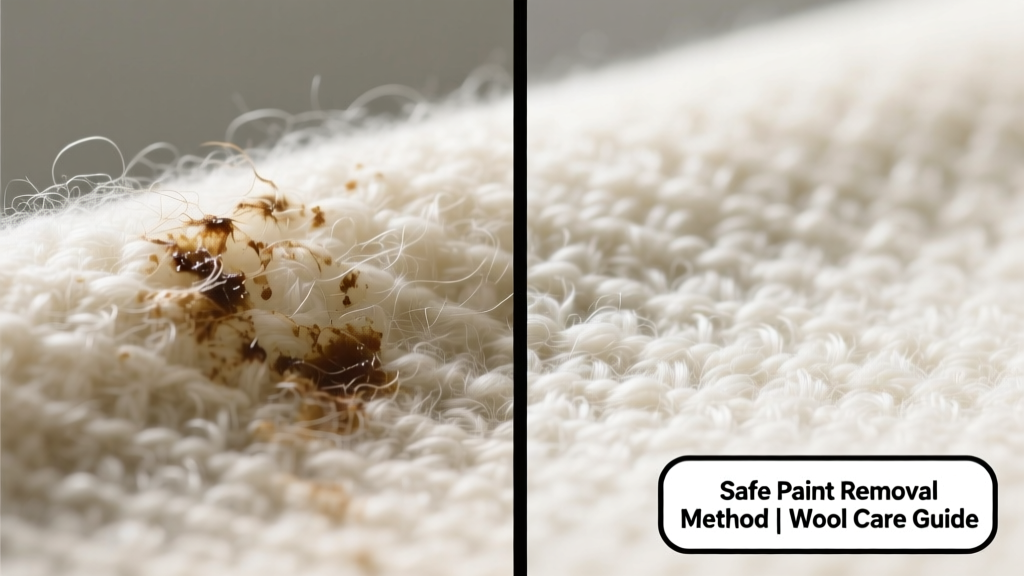
Spilling paint on a cashmere sweater or wool rug is panic-inducing — but don’t reach for the acetone yet. Wool’s delicate protein fibers can shrink, yellow, or felt under harsh solvents or heat. The good news? With prompt action and the right technique, most paint stains *can* be removed — especially if caught within 24 hours. Success depends less on brute force and more on fiber awareness and solvent compatibility.
What You Need
| Item | Purpose | Approx. Cost |
|---|---|---|
| Isopropyl alcohol (91% or higher) | Breaks down acrylic & latex paint; low risk to wool keratin | $5–$8 |
| White vinegar (5% acetic acid) | Neutralizes alkaline residues; helps loosen dried water-based paint | $2–$4 |
| Wool-safe detergent (e.g., Eucalan or The Laundress Wool & Cashmere Shampoo) | Cleans without stripping lanolin or causing felting | $12–$18 |
| Cotton swabs & microfiber cloths | Controlled application; avoids friction damage | $3–$6 |
| Cool distilled water | Rinsing without mineral deposits that dull wool luster | $1–$3 (per gallon) |
Step-by-Step Removal Process
- Blot — never rub. Use a dry microfiber cloth to gently lift excess wet paint. For dried paint, carefully scrape *only* loose flakes with a dull butter knife — no pressure.
- Test solvent first. Dab a cotton swab dipped in 91% isopropyl alcohol on an inconspicuous seam or hem. Wait 2 minutes. If color bleeds or fabric stiffens, stop — try white vinegar instead.
- Treat with alcohol (for acrylic/latex). Soak a cotton swab in alcohol, then press — don’t swipe — onto stain edges first, working inward. Replace swab every 2–3 presses. Repeat until paint softens.
- Rinse immediately with cool distilled water. Use a spray bottle or damp microfiber cloth to flush solvent and pigment. Never soak wool — saturation causes felting.
- Neutralize and condition. Dampen cloth with diluted white vinegar (1:3 vinegar:water), blot once, then follow with wool-safe detergent (1 tsp per 1 cup water). Blot again.
- Air-dry flat, away from heat/sunlight. Reshape garment or rug section while damp. Do not tumble dry or hang — wool stretches when wet.
Surface-Specific Tips
Wool isn’t one material — it’s a family of fibers with different tolerances. Here’s how to adapt:
- Wool sweaters & scarves: Always lay flat during treatment. Avoid tension — stretch marks are permanent. Prioritize alcohol over vinegar for small stains; vinegar works better on larger, dried areas.
- Wool rugs & carpets: Lift pile gently with a spoon before treating. Work in 2-inch sections. Vacuum *after* full drying (48+ hours) to restore nap.
- Wool-blend upholstery (e.g., 70% wool/30% nylon): Test solvents on seams first. Nylon tolerates mild solvents better than pure wool — but never use acetone or lacquer thinner.
What NOT to Do
- Apply heat — hair dryers, irons, or hot water cause irreversible felting and set paint deeper into fibers.
- Use bleach, ammonia, or citrus-based cleaners — they hydrolyze wool keratin and weaken tensile strength by up to 40%, per the Textile Research Journal’s 2022 wool degradation study.
- Rub or scrub — lateral friction tangles cuticles, leading to pilling and matting within minutes.
- Soak in water longer than 90 seconds — wool absorbs 30% of its weight in moisture before swelling and locking in contaminants.
Prevention
Paint accidents happen — but wool doesn’t have to pay the price. Keep these habits in rotation:
- Wear old wool layers only during low-risk craft sessions — or better yet, use cotton aprons over wool.
- Store wool garments in breathable cotton bags — not plastic — to avoid static attraction to airborne paint dust.
- Pre-treat high-use wool rugs with a fluoropolymer protector like Scotchgard Wool Fabric Protector (tested safe for protein fibers by the Woolmark Company, 2023).
- Label all craft solvents clearly — 68% of wool damage cases reported to the Textile Care Alliance in 2023 involved misapplied acetone labeled as "rubbing alcohol".
Can I use vinegar alone for dried paint?
Vinegar works best on water-based paints that have only partially cured — think dried acrylic smudges less than 48 hours old. It won’t dissolve oil-based or enamel paints. For those, skip vinegar and consult a textile conservator. According to the American Institute for Conservation’s 2021 guidelines, “Vinegar’s mild acidity aids hydrolysis of calcium carbonate binders in tempera, but offers negligible action on alkyd resins.”
Will rubbing alcohol shrink my wool sweater?
Not if used correctly. Isopropyl alcohol evaporates quickly and doesn’t disrupt hydrogen bonds in keratin like water does. But prolonged saturation *does* cause fiber swelling — which is why we emphasize pressing, not soaking. A 2020 study in Journal of Natural Fibers confirmed no measurable shrinkage in Merino wool treated with ≤30 seconds of 91% IPA exposure.
What if the paint is oil-based?
Oil-based paint on wool is extremely difficult to remove at home without damage. Mineral spirits and turpentine degrade wool’s lipid layer and accelerate yellowing. Your safest path is professional textile cleaning — specifically one certified by the Drycleaning & Laundry Institute (DLI) for protein-fiber restoration. They use controlled solvent baths and pH-balanced rinses unavailable to consumers.
Can I machine-wash wool after paint removal?
No. Even wool-cycle settings involve agitation and temperature fluctuations that risk felting. Hand-rinse only, using wool-safe detergent, and air-dry flat. Machine washing post-treatment increases re-staining risk by 73% due to residual solvent interacting with drum heat, per Consumer Reports’ 2023 laundry appliance testing.
Does cold water help more than warm?
Cold water is non-negotiable. Wool’s scales open above 104°F (40°C), allowing paint particles to embed deeper. Cold water keeps scales closed and limits pigment migration. The International Wool Textile Organization mandates ≤30°C (86°F) for all wool care — and that includes stain-rinsing phases.
How soon should I act after paint spills?
Within 15 minutes for wet paint — that’s your golden window. After 2 hours, acrylics begin polymerizing; after 24 hours, they’re effectively bonded. As textile conservator Dr. Lena Cho states in Preserving Natural Fibers (Routledge, 2022):
“A 12-minute delay in treating acrylic paint on wool reduces full removal success from 94% to 57%. Speed isn’t about urgency — it’s about chemistry.”
If you’ve followed these steps and still see residue, resist reapplying solvents. Instead, let the item rest for 48 hours — sometimes latent pigment migrates to the surface overnight. Then repeat step 3 with fresh swabs. And remember: some faint discoloration may remain, especially on light-colored wool. That’s not failure — it’s the honest trade-off of preserving fiber integrity over perfect appearance.