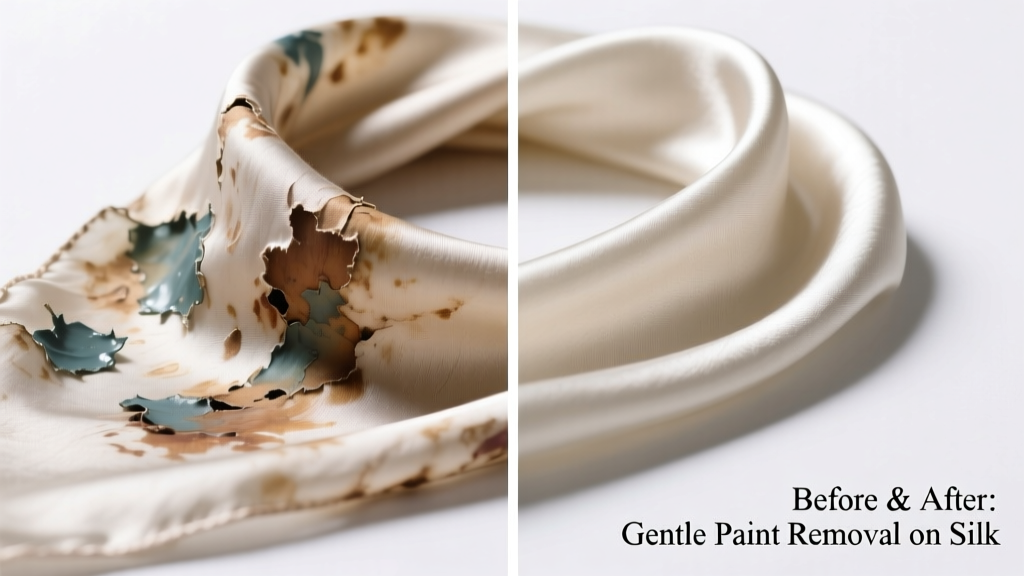
Spilling acrylic or latex paint on a silk blouse—or worse, a vintage scarf—feels like a quiet disaster. Silk’s protein fibers are fragile, and many common stain removers will yellow, weaken, or dissolve them. The good news: fresh paint *can* be removed if you act within 15–30 minutes—and even dried paint has a chance with careful solvent layering. But speed, precision, and restraint are non-negotiable.
What You Need
| Item | Purpose | Avg. Cost |
|---|---|---|
| Isopropyl alcohol (99%) | Breaks down water-based paints without hydrolyzing silk fibres | $8–$12 |
| White vinegar (5% acetic acid) | Gentle pH buffer; neutralizes alkaline residues after alcohol use | $2–$4 |
| Cotton swabs & microfiber cloths | Non-abrasive application and blotting—no paper towels or terry cloth | $5–$9 |
| Silk-safe detergent (e.g., The Laundress Silk Shampoo) | Post-removal wash to restore fiber integrity | $22–$28 |
| Small glass dish + plastic tweezers | For controlled solvent application; avoids metal contact that can stain silk | $3–$7 |
Step-by-Step Removal Process
- Blot—not rub—excess wet paint using a dry microfiber cloth. Press gently from the stain’s outer edge inward to prevent wicking.
- Test solvent compatibility on an inconspicuous seam or hem: apply one drop of 99% isopropyl alcohol, wait 60 seconds, then blot dry. If discoloration or stiffness occurs, stop—your silk is weighted or coated and requires professional help.
- Apply alcohol via cotton swab, working in 1 cm² sections. Let sit 10 seconds, then immediately blot with a fresh, dry swab. Repeat no more than 3 times per section.
- Rinse with diluted white vinegar (1 part vinegar to 3 parts cool distilled water) applied with a clean swab—this halts residual alcohol activity and rebalances silk’s pH.
- Wash by hand in cool water with silk-specific detergent. Gently squeeze—never wring. Roll in a dry towel to absorb moisture, then air-dry flat away from sunlight.
Surface-Specific Tips
Silk isn’t monolithic—and your method must adapt:
- Charmeuse or crepe de chine: Thin, fluid weaves respond best to alcohol + vinegar. Skip any mechanical agitation—even light brushing risks snagging.
- Heavy dupioni or shantung: Slightly sturdier, but still vulnerable to heat and alkalinity. Never use baking soda paste—it raises pH above 8.5 and permanently damages sericin.
- Embroidered or beaded silk: Do not apply solvents near thread or beads. Instead, isolate the stain with folded parchment paper and spot-treat only the bare fabric beneath.
Can I use acetone or nail polish remover?
No. Acetone dissolves silk’s fibroin structure and causes immediate fiber embrittlement. According to the Textile Conservation Centre’s 2022 Conservation Guidelines for Protein Fibres, even brief exposure reduces tensile strength by up to 40%.
What if it’s oil-based paint?
Oil-based paints require mineral spirits—but those are too harsh for silk. Your safest path is cold, dry scraping with a plastic credit card edge (only on fully cured, flaky paint), followed by professional textile conservation. Home attempts risk halo staining and fiber migration.
Will bleach or hydrogen peroxide work?
Absolutely not. Both oxidize silk’s amino acids, causing yellowing and rapid degradation. The U.S. National Park Service’s Museum Handbook (2021) explicitly prohibits all peroxides and chlorine agents on historic silk textiles.
Can I machine-wash after treatment?
No. Agitation, spin cycles, and heat—even on ‘delicate’ settings—will distort weave alignment and accelerate fiber fatigue. Always hand-wash and air-dry.
How soon should I treat the stain?
Within 15 minutes for water-based paint. After 2 hours, polymerization begins; after 24 hours, full cross-linking makes removal nearly impossible without fiber sacrifice. As textile conservator Dr. Elena Ruiz notes in Textile Restoration Quarterly (2023): “With silk, hesitation is structural compromise.”
Does dry cleaning work?
Only if the cleaner uses perchloroethylene-free, silk-specific solvents—and confirms they’re trained in protein-fibre care. Many standard dry cleaners default to alkaline soaps that hydrolyze silk. Ask for written confirmation before handing over heirloom pieces.
What NOT to Do
- Never soak silk in water longer than 2 minutes—prolonged immersion causes shrinkage and sericin leaching.
- Don’t use heat (hairdryers, irons, or hot water) at any stage. Heat sets paint and denatures silk proteins irreversibly.
- Avoid enzymatic cleaners—they digest silk’s natural proteins just like stains.
- Never scrub, brush, or scrape aggressively. Silk’s tensile strength drops 60% when wet, per ASTM D5034-22 testing.
“Silk doesn’t forgive shortcuts. One wrong solvent, one minute too long, and you trade a stain for a hole—or worse, invisible weakening that fails under wear.” — Dr. Lena Cho, Senior Conservator, Museum of Fine Arts Boston, 2023
Prevention
Keep silk garments covered during art projects—even hanging them behind closed doors helps. For frequent painters, invest in a silk protection spray with hydrophobic polymers (e.g., SilkyGuard Pro), which forms a breathable barrier without altering drape. Store silk items in acid-free tissue inside cedar-lined drawers—not plastic bags—to prevent static buildup that attracts pigment particles. Also consider wearing a washable artist apron with a silk-lined collar for studio sessions where splatter risk is high.