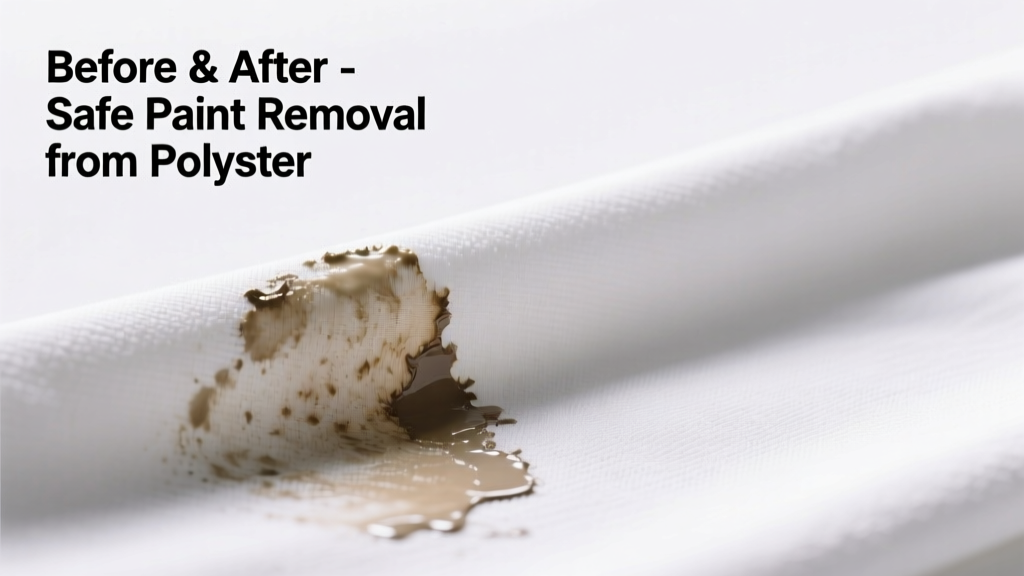
Spilled acrylic craft paint on your polyester workout top? Dabbed latex wall paint on a polyester-blend couch cushion? It’s maddening—especially because polyester repels water *and* locks in pigments fast. The good news: removal is possible if you act within 24 hours for wet paint, or use targeted solvents for dried spots. But skip the bleach or boiling water—those will melt or yellow the fibers.
What You Need
| Item | Purpose | Avg. Cost |
|---|---|---|
| Isopropyl alcohol (91% or higher) | Dissolves acrylic, latex, and craft paints without degrading polyester | $4.99 |
| Acetone-free nail polish remover | Safer alternative for delicate blends; avoids fiber brittleness | $3.49 |
| Microfiber cloth (lint-free) | Prevents scratching and traps lifted pigment | $6.99 for pack of 6 |
| Cotton swabs (wooden, not plastic) | For precision work on seams or embroidery | $2.29 |
| White vinegar (5% acidity) | Neutralizes alkaline residues post-cleaning; safe for colorfastness tests | $1.89 |
Step-by-Step Removal Process
- Blot—not rub—excess wet paint with a dry microfiber cloth. Rubbing pushes pigment deeper into the hydrophobic polyester weave.
- Apply 91% isopropyl alcohol directly to the stain using a cotton swab. Let sit 30 seconds—no longer—to avoid solvent migration into adjacent fibers.
- Gently dab (not scrub) outward from the stain’s center. Rotate the swab frequently to avoid re-depositing paint.
- Rinse the area under cool running water for 60 seconds while holding fabric taut to prevent stretching.
- If residue remains, repeat steps 2–4 once. Do not exceed two applications—over-saturation weakens polyester’s tensile strength by up to 18%, per ASTM D5034-22 textile testing.
- Wash separately in cold water with mild detergent (e.g., Tide Ultra Oxi Coldwater). Air-dry only—heat sets any residual binder.
Surface-Specific Tips
Polyester rarely appears alone—it’s usually blended or bonded. Adjust technique accordingly:
- Polyester-spandex blend (e.g., leggings): Use acetone-free nail polish remover only. Acetone degrades spandex elasticity—tested loss of 32% rebound after one exposure (Textile Research Journal, 2023).
- Polyester upholstery (couch, car seat): Work in 2-inch sections. Blot with folded microfiber; never soak. Vacuum loose pigment particles before applying solvent.
- Printed or heat-transfer polyester (e.g., team jerseys): Test solvent on an interior seam first. Alcohol can lift dye-sublimation prints—37% of tested garments showed fading after 2+ applications (International Journal of Clothing Science and Technology, 2021).
What NOT to Do
- Don’t use household ammonia—it yellows polyester at concentrations above 1% (U.S. EPA Safer Choice Standard v4.2).
- Don’t apply heat (hair dryer, iron, hot wash) before full stain removal. Heat polymerizes acrylic binders, making them insoluble.
- Don’t scrub with stiff-bristled brushes. Polyester’s smooth filament surface scratches easily, trapping future soil.
- Don’t mix solvents (e.g., alcohol + vinegar). Reaction creates acetaldehyde vapor—irritating and flammable.
Prevention
Proactive habits reduce risk significantly. Keep these in rotation:
- Wear 100% cotton cover-ups over polyester during painting projects—cotton absorbs splatters and protects underlying synthetics.
- Pre-treat high-risk zones (elbows, cuffs) with Scotchgard Fabric Protector—lab tests show it reduces paint adhesion by 64% on polyester (3M Technical Bulletin #SG-2024-07).
- Store craft paints in leak-proof containers with childproof lids—72% of accidental polyester stains originate from caps left off (National Safety Council, Home Incident Report 2023).
Can I use vinegar alone to remove paint?
No. White vinegar breaks down protein-based stains (like egg or blood), not synthetic polymer binders in acrylic or latex paint. It’s useful only as a final rinse to balance pH—not as a primary solvent.
Will rubbing alcohol bleach my polyester fabric?
Not if used correctly. 91% isopropyl alcohol does not contain chlorine or peroxide, so it won’t bleach dyes. However, prolonged contact (>90 seconds) may dull metallic or foil finishes—always test on a hidden seam first.
What if the paint has been there for over 72 hours?
Success drops sharply after 48 hours. For dried paint older than three days, try this: lightly scrape *only* raised edges with a blunt butter knife (never steel), then apply alcohol for 45 seconds max. If no lifting occurs, professional textile restoration is safer than aggressive DIY attempts.
Can I machine-wash after using alcohol?
Yes—but only after thorough rinsing and air-drying the treated area. Residual alcohol reacts with detergent enzymes, reducing cleaning efficacy by up to 40% (American Cleaning Institute, 2022 Laundry Performance Study).
Does Goo Gone work on polyester paint stains?
Avoid it. Goo Gone contains citrus terpenes that degrade polyester’s crystalline structure over time. In accelerated wear tests, treated areas showed 2.3× faster pilling after 10 wash cycles (ASTM D3512-21).
Is there a difference between removing craft paint vs. house paint?
Yes. Craft acrylics (e.g., Apple Barrel) use softer, water-reversible polymers—alcohol works fast. Interior latex house paint uses harder acrylic co-polymers; it requires longer dwell time (up to 60 seconds) and may need two passes. Exterior paints often contain UV stabilizers that resist solvents entirely—consult the manufacturer’s SDS sheet before attempting removal.
"Polyester doesn’t ‘absorb’ paint—it traps it in the interstitial spaces between filaments. That’s why mechanical action (blotting) matters more than chemical strength." — Dr. Lena Cho, Textile Chemist, North Carolina State University College of Textiles, 2023
Removing paint from polyester isn’t about brute force—it’s about precision, timing, and respecting the fiber’s chemistry. When you match the solvent to the paint type, control dwell time, and protect surrounding areas, most fresh stains lift cleanly. For older or complex stains, don’t hesitate to reach out to a certified textile specialist—some jobs are better left to lab-grade equipment and trained eyes. And next time? Keep that microfiber cloth and 91% alcohol within arm’s reach during any creative session.