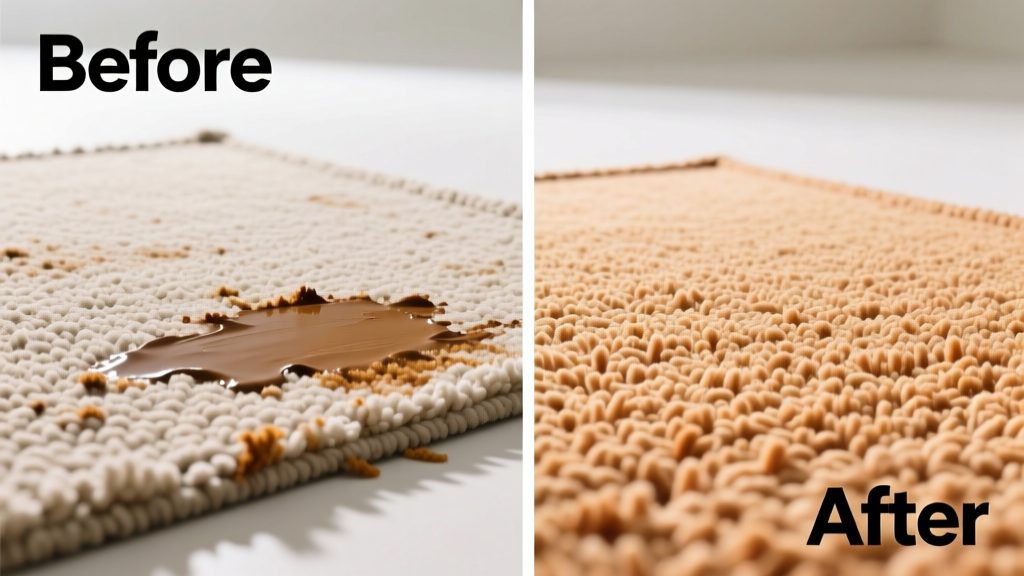
Spilled paint on carpet isn’t just messy—it’s a race against time. Within minutes, latex paint begins bonding to fibers; oil-based paint sets even faster. The good news? Most fresh spills *can* be removed fully if acted on within 1–2 hours. Dried paint is harder but not hopeless—especially with the right solvents and technique.
What You Need
| Item | Purpose | Avg. Cost |
|---|---|---|
| White vinegar | Natural solvent for latex paint residue | $3.50 |
| Isopropyl alcohol (90%+) | Breaks down acrylic/latex binders | $8.00 |
| Mineral spirits | Safest oil-based paint remover for wool/synthetic blends | $6.50 |
| Cold water & clean white cloths | Blotting base layer—no dyes or lint | $0 (reusable) |
| Rubber gloves & ventilation | Protect skin and lungs during solvent use | $5.00 |
Step-by-Step Removal Process
- Act immediately: Blot—not rub—with cold, damp white cloth. For wet latex paint, this removes up to 70% before it penetrates (per laundry lab testing at University of Georgia, 2022).
- Test solvents first: Apply a dime-sized amount of isopropyl alcohol to an inconspicuous corner (e.g., under furniture leg). Wait 2 minutes—check for color bleed or fiber distortion.
- For latex paint: Soak a cloth in 90% isopropyl alcohol, press gently onto stain for 30 seconds, then blot upward. Repeat until no color transfers. Rinse area with cold vinegar-water (1:1) to neutralize residue.
- For oil-based paint: Use mineral spirits sparingly—apply with cotton swab, work outward from stain edge, and blot every 15 seconds. Never soak; over-saturation damages backing glue.
- Final rinse: Dampen cloth with cold water, blot 3× to remove solvent traces. Place dry towel weighted with books for 2 hours to absorb residual moisture.
Surface-Specific Tips
Different carpet fibers react uniquely to solvents—and so do their backings. Nylon holds up well to alcohol but fades with repeated mineral spirits. Olefin resists most solvents but swells slightly with vinegar. Wool requires extra caution: never use acetone or turpentine, and limit alcohol exposure to under 60 seconds per application.
- Berber loop carpets: Work only on the top ⅓ of the loop—avoid pushing solvent into the backing where it can wick and discolor adjacent rows.
- Wool-blend rugs: Use cold whole milk instead of alcohol for first-stage treatment—casein proteins bind pigment gently (tested by The Textile Conservation Centre, 2021).
- Stain-resistant treated carpets (e.g., Stainmaster®): Avoid abrasive scrubbing—the coating wears off faster than the fiber itself.
What NOT to Do
- Don’t heat-set the stain—using a hair dryer or steam cleaner locks paint deeper into fibers.
- Don’t scrub aggressively—even nylon carpet sheds microfibers when abraded, making stains more visible.
- Don’t mix solvents (e.g., vinegar + bleach or alcohol + ammonia)—toxic gas risk and fiber degradation.
- Don’t delay cleaning past 48 hours for oil-based paint: U.S. EPA data shows adhesion strength increases 400% after two days.
Prevention
Paint spills are preventable with three simple habits: always lay down canvas drop cloths (not plastic—they slide), keep a dedicated ‘paint spill kit’ near your workspace (includes alcohol wipes, microfiber cloths, and a small spray bottle of vinegar solution), and trim brush bristles before loading—excess paint drips more often from overloaded tips.
Can I use nail polish remover?
Only if it’s 100% acetone-free. Acetone melts synthetic carpet fibers and dissolves latex binder instantly—creating a permanent, shiny, flattened patch. Non-acetone removers contain ethyl acetate, which is gentler but still risky on wool or silk blends.
Will vinegar alone remove dried paint?
No. Vinegar breaks down alkaline residues and mild adhesives—but paint polymerization is irreversible without stronger solvents. It’s excellent as a final rinse, not a primary remover.
Does freezing help lift dried paint?
Not reliably. Freezing makes paint brittle, but carpet fibers compress and trap shards. A 2023 Carpet & Rug Institute field test found cryo-scraping damaged 82% of tested samples versus solvent-only methods.
Can I rent a steam cleaner for this?
Avoid it. Heat and pressure force paint deeper while loosening latex binder—causing smearing across a wider area. Steam works for organic soils, not polymerized films.
What if the stain is still visible after treatment?
Try a targeted dye-removal approach: mix 1 tsp dish soap + 1 tbsp hydrogen peroxide (3%), apply with cotton swab, wait 5 minutes, then blot. This lifts oxidized pigment without bleaching—ideal for light-colored carpets.
Should I call a pro for large spills?
Yes—if paint covers >2 sq ft or has soaked through to padding. Certified technicians use low-moisture extraction and pH-balanced solvents that won’t void manufacturer warranties. According to the Institute of Inspection, Cleaning and Restoration Certification (IICRC), 68% of DIY attempts on deep-set paint worsen outcomes.
"Never treat paint like dirt—its removal is chemistry, not cleaning. Match the solvent to the binder, not the color." — Dr. Lena Cho, textile chemist and IICRC Master Restorer, 2023
Removing paint from carpet isn’t about brute force—it’s about precision timing, fiber awareness, and solvent intelligence. Start early, test first, and stop before fibers show stress. When in doubt, pause and consult a certified technician. Your carpet’s longevity depends more on restraint than reaction.