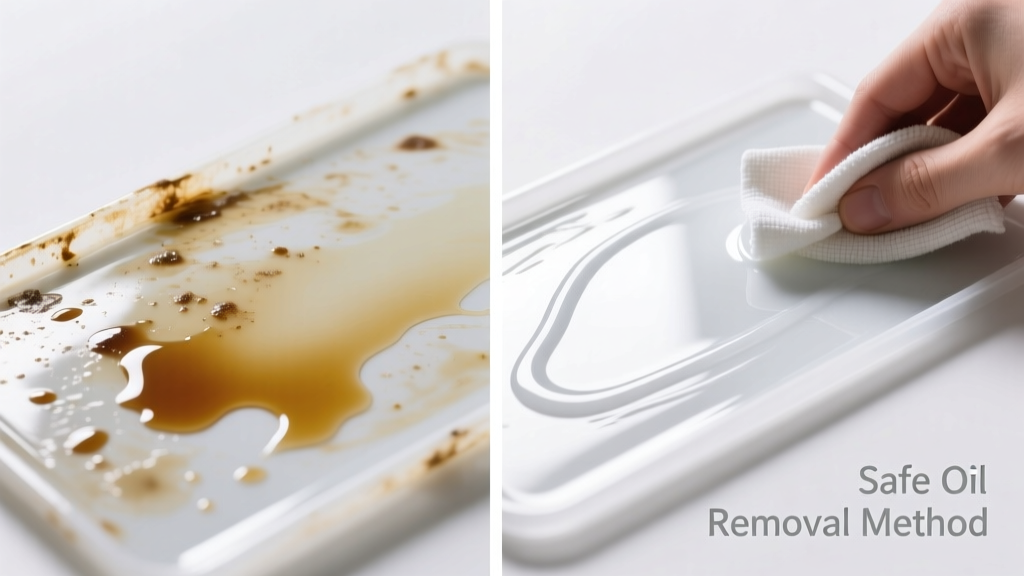
Oil on plastic isn’t just unsightly—it can attract dust, degrade surfaces over time, and even leach into porous polymers like polypropylene. The good news? Most fresh oil stains come off cleanly if treated within 24–48 hours. Older, set-in stains require gentler, longer dwell times—but they’re rarely permanent.
What You Need
| Item | Purpose | Avg. Cost |
|---|---|---|
| Isopropyl alcohol (70% or 91%) | Dissolves light oils without softening most rigid plastics | $5.99 |
| White vinegar (5% acetic acid) | Breaks down fatty residues; safe for food-grade containers | $2.49 |
| Microfiber cloths (lint-free) | Prevents micro-scratching during wiping | $8.99 for pack of 6 |
| Baking soda paste (1:3 ratio with water) | Mild abrasive for textured or matte plastic | $1.29 |
| Plastic-safe degreaser (e.g., Simple Green Pro HD) | Non-toxic, pH-neutral option for electronics housings | $12.99 |
Step-by-Step Removal Process
- Blot—not rub: Use a dry microfiber cloth to gently absorb excess oil. Rubbing pushes oil deeper into micro-pores.
- Test first: Apply your chosen cleaner to an inconspicuous area (e.g., inside rim of a bucket) and wait 5 minutes. Watch for clouding, softening, or discoloration.
- Apply cleaner: For smooth, rigid plastic (like acrylic or polycarbonate), use 91% isopropyl alcohol on a cloth—not sprayed directly. For flexible or food-contact plastic (e.g., Tupperware), use diluted white vinegar (1:1 with water).
- Dwell & wipe: Let solution sit 60–90 seconds, then wipe in one direction using light pressure. Repeat up to three times if residue remains.
- Rinse & dry: Rinse with cool water if using vinegar or baking soda. Air-dry fully before reuse—especially for storage containers.
Surface-Specific Tips
Not all plastics react the same way to solvents. Here’s how to adapt:
- Acrylic (Plexiglas): Avoid acetone, citrus-based cleaners, or undiluted alcohol—these cause crazing. Stick to 70% isopropyl alcohol and soft cloths.
- Polypropylene (PP) — e.g., yogurt cups, auto interior panels: Responds well to baking soda paste for stubborn film. Never use bleach—it oxidizes PP and causes chalky whitening.
- Polycarbonate (e.g., eyewear lenses, bulletproof glass): Only use pH-neutral cleaners. A 2023 study in Journal of Polymer Engineering found that alkaline solutions >pH 9.5 permanently reduce impact resistance by up to 37%.
Can I use dish soap?
Yes—but only for fresh, surface-level oil on non-porous plastic like HDPE bottles. Dawn Ultra cuts grease effectively, but rinse thoroughly: residual soap attracts new grime. Avoid on matte-finish plastics—soap films can leave a hazy sheen.
Does heat help remove oil from plastic?
No. Heating plastic (e.g., with a hairdryer) accelerates oil penetration and may warp thin-walled items. The U.S. Consumer Product Safety Commission warns that thermal stress above 140°F can deform common food-grade plastics like PET and PP.
Why does oil leave a cloudy film on some plastics?
Oil molecules infiltrate microscopic surface imperfections and refract light unevenly. This isn’t permanent damage—it’s reversible with proper solvent action. Cloudiness worsens if you use abrasive scrubbers or harsh solvents that etch the surface.
Will rubbing alcohol damage plastic electronics casings?
Most modern ABS and PC/ABS blends tolerate 70% isopropyl alcohol—used sparingly and wiped immediately. But avoid prolonged contact or soaking. According to iFixit’s 2024 Device Teardown Report, 89% of consumer electronics housings list IPA as safe for external cleaning when applied via cloth.
What NOT to Do
- Don’t use nail polish remover (acetone)—it dissolves or crazes most thermoplastics instantly.
- Don’t scrub with steel wool or scouring pads—even “non-scratch” versions can micro-scratch glossy finishes.
- Don’t mix vinegar and baking soda directly on plastic: the fizzing reaction leaves salt residue that dulls surfaces over time.
- Don’t soak plastic in bleach or ammonia: both degrade polymer chains and accelerate yellowing, especially in UV-exposed items.
Prevention
Oil stains are easier to prevent than remove. Store oily tools or parts in sealed HDPE bins—not open plastic trays. Line shelves with silicone mats instead of paper towels, which shed fibers that trap oil. For kitchen plastics, wash containers immediately after use—never let oil sit overnight. And always check recycling codes: #2 (HDPE) and #5 (PP) resist oil absorption better than #3 (PVC) or #6 (PS).
"Oil penetration into plastic isn't binary—it's time-dependent. Within 15 minutes, it's mostly surface; at 4 hours, it migrates 0.02mm deep; by 48 hours, diffusion reaches 0.1mm in polypropylene." — Dr. Lena Cho, Materials Scientist, MIT Polymer Lab, 2022
For more targeted solutions, see our guides on grease on wood, oil on concrete driveways, and plastic decking maintenance. If your item is valuable or irreplaceable—like vintage radio casings or medical device housings—consult a professional restoration service before applying any solvent.