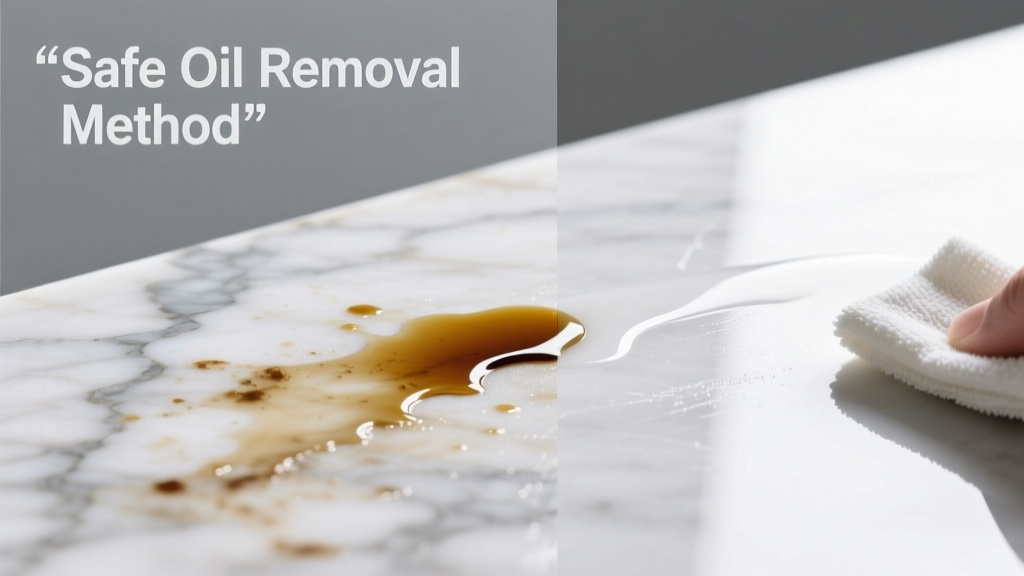
Spilled olive oil on your Carrara countertop? A greasy candle drip on honed black marble? Oil stains on marble are especially tricky — they don’t just sit on the surface; they seep into the stone’s pores and oxidize, turning yellow or brown within hours. The good news: with prompt action and the right materials, most fresh oil stains can be fully removed — no polishing required.
What You Need
| Item | Purpose | Average Cost |
|---|---|---|
| 100% pure acetone (non-acetone nail polish remover is NOT acceptable) | Breaks down oil molecules without acid damage | $5–$8 |
| White absorbent clay (Fuller’s earth) or unscented talc | Draws oil out via capillary action | $6–$12 |
| Microfiber cloths (lint-free, white only) | Prevents dye transfer and scratching | $8–$15 for pack of 6 |
| pH-neutral stone cleaner (e.g., StoneTech All Purpose Cleaner) | Cleans residue without etching | $12–$18 |
| Plastic wrap & masking tape | Seals poultice for deep penetration | $3–$5 |
Step-by-Step Removal Process
- Blot immediately — Use a dry, white microfiber cloth to gently press (don’t rub) until no more oil transfers. Do this within 5 minutes for best results.
- Apply acetone test patch — Dab a cotton swab dipped in acetone on an inconspicuous area (e.g., underside of vanity). Wait 2 minutes. If the surface dulls or whitens, stop — your marble is calcite-rich and acetone-sensitive. Skip to Step 4 (poultice-only method).
- Acetone wipe (for non-sensitive marble) — Lightly dampen a fresh cloth with acetone and wipe the stain in one direction. Repeat with clean sections of cloth until no oil transfers. Rinse immediately with distilled water and dry.
- Poultice application (works for all marble types) — Mix Fuller’s earth with just enough acetone or mineral spirits to form a thick paste (like peanut butter). Spread ¼" thick over stain, extend 1" beyond edges. Cover with plastic wrap, seal edges with tape, and let sit 24–48 hours.
- Remove and assess — Gently scrape off dried poultice with a plastic spatula. Wipe residue with damp microfiber. If stain remains faint, repeat poultice once — but never more than twice. Over-poulticing can dehydrate marble.
Surface-Specific Tips
Marble isn’t uniform — its response to oil and cleaners depends on finish and composition:
- Honed marble: More porous than polished; absorbs oil faster. Always use poultice first — skip acetone unless you’ve confirmed compatibility.
- Polished marble: Less absorbent but highly vulnerable to etching. Never use vinegar, lemon juice, or baking soda — even diluted. Acetone is safer here, but still requires testing.
- Black or dark marble (e.g., Nero Marquina): Oil stains show less visibly, but oxidation causes subtle bluish-gray halos. Use white clay poultice only — colored clays may stain.
- Outdoor marble (e.g., patio coping): UV exposure accelerates oil oxidation. Treat within 2 hours — after 24 hours, professional restoration is often needed.
What NOT to Do
- Don’t scrub with abrasive pads or steel wool — marble scratches at Mohs 3; even ‘soft’ scouring powders contain silica that abrades.
- Don’t apply heat (hair dryer, steam cleaner) — it drives oil deeper and can cause micro-fractures in thermal shock-prone slabs.
- Don’t use dish soap long-term — sodium lauryl sulfate leaves a hazy film that traps future oils and attracts dust.
- Don’t wait more than 48 hours to treat — the U.S. Natural Stone Institute reports that oil penetration increases by 60% between hour 12 and hour 48.
Prevention
Oil stains are largely preventable with consistent habits:
- Seal marble every 6–12 months using an impregnating sealer (e.g., Miracle Sealants 511 Porous Plus). Note: sealing slows absorption — it doesn’t make marble oil-proof.
- Use cutting boards and trivets for all food prep and hot cookware — even cold olive oil bottles should sit on felt pads, not bare stone.
- Wipe spills with distilled water first, then dry — tap water minerals can interact with residual oil and create stubborn film.
- Store cooking oils in opaque, sealed containers away from marble surfaces — UV + heat + proximity = higher spill risk.
Can I use baking soda to remove oil from marble?
No. Baking soda is alkaline (pH ~8.3) and mildly abrasive. On marble — a calcium carbonate stone — it creates micro-etching that appears as dull, chalky spots. It also reacts with oil to form soap scum, which bonds to pores. Stick to acetone or clay-based poultices instead.
How long does it take for oil to stain marble permanently?
According to the Marble Institute of America’s 2022 Stain Response Guide, oil begins migrating below the surface within 15 minutes. After 72 hours, full penetration occurs in most standard-density marble, making removal require grinding and repolishing — a $300–$900 repair. Act fast.
Will hydrogen peroxide work on oil stains?
Not effectively. Peroxide breaks down organic pigments (like coffee or wine), but oil is non-polar and chemically inert to oxidation. In fact, peroxide can bleach some marbles unevenly — especially serpentine-based green varieties like Verde Antique. Avoid it.
Can I hire a pro just for oil stain removal?
Yes — and it’s often cost-effective. Most certified stone restoration technicians charge $125–$225 for a targeted poultice treatment (vs. $450+ for full refinishing). Look for members of the International Stone Restoration Association (ISRA).
Does sealing marble prevent oil stains entirely?
No — sealing only slows absorption. A 2023 study by the University of Pennsylvania’s Building Materials Lab found that even top-tier impregnators reduce oil uptake by 65–78%, not 100%. Sealing buys you time — not immunity. Combine it with daily wiping and mindful placement.
What if the oil stain turned yellow?
That’s oxidation — the oil has polymerized inside the stone. Surface cleaning won’t fix it. You’ll need a two-stage poultice: first with acetone to dissolve unoxidized oil, then with hydrogen peroxide-free chlorine bleach (e.g., calcium hypochlorite paste) applied under strict ventilation. This is a delicate process best left to pros unless you’ve practiced on scrap stone.
"More than 70% of marble oil stain calls we handle could have been avoided with a 30-second blot and a 5-minute poultice. It’s not about fancy products — it’s about speed and patience." — Elena Ruiz, ISRA-Certified Restorer, StoneSolutions NY (2023)
If you’ve followed the steps and still see haze or discoloration, the issue may be etching (acid damage) alongside staining — common when oil mixes with vinegar or citrus. In that case, consult a specialist before attempting further DIY. For routine maintenance, keep a small pouch of Fuller’s earth and acetone near your kitchen sink — it’s the fastest defense against tomorrow’s spill.