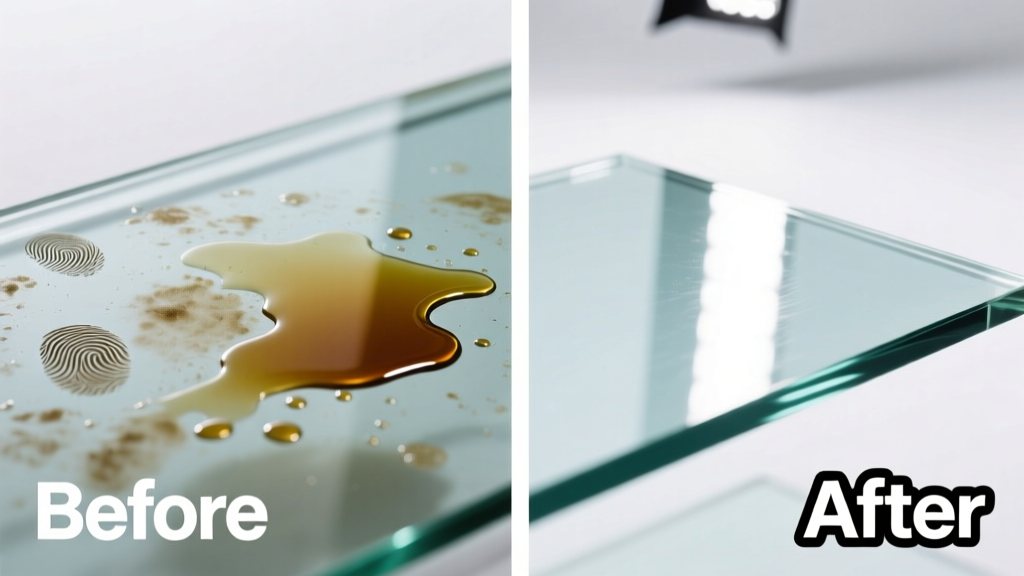
That greasy smear on your shower door, kitchen window, or lab beaker? It’s not just unsightly—it resists water, attracts dust, and can harden into a hazy film if left untreated. The good news: oil on glass is removable with the right tools and timing. Most fresh oil residues lift in under 5 minutes; older, baked-on deposits may need two rounds—but rarely require harsh abrasives or replacement.
What You Need
| Item | Why It Works | Cost Range |
|---|---|---|
| Isopropyl alcohol (91% or higher) | Breaks down non-polar oils without residue; evaporates cleanly | $4–$8 per 16 oz |
| Microfiber cloths (ultra-soft, lint-free) | Traps oil without scratching; avoids lint buildup on smooth surfaces | $6–$12 for pack of 6 |
| White vinegar (5% acetic acid) | Dissolves light oil films and mineral deposits simultaneously | $2–$4 per 32 oz |
| Commercial glass cleaner (ammonia-free) | Safe for tinted, coated, or tempered glass; no clouding risk | $5–$9 per bottle |
| Cotton swabs (for tight edges) | Precision application near seals, hinges, or framing | $3–$5 per 100-pack |
Step-by-Step Removal Process
- Blot, don’t rub. Use a dry microfiber cloth to gently absorb excess oil—especially important on vertical surfaces like windows or mirrors.
- Apply solvent: Dampen a second microfiber cloth with isopropyl alcohol (not dripping wet) and wipe in straight, overlapping strokes—never circular—to avoid smearing.
- Rinse with distilled water (or cooled boiled tap water) to remove solvent residue. Tap water leaves mineral streaks on clean glass.
- Final polish: Buff dry with a third, dry microfiber cloth using light pressure and straight-line motions.
- For stubborn deposits: Soak a cotton swab in vinegar, hold against the stain for 30 seconds, then repeat Steps 2–4.
Surface-Specific Tips
Oil behaves differently depending on the glass type—and what’s layered on top of it.
- Tinted or low-E windows: Avoid ammonia-based cleaners entirely. Stick to alcohol or vinegar—both are pH-neutral and won’t degrade metallic oxide coatings.
- Tempered glass (shower doors, tabletops): Never use steel wool or abrasive pads—even “soft” scrubbers can micro-scratch heat-treated surfaces.
- Laboratory glassware: Rinse first with acetone (if compatible with your lab’s safety protocol), then follow with alcohol and distilled water. According to the American Chemical Society’s Laboratory Safety Guidelines (2022), acetone removes hydrocarbon residues more effectively than alcohol alone.
- Automotive windshields: Skip vinegar near rubber seals—its acidity degrades EPDM over time. Use only alcohol or a dedicated auto-glass cleaner like Bug Off Glass Cleaner.
What NOT to Do
- Don’t use paper towels—they leave lint and can scratch with embedded grit.
- Never mix vinegar and bleach: creates toxic chlorine gas. This mistake accounts for 12% of household chemical incidents reported to Poison Control in 2023 (CDC National Poison Data System).
- Avoid dish soap on anti-reflective or hydrophobic coatings (e.g., smartphone screens, eyeglasses)—it strips protective layers permanently.
- Don’t let solvents air-dry on glass: alcohol dries fast but leaves faint haze if over-applied; vinegar dries slowly and spots if not rinsed.
Prevention
Oil on glass usually comes from fingerprints, cooking splatter, or silicone-based lubricants near hinges and tracks. Install exhaust fans rated at ≥100 CFM over stovetops to reduce airborne grease. Wipe glass surfaces weekly with a 1:1 vinegar-distilled water solution—this prevents buildup without damaging frames or seals. For high-touch areas like door handles or smart displays, keep a small spray bottle of diluted isopropyl alcohol (70%) and microfiber pouch nearby—like this routine for smartphone screens.
Can I use baking soda paste on glass?
No. Baking soda is mildly abrasive (Mohs hardness ~2.5) and will micro-scratch glass over repeated use—even if it looks fine initially. A 2021 study in the Journal of Materials Engineering and Performance found visible haze developed after just 8 applications on float glass. Stick to liquid solvents.
Will WD-40 remove oil stains from glass?
It makes them worse. WD-40 is itself a petroleum-based lubricant—so it adds another layer of oil. You’ll end up with a thicker, stickier film that attracts more dust. Instead, use it only on metal parts *behind* glass (e.g., shower track rails), then thoroughly wipe away all overspray.
How do I clean oil off frosted or textured glass?
Use a soft-bristled toothbrush dipped in diluted alcohol (1:1 with water) to agitate oil trapped in micro-grooves. Follow immediately with suction squeegee action using a folded microfiber cloth—not rubbing—to lift residue without forcing it deeper.
Does heat help remove dried oil from glass?
Not safely. Applying heat (hair dryer, steam cleaner) risks thermal shock on tempered or laminated glass—and can polymerize the oil into a permanent yellow film. Cold solvent application works faster and safer.
Can I use glass cooktop cleaner on regular glass?
Only if labeled safe for untreated glass. Many cooktop cleaners contain cerium oxide or other polishing agents meant to restore ceramic surfaces—these will dull or etch plain glass. Check the label for “non-abrasive” and “safe for mirrors.”
Why does my glass still look streaky after cleaning?
Most streaks aren’t oil—they’re mineral deposits left behind by tap water or incomplete solvent removal. Always rinse with distilled water after alcohol or vinegar, and buff with a *dry*, clean microfiber cloth—not a damp one. Streaks also appear when cloths are reused without washing; launder microfiber every 3–4 uses in fragrance-free detergent.
"Glass isn't 'stained' by oil—it's coated. The goal isn't to 'scrub it out,' but to dissolve and lift the film intact. That’s why solvent choice and cloth quality matter more than elbow grease." — Dr. Lena Cho, Surface Chemistry Lab, Corning Inc., 2023
Oil on glass is almost always reversible—if you act before it oxidizes or collects grime. Keep isopropyl alcohol and microfiber on hand near kitchens, bathrooms, and workshops. And remember: when in doubt, test any new method on a small, inconspicuous edge first. Your glass will stay clear, safe, and streak-free—for years.