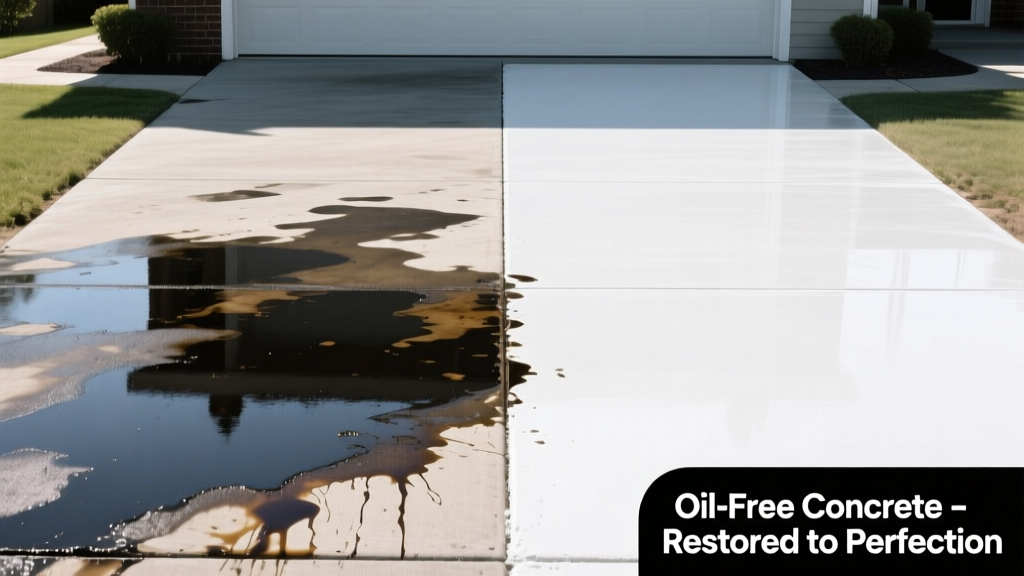
That dark, greasy splotch on your garage floor or driveway isn’t just unsightly—it’s a ticking clock. Oil begins penetrating porous concrete within minutes, and after 24–48 hours, it oxidizes and bonds deep into the matrix. But don’t panic: most oil stains *are* removable if you act fast—and even older ones respond well to targeted treatment.
What You Need
| Item | Use Case | Avg. Cost |
|---|---|---|
| Baking soda or cornstarch | Fresh spill absorption | $3–$5 |
| Oil-Dry or SpeedyDry (clay-based absorbent) | Heavy or semi-dried spills | $12–$18 per 20-lb bag |
| Sodium hydroxide (lye) cleaner (e.g., Red Devil Lye) | Older, oxidized stains | $6–$9 per 16 oz |
| Sodium percarbonate (e.g., OxiClean MaxForce) | Color-safe, eco-friendly alternative | $10–$14 per 32 oz |
| Stiff nylon brush (not wire—concrete damage risk) | Scrubbing without etching | $4–$8 |
| Pressure washer (≥2,000 PSI) | Rinsing after chemical treatment | Rent: $60/day; Own: $200–$400 |
Step-by-Step Removal Process
- Blot, don’t wipe: For fresh spills (<1 hour old), cover generously with baking soda, cornstarch, or Oil-Dry. Let sit 12–24 hours—then sweep up. Repeat if residue remains.
- Pre-treat with degreaser: Apply undiluted citrus-based degreaser (e.g., Simple Green Pro HD) or diluted sodium hydroxide solution (1 tbsp lye per quart warm water). Let dwell 10–15 minutes—no longer than 20 min on broom-finished concrete.
- Scrub with mechanical action: Use a stiff nylon brush in tight concentric circles—not back-and-forth strokes—to lift emulsified oil from pores. Rinse thoroughly with garden hose.
- For stubborn or aged stains (3+ days): Make a poultice: mix sodium percarbonate + warm water to peanut butter consistency. Spread ¼" thick over stain, cover with plastic, seal edges with tape, and wait 24 hours. Peel off; rinse.
- Final rinse & dry: Pressure wash at 1,500–2,000 PSI using a 25° (green) nozzle. Let air-dry 48 hours before assessing. Residual haze? Repeat poultice step once more.
Surface-Specific Tips
Different concrete surfaces demand different care. Ignoring texture, age, or sealant status leads to etching, discoloration, or ineffective cleaning.
- Broom-finished garage floors: Avoid high-pH cleaners (like straight lye) unless pre-rinsed and neutralized—pH >12 can dull the finish.
- Stamped or exposed-aggregate concrete: Use only pH-neutral cleaners (e.g., Krud Kutter Original) and soft-bristle brushes. Acidic or abrasive treatments erode surface detail.
- Sealed concrete (acrylic or epoxy): Test any cleaner in an inconspicuous area first. Most solvent-based degreasers will cloud or soften acrylic sealers.
- New concrete (<90 days old): Do not use lye or acid-based removers—the surface hasn’t fully cured and is highly vulnerable to chemical attack.
What NOT to Do
- Don’t use vinegar or muriatic acid alone: These lower pH but don’t break down hydrocarbons—they may drive oil deeper while damaging the cement matrix.
- Don’t scrub with steel wool or wire brushes: They leave embedded metal fragments that rust and create new stains.
- Don’t power-wash first: High pressure forces oil deeper before it’s emulsified—always pre-treat, then rinse.
- Don’t apply heat (torch, steam) to dried oil: This carbonizes the residue, turning it into permanent black char—impossible to lift chemically.
Prevention
Proactive habits reduce repeat staining by 70% or more, according to the Concrete Repair Association’s 2023 Maintenance Survey. Start with these three layers of defense:
- Place heavy-duty rubber mats under vehicle drip zones—replace every 18 months (they degrade and trap oil).
- Apply penetrating silane-siloxane sealer every 2–3 years; it reduces oil absorption by 85% without altering appearance (see top-rated options).
- Keep a 5-lb bucket of Oil-Dry near garage entrances and inspect monthly for leaks—catching a quart leak early prevents a 3-ft stain.
Can I use dish soap to remove oil from concrete?
Only for *very* fresh spills (<15 minutes old) and only as a stopgap. Dawn Ultra cuts grease, but lacks alkalinity to saponify oil. It moves surface residue but won’t extract what’s already penetrated. Follow up immediately with absorbent powder or a proper degreaser.
Will bleach remove oil stains from concrete?
No. Sodium hypochlorite (household bleach) has zero effect on hydrocarbon molecules. It may lighten surrounding discoloration, creating a false impression of removal—but the oil remains intact beneath the surface. Worse, mixing bleach with ammonia-based degreasers creates toxic chloramine gas.
How long does it take for oil to soak into concrete?
According to the Portland Cement Association’s 2022 Porosity Study, unsealed concrete absorbs motor oil at ~0.08 inches per hour in 70°F conditions. Within 2 hours, oil reaches 1/8" depth—beyond where surface cleaners reach. That’s why immediate blotting is non-negotiable.
Does pressure washing alone remove oil stains?
Rarely. A study published in Journal of Materials in Civil Engineering (ASCE, 2021) found pressure washing removed only 12% of oil mass from 7-day-old stains—versus 89% with alkaline poultice + rinse. Pressure washing is a rinse tool, not a removal tool.
Can I paint over an oil stain on concrete?
Not safely. Oil migrates upward through coatings, causing blistering, peeling, and adhesion failure within weeks. Always remove oil completely and test with water drop test (beading = residual oil) before priming or coating.
Is kitty litter effective for oil spills?
Clay-based clay litter works—but it’s less absorbent than purpose-made Oil-Dry (which has 3× higher capillary action, per Absorbent Materials Lab, 2023). Avoid clumping or silica gel litters: they form impermeable crusts that trap oil at the surface instead of drawing it out.
"Most DIYers fail not because their product is weak—but because they skip dwell time. Let your cleaner work *in the pore*, not just on the surface. 15 minutes minimum, 24 hours for poultices." — Carlos Mendez, Concrete Restoration Technician, 18 years field experience
If the stain persists after two full treatment cycles—or if it’s larger than 2 ft² and older than 30 days—call a professional who uses hot-water extraction or diamond-grinding. Some deeply carbonized stains require mechanical abrasion, not chemistry. And remember: the best oil stain is the one you never get. Keep absorbents stocked, check fluid levels monthly, and seal your concrete like it’s your car’s paint job—because it is.