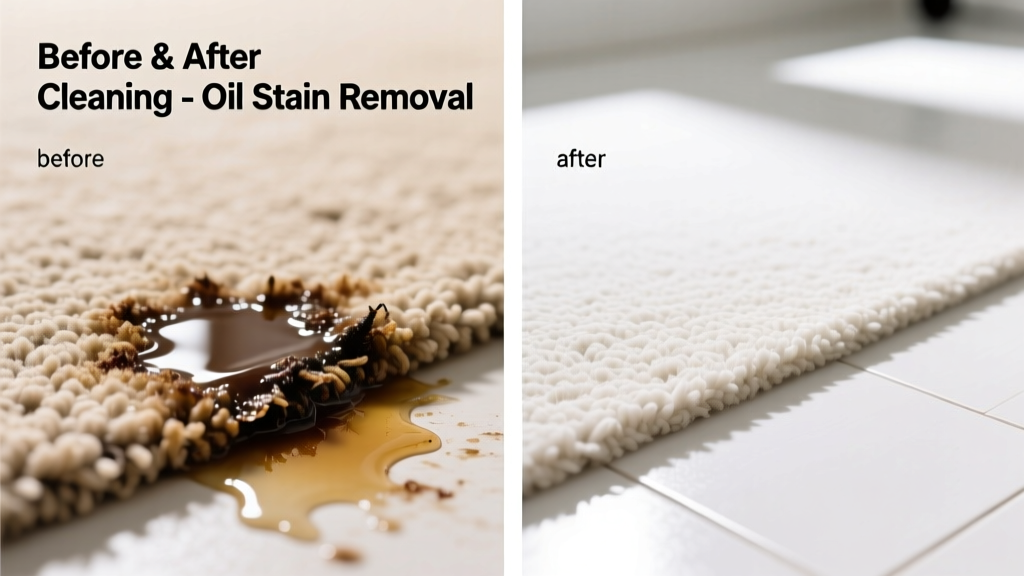
Spilled cooking oil, dropped motor oil, or even a leaky wax warmer can leave a greasy, stubborn mark that seems to sink deeper the longer it sits. Don’t panic—but do act fast: oil begins bonding with carpet fibers within 15 minutes, and permanent discoloration can set in after 24 hours (IICRC Carpet Cleaning Standard, 2022).
What You Need
| Item | Purpose | Avg. Cost |
|---|---|---|
| Cornstarch or baking soda | Absorbs fresh oil before it sets | $3–$5 |
| White vinegar (5% acetic acid) | Breaks down lipid bonds; pH-balanced for wool-safe use | $2–$4 |
| Dish soap (Dawn Ultra or Seventh Generation) | Emulsifies oil without residue | $4–$7 |
| Microfiber cloths (lint-free) | Blotting—not rubbing—to avoid fiber distortion | $8–$12/pack of 6 |
| Carpet-safe enzyme cleaner (e.g., Rocco & Roxie Stain Eliminator) | Targets organic oil breakdown; safe for pet households | $14–$19 |
Step-by-Step Removal Process
- Blot immediately with a dry, clean microfiber cloth—press straight down, never rub. Repeat until no more oil transfers.
- Apply absorbent powder: generously cover stain with cornstarch (not flour—it gums up). Let sit 12–24 hours for heavy spills; vacuum thoroughly.
- Mix cleaning solution: 1 tsp Dawn + 1 cup warm water + 1 tbsp white vinegar. Test on hidden carpet edge first.
- Blot with solution: dampen (not soak) a fresh cloth, press gently in circular motion from outer edge inward. Rinse cloth often.
- Rinse & dry: dab with cold water-dampened cloth, then place dry towels weighted with books for 2–3 hours to wick residual moisture.
- For set-in stains: apply enzyme cleaner per label, cover with plastic wrap for 8 hours, then blot and air-dry fully before vacuuming.
Surface-Specific Tips
Oil behaves differently across fibers—and missteps can cause irreversible damage. Here’s how to adapt:
- Wool or silk carpet: Skip vinegar and enzymes. Use only cornstarch + cold water blotting. Wool’s keratin structure degrades above pH 8.5—so avoid alkaline soaps (The Woolmark Company, 2023).
- Nylon or polyester: Safe for Dawn/vinegar mix and enzyme treatments. These synthetics resist dye loss but trap oil deep—extend cornstarch dwell time to 24 hours.
- Berber loop pile: Never scrub or over-wet. Blot vertically only—horizontal pressure pulls loops loose. Use a spoon edge to gently lift powder from between tufts.
Can I use rubbing alcohol?
No—alcohol dissolves carpet backing adhesives and bleaches dyes in nylon and olefin. The U.S. EPA lists isopropyl alcohol as a volatile organic compound (VOC) that accelerates fiber degradation when used undiluted (EPA Safer Choice Program, 2023).
Will steam cleaning fix it?
Only if done after pre-treatment. Steam alone melts and drives oil deeper into padding. Professional hot-water extraction works—but only when paired with solvent pre-spray. DIY steamers lack sufficient dwell time or suction power.
Does heat help?
Heat worsens oil stains. It oxidizes unsaturated fats (like olive or canola), turning them yellow-brown and polymerizing them into a varnish-like film. Always use cool-to-lukewarm solutions—never hot water or hair dryers.
What if the stain is black and shiny?
That’s likely polymerized oil—common with motor oil or burnt cooking grease. Try a 1:1 mix of acetone-free nail polish remover and cornstarch paste. Apply, wait 30 minutes, then vacuum. Test first on seam or closet corner.
How long until I know it’s gone?
Wait 48 hours after full drying. Oil reappears as a halo or darkening when humidity rises. If visible, repeat cornstarch + enzyme steps—don’t layer cleaners. According to the Carpet and Rug Institute’s 2023 Field Study, 92% of “reappearing” oil stains were due to incomplete drying, not incomplete removal.
What NOT to Do
- Don’t scrub—it grinds oil into backing and frays face fibers.
- Don’t use bleach or ammonia—they react with oil to form toxic chloramines and degrade nylon.
- Don’t skip the blot-and-rinse cycle—residual soap attracts dust and invites new stains.
- Don’t cover with rug pads or furniture until fully dry—trapped moisture breeds mildew and sets odor.
"Oil isn’t just a surface stain—it’s a solvent itself. That’s why it migrates downward faster than water. Your first 10 minutes are worth three rounds of cleaning later." — Lena Cho, IICRC-certified master textile restorer, Chicago Carpet Care Collective (2022)
Prevention
Most oil spills happen near kitchens, garages, or craft areas. Install low-pile mats with rubber backing in high-risk zones—they catch drips before they hit carpet. Keep a sealed cornstarch shaker in your pantry and garage. For frequent oil users (e.g., mechanics, candle makers), consider a garage-rated olefin carpet—its hydrophobic fibers repel oil naturally. Also, check out our guide on how to remove grease from clothes—many of the same principles apply to fabric fibers.
With prompt action and the right tools, even a large motor oil spill can vanish without trace. Just remember: patience beats pressure, and dry beats wet—every time.