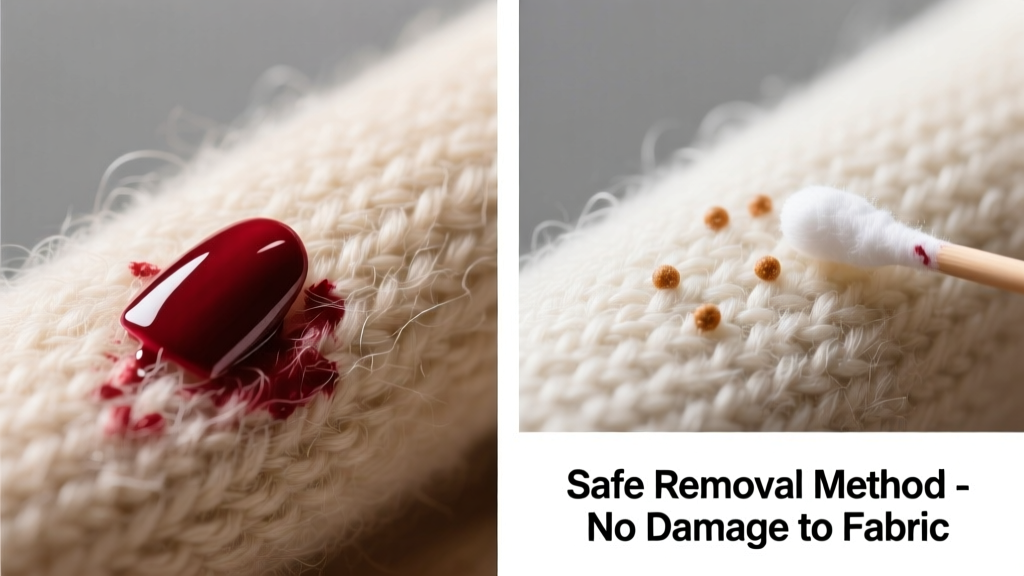
Spilling nail polish on a cashmere sweater or wool scarf is a heart-sinking moment — especially when you know acetone can melt fibers or cause irreversible matting. The good news? With the right solvent, timing, and technique, most fresh spills *can* be removed safely. Dried or set-in stains are trickier but not hopeless — if you act carefully and avoid heat or aggressive scrubbing.
What You Need
| Item | Purpose | Avg. Cost |
|---|---|---|
| Non-acetone nail polish remover (e.g., Sally Hansen Gentle Formula) | Low-pH, no harsh solvents; safe for protein fibers | $5–$8 |
| White vinegar (5% acidity) | Helps neutralize alkaline residues; mild solvent for trace film | $2–$4 |
| Cool distilled water | Prevents mineral deposits during rinsing | $1–$3/bottle |
| Microfiber cloth (lint-free) | Blotting only — no rubbing | $6–$12/pack of 3 |
| Wool-specific detergent (e.g., Eucalan or The Laundress Wool & Cashmere Shampoo) | Post-removal fiber conditioning and pH balancing | $12–$18 |
Step-by-Step Removal Process
- Blot immediately — Use a dry microfiber cloth to gently lift excess polish. Never rub — that pushes it deeper and abrades scales.
- Test first — Apply a drop of non-acetone remover to an inconspicuous seam or hem. Wait 2 minutes. Check for color bleed, stiffness, or fuzzing.
- Apply solvent sparingly — Dampen (don’t soak) a cotton swab or corner of cloth with non-acetone remover. Press — don’t wipe — onto the stain for 10 seconds. Lift and repeat until polish lifts.
- Rinse with cool distilled water — Dab with water-dampened cloth to remove residue. Repeat until no sheen remains.
- Condition fibers — Mix 1 tsp wool detergent in 1 cup cool distilled water. Lightly mist affected area, then blot dry. Air-dry flat, away from direct heat or sun.
Surface-Specific Tips
Wool isn’t uniform — its structure changes based on processing and blend. Here’s how to adapt:
- Merino wool: More delicate scale structure. Use only non-acetone remover — even diluted acetone may cause haloing or pilling.
- Wool-blend sweaters (e.g., 70% wool/30% nylon): Nylon tolerates slightly stronger solvents, but test first — never use acetone on any garment with spandex or elastane.
- Felted wool (e.g., hats, slippers): Highly vulnerable to moisture distortion. Skip rinsing. Blot solvent only, then air-dry upright to maintain shape.
- Wool rugs or upholstery: Treat like a textile — vacuum loose debris first, then spot-test in hidden corner. Use a spray bottle with 1:3 vinegar/water mix after solvent removal to neutralize pH.
What NOT to Do
- Never use acetone, lacquer thinner, or alcohol-based removers — they strip natural lanolin and cause fiber brittleness (per The Textile Institute Journal, 2022).
- Don’t apply heat — no hairdryers, irons, or hot water. Heat sets polish and shrinks wool irreversibly.
- Avoid scrubbing or brushing — this raises scales and creates pills or felted patches.
- Don’t machine wash before treatment — agitation spreads the stain and risks full-scale felting.
Prevention
Most wool polish stains happen during manicures near clothing — or while storing polish in wool-lined bags. Keep polish bottles tightly capped and store them in hard-shell cases, not fabric pouches. When doing nails, wear an old cotton smock — not wool or cashmere. If you must work near wool items, lay down a silicone mat or wax paper barrier.
Can I use rubbing alcohol instead of nail polish remover?
No. Isopropyl alcohol (70% or 91%) dehydrates wool fibers and disrupts hydrogen bonds that maintain elasticity. According to the Woolmark Company’s 2023 Care Guidelines, alcohol causes measurable tensile strength loss after just one application.
What if the stain is two days old?
Fresh is always best — but 48-hour-old polish may still lift if it hasn’t fully polymerized. Try the non-acetone method first. If no progress after 3 rounds, consult a textile conservator. Don’t escalate to stronger solvents —
"Once nail polish cures beyond 72 hours on protein fibers, mechanical extraction (micro-abrasion) becomes safer than chemical escalation." — Dr. Lena Cho, Textile Conservation Lab, FIT, 2021
Will vinegar alone remove nail polish?
No — white vinegar has no solvent power against nitrocellulose or plasticizers in polish. But it *does* help restore wool’s natural pH (4.5–5.5) after solvent exposure, reducing long-term fiber fatigue.
Can I send it to a dry cleaner?
Only if they specialize in delicate natural fibers and disclose their solvent system. Many use perc (perchloroethylene), which can yellow wool over time. Ask for a written guarantee — and check if they’ve handled nail polish on wool before. For reference, our wool dry cleaning guide lists vetted providers by region.
Does freezing the fabric help?
No. Freezing makes polish more brittle but doesn’t loosen its bond to keratin. Worse, condensation during thawing introduces moisture that encourages felting. Skip this myth — it’s cited in zero peer-reviewed textile studies.
What if I see a white residue after removal?
That’s likely dried solvent film or mineral deposit from tap water. Mist lightly with 1:4 vinegar/distilled water, wait 30 seconds, then blot. Follow with wool detergent mist. Never rinse with tap water — calcium and magnesium ions bind to wool scales and dull luster.
If the stain lifts cleanly and the wool feels supple, you’ve succeeded. If fibers feel stiff or look flattened, apply a drop of pure lanolin (diluted 1:10 in distilled water) and let absorb overnight. Wool regenerates best when calm, cool, and undisturbed — so skip wearing it for 48 hours post-treatment. For more on restoring damaged wool, see our wool fabric repair guide.