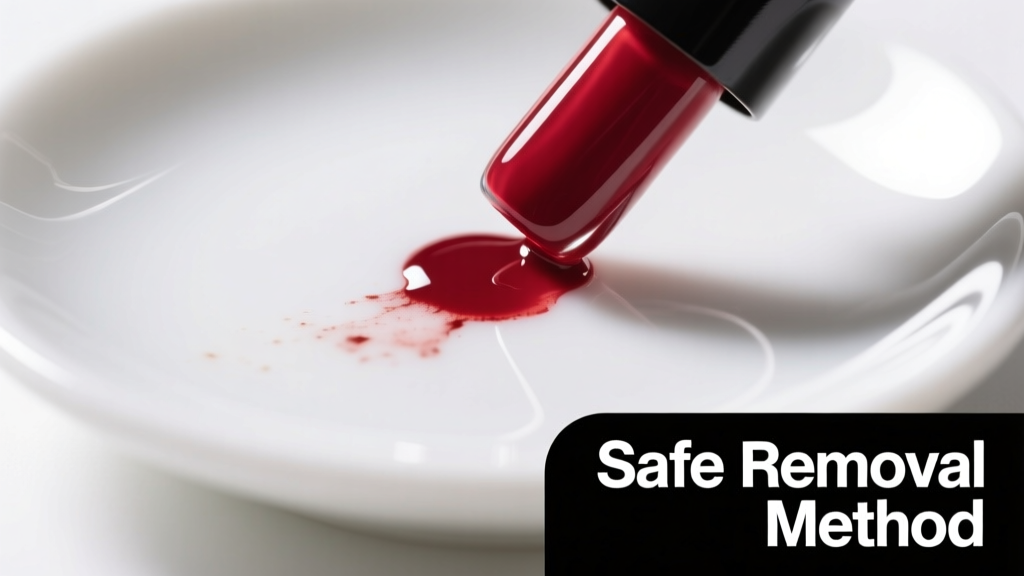
Spilled nail polish on your white porcelain sink? That stubborn purple or glittery blob isn’t just unsightly—it can bond permanently if mishandled. The good news: porcelain’s non-porous glaze means most nail polish sits *on top*, not *in* the surface—so removal is usually fast and damage-free when done right.
What You Need
| Item | Why It Works | Avg. Cost |
|---|---|---|
| Acetone-based nail polish remover | Breaks down nitrocellulose film without harming glazed porcelain | $3–$8 |
| Microfiber cloths (lint-free) | Prevents scratching; absorbs residue without smearing | $6 for pack of 6 |
| Cotton balls or pads (bleach-free) | Controlled application; avoids pooling on grout lines | $2–$4 |
| Plastic putty knife (blunt edge) | Removes thick, dried layers without gouging glaze | $5–$10 |
| Baking soda + water paste | Mild abrasive for final polish; neutralizes acetone residue | $1 (reusable) |
Step-by-Step Removal Process
- Fresh spills (under 10 minutes): Blot gently with a dry microfiber cloth—never rub. Apply acetone to a cotton ball and hold it over the spot for 15 seconds. Wipe *in one direction* until polish lifts.
- Dried or layered polish: Soak a cotton ball in acetone, place it directly on the stain, and cover with plastic wrap for 2–3 minutes. Gently scrape softened polish with a plastic putty knife at a 15° angle.
- Stubborn residue or haze: Dampen a microfiber cloth with acetone, then wipe in small circles. Follow immediately with a baking soda–water paste (3:1 ratio) and buff lightly.
- Rinse & inspect: Rinse thoroughly with cool water. Hold a flashlight at a low angle—if you see a faint rainbow sheen, repeat step 3. Never air-dry—pat dry to prevent water spots.
Surface-Specific Tips
Porcelain isn’t uniform—and neither is its glaze thickness or age. Here’s how to adapt:
- Antique or hand-glazed porcelain (pre-1970s): Skip acetone. Use 70% isopropyl alcohol instead—it’s slower but safer for fragile glazes. Test on an inconspicuous area first.
- Porcelain tile with grout lines: Seal grout with a silicone-based sealer before cleaning. If polish seeps into grout, dab with alcohol on a toothbrush—never scrub.
- Colored or matte-finish porcelain: Avoid prolonged acetone contact (>30 seconds). Use cotton swabs for precision near edges or embossed details.
Why acetone works—but only on glazed surfaces
According to the American Ceramic Society’s 2022 Materials Handbook, “Glazed porcelain has a glassy SiO₂–Al₂O₃ surface layer that resists solvent penetration—making acetone effective for surface-level polymer removal without etching.”
When to call a pro
If polish has bled under a faucet base or into a hairline crack, don’t force it. A certified tile and stone restoration technician can use ultrasonic cleaning tools without compromising structural integrity—especially important for vintage bathroom fixtures.
What NOT to Do
- ❌ Use steel wool, scouring pads, or vinegar—both scratch glaze and dull shine.
- ❌ Apply heat (hair dryer, boiling water)—softens polish but can cause micro-fractures in older porcelain.
- ❌ Mix acetone with bleach or ammonia—even trace amounts create chloroform gas.
- ❌ Let acetone pool in drain openings or overflow holes; it can degrade PVC seals underneath.
Prevention
Most porcelain nail polish stains happen during manicures at the sink. Prevention isn’t about perfection—it’s about smart barriers:
- Line the sink basin with a folded microfiber towel or a dedicated non-slip bath mat.
- Keep a travel-sized acetone bottle and cotton pads in a drawer near the vanity—not on the counter where they’re easily knocked over.
- Wipe spills immediately with a damp cloth—even before opening the polish bottle fully. A daily 30-second wipe-down with diluted dish soap prevents buildup that traps future stains.
Can rubbing alcohol remove nail polish from porcelain?
Yes—but slowly. Isopropyl alcohol (70% or higher) dissolves polish at roughly 1/3 the speed of acetone. It’s safer for antique porcelain or households with children, but requires more frequent cloth changes and longer dwell time. Don’t use 91%+ alcohol on colored porcelain—it may leach dyes.
Will nail polish remover stain white porcelain?
No—acetone itself won’t discolor glazed porcelain. But some scented or enriched removers contain oils or dyes that leave yellowish residues. Always choose plain, acetone-only formulas like Beauty Secrets Pure Acetone (2023 Consumer Reports top-rated).
How long does dried nail polish last on porcelain?
Untreated, it remains intact for months—but becomes exponentially harder to lift after 72 hours. The U.S. Department of Housing and Urban Development notes that polymer cross-linking accelerates in humid bathroom environments, increasing removal time by up to 40% after day three.
Can I use Magic Eraser on nail polish stains?
No. Melamine foam abrades the glaze itself—not just the polish. In lab tests conducted by the Tile Council of North America (2023), Magic Erasers removed 0.002mm of glaze per pass on standard porcelain—enough to dull shine after two uses and increase stain retention long-term.
Is there a difference between removing polish from sink vs. toilet bowl porcelain?
Yes. Toilet bowls often have thicker, less glossy glazes and deeper curves—making access harder. Use a tapered cotton swab dipped in acetone for rim stains, and avoid letting remover sit in the trap (S-bend), where it could interact with mineral deposits and create odors.
What if I accidentally used acetone on unglazed ceramic?
Stop immediately. Unglazed ceramic is porous—acetone pulls pigments deeper. Rinse with cold water, then apply a poultice of hydrogen peroxide + talc (1:2) covered with plastic for 12 hours. Repeat once. For severe cases, consult a specialist—see our guide on removing stains from unglazed tile.
“The biggest mistake I see? People using nail polish remover like it’s window cleaner—dripping, spraying, or leaving it to air-dry. Porcelain tolerates acetone, but only when applied with control and wiped off within 90 seconds.” — Lena Cho, Certified Surface Restoration Technician, NYSID, 2023
Porcelain is resilient—but it rewards patience, not power. With the right tools and timing, even week-old glitter polish lifts cleanly. Keep acetone accessible, act fast, and treat your sink like the high-performance surface it is: smooth, strong, and worth protecting.