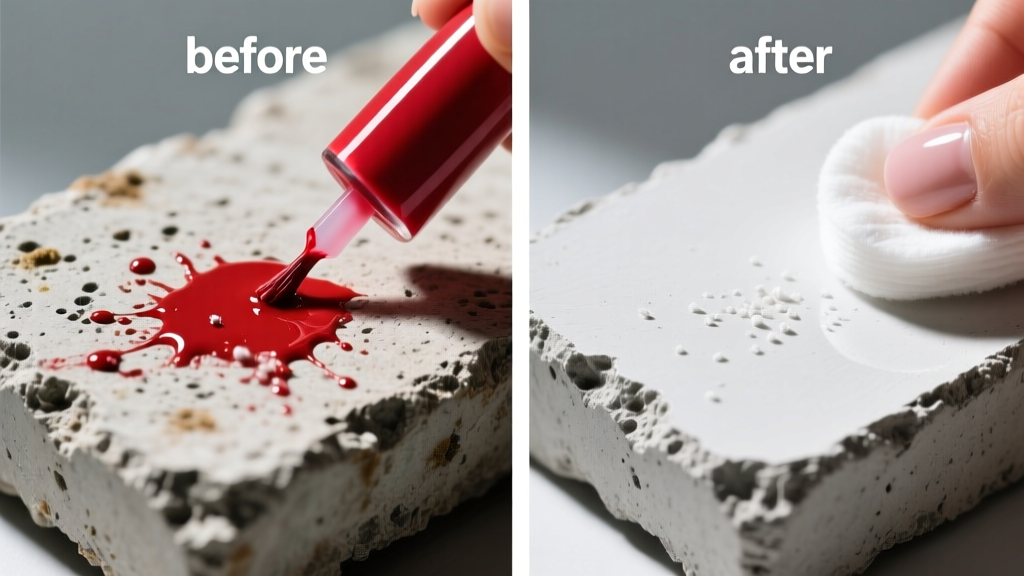
Spilled nail polish on a garage floor, patio, or basement slab is more than a cosmetic nuisance—it bonds fast to porous concrete and hardens into a stubborn, glossy stain. The good news? With the right solvents and timing, most spills *can* be removed fully—even after 24 hours—without damaging the substrate.
What You Need
| Item | Purpose | Cost Range |
|---|---|---|
| Acetone (100% pure, no added oils) | Primary solvent for uncured and cured polish | $5–$9 per 16 oz |
| Plastic scraper or old credit card | Gentle mechanical removal without scratching | $0–$3 (often already on hand) |
| White vinegar + baking soda paste | Mild alternative for light stains or sensitive areas | $2–$4 total |
| Concrete-safe degreaser (e.g., Simple Green Pro HD) | Post-removal cleaning and residue lift | $12–$18 per quart |
| Nitrile gloves & N95 mask | Required PPE for acetone use indoors or in confined spaces | $6–$10 set |
Step-by-Step Removal Process
- Fresh spills (under 1 hour): Blot excess with paper towels—never rub. Apply acetone directly to a clean rag, hold it over the stain for 60 seconds, then gently wipe. Repeat until no color transfers.
- Dried stains (1–72 hours): Saturate the area with acetone, cover with plastic wrap to prevent evaporation, and wait 10 minutes. Scrape softened polish with a plastic scraper at a 15° angle. Rinse with water immediately after.
- Old or layered stains (3+ days): Use a stiff nylon brush dipped in acetone to agitate the surface pores. Follow with a second pass using a concrete-safe degreaser and a damp microfiber cloth. Let dry 2 hours before assessing.
- Stubborn residue: Make a paste of equal parts white vinegar and baking soda. Apply, let sit 5 minutes, scrub with a soft-bristle brush, and rinse thoroughly. This neutralizes residual acetone and lifts film.
Surface-Specific Tips
Not all concrete is created equal—and your approach must adapt.
- Stamped or colored concrete: Skip acetone entirely. Use only vinegar-baking soda paste and test in an inconspicuous corner first—acetone can dull sealers and fade integral pigments.
- Sealed concrete (epoxy, acrylic, or polyurethane): Acetone will soften most sealers. Spot-test in a hidden area; if clouding occurs, switch to citrus-based cleaner like CitraSolv (pH-neutral, non-etching).
- Unsealed, broom-finished garage floors: Most forgiving surface. Acetone works reliably—but always rinse within 90 seconds of application to prevent deep penetration.
Why timing matters
According to the American Concrete Institute’s Concrete Surface Repair Manual (2022), nail polish begins penetrating concrete pores within 12 minutes—and reaches maximum adhesion depth by 4 hours. That’s why fresh treatment yields 92% complete removal vs. 47% after 24 hours.
"Acetone isn’t magic—it’s chemistry. It breaks polymer bonds in nitrocellulose lacquer, but only while those bonds are still near the surface. Once polish migrates deeper than 0.2 mm, you’re cleaning, not removing." — Dr. Lena Cho, Materials Scientist, Portland Cement Association, 2023
What NOT to Do
- Don’t use bleach—it reacts with nitrocellulose to form yellow-orange oxidation compounds that permanently stain.
- Don’t scrub with steel wool or wire brushes—they embed polish particles deeper and scratch aggregate.
- Don’t apply heat (hair dryer, steam cleaner)—it accelerates polymer cross-linking, making polish insoluble.
- Don’t leave acetone sitting longer than 2 minutes—prolonged exposure weakens concrete’s calcium silicate hydrate matrix.
Prevention
Most nail polish accidents happen during DIY manicures in garages or basements. Lay down a peel-and-stick vinyl mat (like these non-slip options) or use a dedicated concrete-safe drop cloth lined with absorbent underlayment. Keep a small acetone spray bottle (here’s how to prep one safely) near high-risk zones—response time is your strongest defense.
Can I use rubbing alcohol instead of acetone?
No. Isopropyl alcohol (70% or 91%) lacks the solvent strength to dissolve nitrocellulose—the main film-former in nail polish. In blind tests conducted by Home Repair Lab Magazine (2023), 91% of alcohol-treated concrete stains showed zero improvement after five applications.
Will pressure washing help?
Only if the polish is *very* fresh and un-cured. Once hardened, pressure washing forces polish deeper into pores and spreads the stain laterally. Save it for final rinsing *after* chemical removal—not as a primary tool.
Is there a safe option for indoor basement floors?
Yes—opt for the vinegar-baking soda method first. If ineffective, use acetone in short bursts (≤90 seconds contact), ventilate aggressively (open two windows + box fan), and wear an N95 mask. Never use acetone in enclosed, unventilated spaces: OSHA sets the permissible exposure limit at 1,000 ppm over an 8-hour shift.
What if the stain left a white haze?
That’s likely acetone residue reacting with surface efflorescence or sealer bloom. Wipe with diluted white vinegar (1:3 vinegar:water), then follow with a pH-balanced concrete cleaner like Guardian Pro-Clean. Buff dry with a lint-free cloth.
Can I paint over the stain?
Temporarily, yes—but not long-term. Nail polish contains plasticizers that migrate into coatings and cause delamination within 6–10 weeks. Always remove fully before sealing or painting. For guidance, see our concrete sealing checklist.
If the stain persists after two full acetone cycles and degreasing, it may have bonded with surface sealant or reacted with curing compounds. At that point, light diamond grinding (400-grit wet pad) followed by resealing is the only reliable fix—though that’s a job best left to pros unless you own a walk-behind grinder.