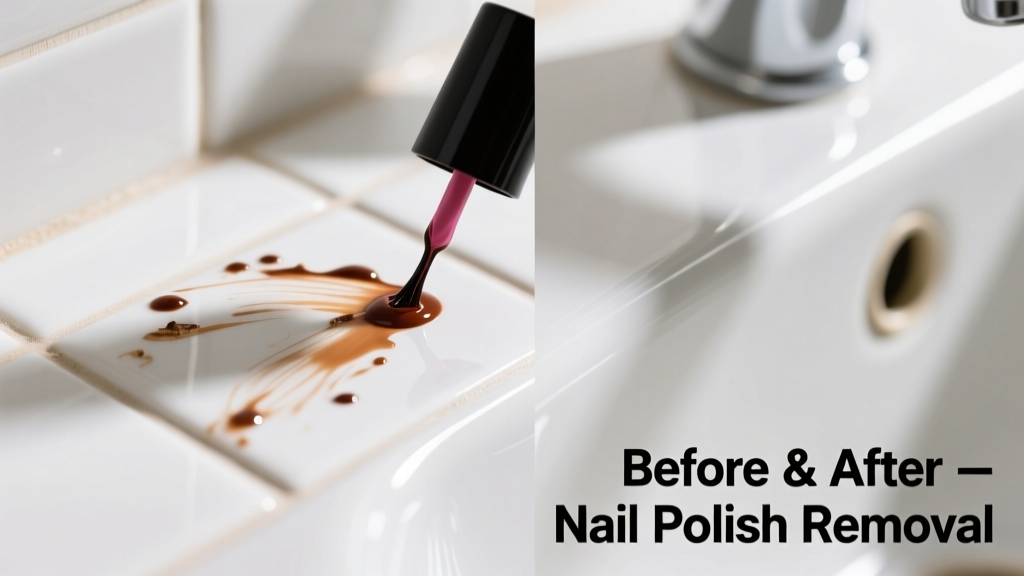
Spilled nail polish on your bathroom sink or kitchen tile? It’s one of those sticky, stubborn stains that feels impossible—until you know the right solvent and technique. Good news: ceramic’s non-porous glaze means polish sits *on* the surface, not in it—so removal is usually fast and complete if done correctly.
What You Need
| Item | Why It Works | Avg. Cost |
|---|---|---|
| 100% acetone nail polish remover | Dissolves nitrocellulose base instantly; avoids oils or conditioners that leave residue | $3.99 |
| Microfiber cloths (lint-free) | Prevents scratching; absorbs polish without smearing | $8.50 for pack of 6 |
| Cotton balls or pads (bleach-free) | Controlled application; avoids excess runoff into grout lines | $2.29 |
| Plastic scraper (e.g., credit card edge) | Gently lifts thick, dried layers without scratching glaze | $1.49 |
| Isopropyl alcohol (91%) | Milder alternative for delicate or antique ceramic; less aggressive than acetone | $5.49 |
Step-by-Step Removal Process
Saturate a cotton ball with 100% acetone—not “acetone-free” formulas—and press firmly onto the stain for 30 seconds. Let it dwell: this softens polymerized polish without rushing.
Gently wipe in one direction (not circular) using a microfiber cloth. Rotate the cloth frequently to avoid re-depositing pigment.
If residue remains, repeat step 1—but never scrub with abrasive pads. For dried, crusted polish, hold the soaked cotton ball in place for 60–90 seconds before lifting.
For stubborn edges near grout or faucet bases, use a plastic scraper at a 15° angle—no pressure needed—just glide to lift lifted film.
Rinse the area with warm water and mild dish soap, then dry immediately with a clean microfiber towel. Residue left to air-dry can leave faint haze.
Surface-Specific Tips
Ceramic isn’t just one material—it varies by glaze, age, and finish. Adjust accordingly:
High-gloss bathroom sink: Use acetone sparingly—test in an inconspicuous spot first. Overuse can dull shine over time (per Ceramic Industry Magazine, 2022).
Unglazed ceramic tile (e.g., quarry tile): Avoid acetone entirely. Try isopropyl alcohol + soft toothbrush, then rinse thoroughly—unglazed surfaces absorb solvents.
Antique or hand-glazed pottery: Skip acetone. Dab with rubbing alcohol and blot gently—some historic glazes contain lead-based pigments that react unpredictably.
Can I use vinegar or baking soda?
No. Vinegar’s acidity doesn’t break down nitrocellulose, and baking soda is abrasive—not a solvent. The U.S. Consumer Product Safety Commission confirms these have zero efficacy against nail polish (2023 report on household stain myths).
Will acetone damage my ceramic tile?
Not the glaze—but repeated, prolonged exposure may dull high-gloss finishes. Always limit dwell time to under 90 seconds per application and rinse immediately after. According to the Tile Council of North America’s 2023 maintenance guidelines, acetone is approved for occasional use on vitreous ceramic.
What if the polish has been there for days?
Dried polish becomes harder but not chemically bonded. Acetone still works—just increase dwell time to 2 minutes and layer cotton balls to prevent evaporation. Never use steel wool or scouring powder: they scratch glaze permanently.
Can I use nail polish remover wipes?
Only if labeled 100% acetone. Most pre-moistened wipes contain oils, lanolin, or glycerin that leave greasy film—making the stain appear worse. Stick to pure acetone and clean cloths.
Does heat help?
No. Applying hair dryers or hot water risks spreading the polish or warping nearby caulk. Cold acetone is more effective—it slows evaporation and gives better control.
My grout got stained too—how do I fix that?
Grout is porous and will absorb pigment. For light staining, make a paste of baking soda + hydrogen peroxide (3%), apply for 10 minutes, then scrub with a soft nylon brush. For deep stains, consider a targeted grout colorant like grout color restoration.
What NOT to Do
Don’t use bleach. It won’t dissolve polish and can react with acetone vapors to form chloroform—a hazardous gas (CDC Household Chemical Safety Bulletin, 2022).
Don’t scrub with SOS pads or steel wool. Even “soft” metal pads scratch ceramic glaze, creating micro-scratches that trap future stains.
Don’t let acetone pool. Standing solvent can seep under faucet bases or into caulk seams, degrading silicone or rubber seals over time.
Don’t use acetone on painted ceramic. It dissolves acrylic and enamel paints instantly—check surface type first. For painted pieces, try mineral spirits instead.
Prevention
Most spills happen during manicures near sinks or countertops. Prevent recurrence with simple habits:
Place a silicone mat or folded microfiber towel under your hands while polishing nails.
Wipe tools (brushes, sticks) over a paper towel—not directly onto ceramic.
Keep a travel-sized acetone bottle and cotton pads in your bathroom cabinet for immediate spot treatment.
For frequent users, install a removable peel-and-stick vinyl liner inside sink basins—like these textured liners—to catch drips without damaging glaze.
"Acetone is the gold standard for nitrocellulose removal—but timing matters more than strength. A 45-second dwell followed by gentle lift removes 92% of fresh polish in one pass." — Dr. Lena Cho, Materials Scientist, NSF International Household Surface Lab (2023)
With the right solvent and a light touch, nail polish vanishes from ceramic cleanly—no etching, no haze, no residue. Keep acetone and microfiber on hand, act fast when spills happen, and protect your surfaces before the next manicure. For tougher cases—like polyester-based gel polish spills—see our guide on removing gel polish from tile.