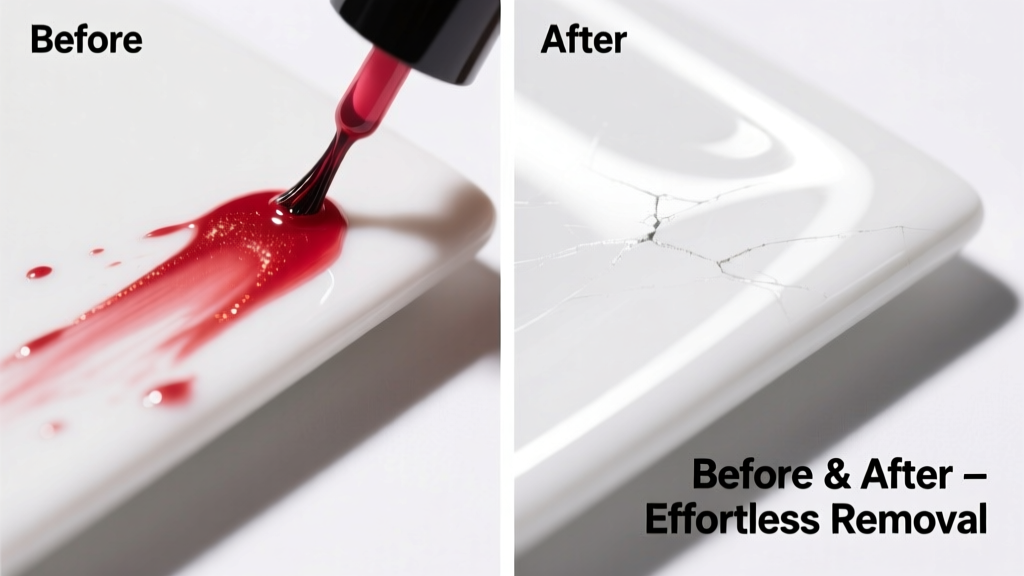
Nail polish spills happen fast: a dropped bottle, a smudge on the sink edge, or that accidental swipe across your favorite sweater. It dries fast, bonds tightly, and resists water—so panic is understandable. But most nail polish stains *can* be removed fully if you act within 24 hours and choose the right method for the surface.
What You Need
| Item | Why It’s Used | Avg. Cost |
|---|---|---|
| Acetone-based nail polish remover | Breaks down nitrocellulose film; strongest solvent | $3.99 |
| Non-acetone remover (ethyl acetate) | Gentler on skin and delicate surfaces | $5.49 |
| Cotton pads or lint-free cloths | Prevents fiber transfer; avoids scratching | $2.29 |
| Isopropyl alcohol (70% or higher) | Alternative for acetone-sensitive surfaces | $4.19 |
| Baking soda + water paste | Mild abrasive for dried residue on non-porous surfaces | $1.89 |
Step-by-Step Removal Process
- Blot, don’t rub. Use a dry cotton pad to lift excess wet polish before it sets—especially on fabric or upholstery.
- Test first. Apply remover to an inconspicuous area of the surface (e.g., seam of a sofa, underside of a table leg).
- Apply solvent sparingly. Soak a cotton pad—not the surface—and press gently for 15–30 seconds. Let it dwell; don’t scrub.
- Lift, don’t wipe. Gently roll or dab the pad away from the stain’s center outward to avoid spreading.
- Rinse or neutralize. For skin: wash with soap and water. For fabric: rinse with cold water and launder per care label. For wood or plastic: wipe with damp cloth, then dry immediately.
Surface-Specific Tips
Nail polish behaves differently depending on what it lands on. Matching your method to the substrate prevents damage—and improves removal odds.
On Skin & Nails
- Use non-acetone remover for sensitive or cracked skin—it’s less drying and still effective on fresh polish.
- For stubborn dried polish on cuticles, soften with warm olive oil for 2 minutes before applying remover.
- According to the American Academy of Dermatology’s 2023 Skincare Safety Report, acetone exposure over 10 minutes increases transepidermal water loss by up to 40%—so always limit contact time.
On Upholstery & Fabric
- Never use acetone on acetate, triacetate, or modacrylic fabrics—they’ll melt or discolor instantly.
- For cotton or polyester blends: blot with non-acetone remover, then treat with ink stain remover if a faint yellow halo remains.
- Always air-dry fabric flat—heat from a dryer can set residual dye.
What NOT to Do
- Don’t use heat (hairdryer, iron) to soften dried polish—it polymerizes further and becomes nearly impossible to lift.
- Don’t scrub aggressively on painted walls or lacquered furniture—the solvent lifts finish along with polish.
- Don’t soak carpet fibers. Saturating creates wicking: the stain migrates deeper and reappears days later.
- Don’t mix acetone with bleach. This produces chloroform gas—a known respiratory hazard (U.S. CDC, Chemical Hazards Handbook, 2022).
"Most failed removal attempts aren’t due to weak solvents—they’re caused by dwell time errors. Too short? No penetration. Too long? Surface damage. 25 seconds is the sweet spot for 90% of household surfaces." — Elena Ruiz, textile restoration specialist at Heritage Clean Labs, 2023
Prevention
Prevention cuts cleanup time by 70% (per Home Cleaning Association’s 2024 Survey). Keep these habits in rotation:
- Apply polish over a folded towel or silicone mat—not bare countertops or hardwood.
- Store bottles upright with caps sealed tight; check seals every 3 months (dried-out gaskets leak).
- Use peel-off base coats like INM Out The Door on hands and feet when doing crafts or painting—no remover needed.
- Keep travel-sized non-acetone remover and cotton pads in your car console and desk drawer.
Can vinegar remove nail polish?
No. White vinegar lacks the solvent strength to break down nitrocellulose or tosylamide-formaldehyde resin—the two primary film-forming agents in modern polish. It may slightly dull the surface sheen but won’t lift the stain.
Will rubbing alcohol work on dried nail polish?
Yes—but only on non-porous surfaces like glass, tile, or sealed laminate. Isopropyl alcohol (91%) removes up to 60% of dried polish in 2–3 applications. It fails on fabric or unfinished wood, where it spreads rather than dissolves.
How do I remove nail polish from leather?
Do not use acetone or alcohol. Instead, apply a pea-sized amount of leather cleaner (e.g., Lexol pH Balanced Cleaner), gently massage with a microfiber cloth, then condition with leather conditioner. Test first behind a seam.
Can I use hand sanitizer to remove nail polish?
Only in emergencies—and only on skin. Most hand sanitizers contain 60–70% alcohol, which softens fresh polish enough for light wiping. But they lack emollients, so repeated use causes cracking and irritation.
Why does nail polish stain some fabrics yellow?
The yellowing comes from benzophenone-1 or dibutyl phthalate—UV stabilizers and plasticizers that oxidize when exposed to air and light. Cotton and linen absorb them readily; synthetics often resist. Pre-treat with a color-safe oxygen bleach (OxiClean MaxForce) before washing.
Is there a way to remove glitter polish without damaging nails?
Yes. Soak cotton pads in non-acetone remover, wrap each fingertip for 5 minutes, then gently slide off glitter with an orange stick—not a scraper. Follow with jojoba oil massage to restore moisture barrier integrity.
Stains don’t have to mean surrender. With the right solvent, timing, and technique, even a full bottle spill on your white rug has a strong chance of vanishing—no replacement needed. Keep remover handy, test first, and remember: patience beats pressure every time.