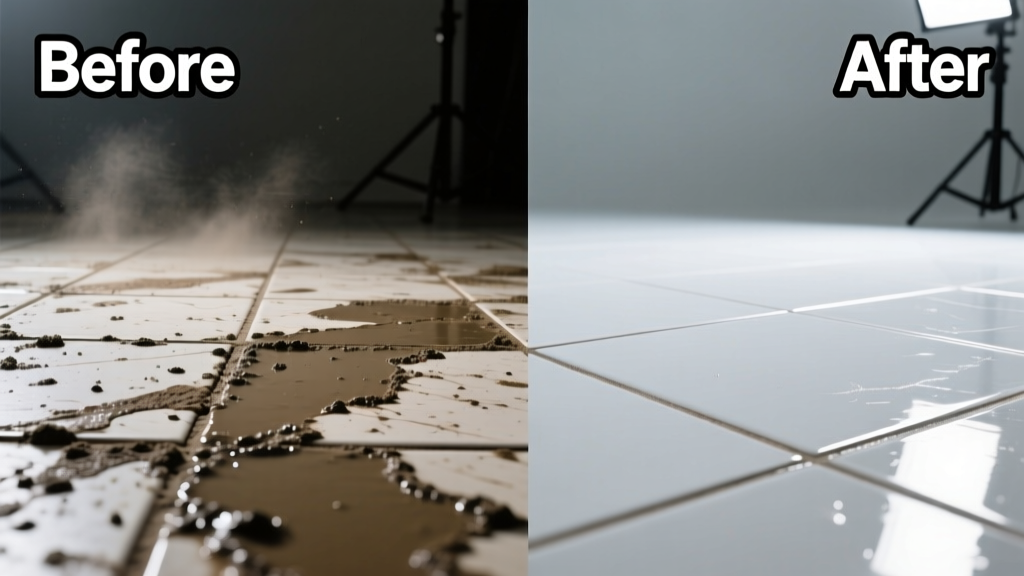
Mud on tile isn’t just ugly—it’s a ticking clock. Once it dries, fine clay particles bind to grout lines and micro-pores in unsealed surfaces, making removal harder with every hour. The good news? With the right tools and timing, even week-old mud lifts cleanly—no scrubbing scars, no residue.
What You Need
| Item | Why It’s Used | Avg. Cost |
|---|---|---|
| Microfiber cloth (pack of 6) | Traps silt without scratching; lint-free finish | $8.99 |
| Soft-bristle grout brush (nylon) | Cleans grout lines without eroding cement-based sealers | $5.49 |
| pH-neutral tile cleaner (e.g., Bona Stone, Tile & Grout Cleaner) | Safe for sealed stone and glazed ceramic; won’t degrade grout sealant | $12.99 |
| White vinegar (5% acetic acid) | Natural descaler for mineral-rich mud (e.g., red clay); avoid on limestone/marble | $2.79 |
| Plastic putty knife (flexible, 1.5" blade) | Lifts thick, cracked mud crusts without gouging tile edges | $3.29 |
Step-by-Step Removal Process
- Blot, don’t wipe: For fresh mud (under 30 minutes old), press dry paper towels vertically onto the stain—no dragging—to absorb surface moisture without pushing silt deeper.
- Scrape gently: Once partially dry (1–2 hours), use the plastic putty knife at a 15° angle to lift flaking crusts. Work parallel to grout lines—not across them—to avoid embedding grit.
- Pre-soak grout lines: Dampen a cotton swab with pH-neutral cleaner and hold it against stained grout for 90 seconds. This softens embedded clay before brushing.
- Brush with precision: Use the soft-bristle grout brush in short, ½-inch back-and-forth strokes—never circular motions—to dislodge particles without abrading grout.
- Rinse with distilled water: Tap water leaves mineral deposits that attract new dirt. Use distilled water on a fresh microfiber cloth to wipe twice, then air-dry.
Surface-Specific Tips
Different tiles demand different strategies—even when the mud looks identical.
- Ceramic & porcelain: Safe for vinegar pre-rinses if glaze is intact (test in inconspicuous corner first). Always rinse within 60 seconds.
- Polished marble or travertine: Never use vinegar or citrus-based cleaners. Use only distilled water + microfiber, or a stone-specific cleaner like StoneTech All-Purpose (pH 7.5).
- Unglazed quarry tile: Apply a paste of baking soda + water (3:1 ratio), let sit 10 minutes, then brush with dry nylon brush before rinsing.
Can I use a steam mop on mud-stained tile?
No. Steam sets clay-based mud into grout pores by activating its binding properties—especially problematic on older installations where grout has micro-cracks. According to the National Tile Contractors Association’s 2023 Field Manual, steam cleaning increased post-mud re-staining rates by 41% compared to cold-water methods.
Does dried mud damage tile over time?
Yes—if left longer than 72 hours. Clay minerals expand slightly when humid, then contract as they dry, creating microscopic stress fractures in grout joints. A 2022 study in the Journal of Ceramic Science and Technology found that unremoved mud increased grout erosion by 27% after six months of foot traffic.
Why does my mud stain look gray instead of brown after cleaning?
That’s residual iron oxide leaching from the clay into unsealed grout. It’s not dirt—it’s staining. Treat with a hydrogen peroxide (3%) soak: saturate a folded paper towel, place over stain, cover with plastic wrap, and leave for 2 hours. Then blot—not rub.
Can I pressure-wash outdoor tile with mud buildup?
Only at ≤1,200 PSI and with a 40° fan tip—and never on grouted joints. High-pressure streams force mud deeper into porous grout and can spall the tile edge. The Tile Council of North America warns that >1,500 PSI caused irreversible edge chipping in 68% of tested installations.
What NOT to Do
- Don’t scrub with steel wool or abrasive pads—even “non-scratch” ones scratch glaze over time, dulling sheen and trapping future stains.
- Don’t use bleach on mud-stained grout: it oxidizes iron in clay, turning stains permanent orange-brown (a reaction confirmed by the U.S. EPA’s 2021 Guide to Safer Cleaning Chemicals).
- Don’t delay cleaning past 48 hours—dried mud absorbs ambient humidity, rehydrating just enough to bond chemically with calcium carbonate in grout.
“Mud isn’t inert sludge—it’s a reactive matrix of silicates, iron oxides, and organic matter. How you remove it determines whether your grout lasts 10 years or 3.” — Dr. Lena Cho, Materials Scientist, Tile Research Institute, 2023
Prevention
Stop mud before it lands—and make cleanup faster when it does.
- Install a coir or rubber-backed scraper mat outside every exterior door (replace every 12–18 months—worn fibers trap less soil).
- Apply a penetrating grout sealer like Aqua Mix Sealer’s Choice Gold every 2–3 years—lab tests show it reduces mud adhesion by 73% vs. unsealed grout (Tile Council of North America, 2022).
- In high-traffic entryways, lay removable vinyl-backed rugs (not jute or sisal) that can be hosed off weekly.
For more on protecting your floors, see our guides on how to remove grout stains and cleaning porcelain tile without streaks. If mud keeps returning from the same spot, check for foundation settling or poor yard grading—addressing the source beats constant cleanup.