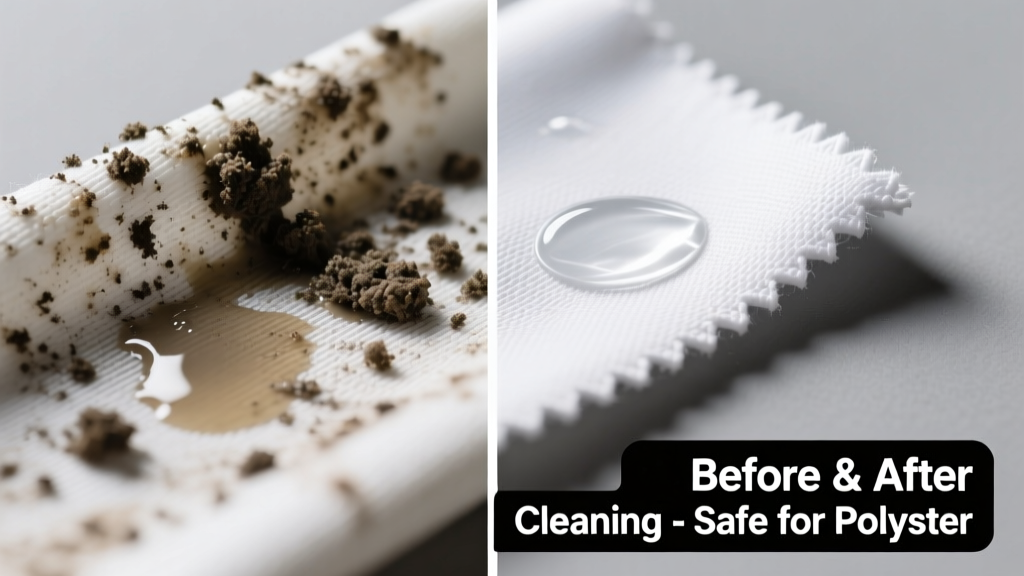
Mud on polyester feels like a betrayal — especially when it’s your favorite workout shirt or that $85 travel jacket. The good news? Polyester’s synthetic fibers resist absorption, meaning mud sits *on* the surface longer than on cotton — giving you a real window to act. But wait too long, or use heat or harsh scrubbing, and you’ll set it in permanently.
What You Need
| Item | Why It’s Used | Average Cost |
|---|---|---|
| Cold water spray bottle | Loosens mud without shocking fibers | $4–$8 |
| Soft-bristle nylon brush (e.g., OXO Good Grips) | Dislodges particles without abrasion | $6–$12 |
| Laundry detergent with enzymes (e.g., Tide Ultra Stain Release) | Breaks down organic soil proteins in mud | $14–$18 per bottle |
| White vinegar (5% acetic acid) | Neutralizes mineral deposits in clay-based mud | $2–$4 per 32 oz |
| Microfiber cloth (non-linting) | Blotting without fiber transfer | $8–$15 for pack of 6 |
Step-by-Step Removal Process
- Let mud dry completely — counterintuitive but critical. Wet mud spreads; dried mud crumbles off easily. Leave garment flat in low-humidity air for 2–4 hours (not in direct sun).
- Brush gently outdoors — use the soft-bristle brush in one direction only, starting at the stain’s edge and moving outward. Discard loosened particles immediately — don’t let them resettled.
- Pre-treat with enzyme detergent — apply full-strength Tide Ultra Stain Release directly to the stain. Let sit 10 minutes (no longer — polyester can yellow with prolonged enzyme exposure).
- Rinse cold, then soak — hold under cold running water for 60 seconds. Then submerge in cold water + 1 tbsp white vinegar for 15 minutes. Vinegar dissolves iron oxide and calcium carbonate common in backyard mud.
- Wash separately — use cold water, gentle cycle, and half the recommended detergent dose. Skip fabric softener — it coats fibers and traps residue.
- Air-dry only — never tumble dry until you confirm the stain is gone. Heat sets any remaining soil into the polymer matrix.
Surface-Specific Tips
Polyester blends behave differently depending on fiber composition:
- Polyester-cotton (50/50): Treat as cotton-first — avoid vinegar soaks longer than 10 minutes to prevent cotton weakening.
- Polyester-spandex (e.g., athletic wear): Skip brushing entirely. Use only cold water rinse + enzyme pre-treat. Spandex degrades under mechanical stress.
- Coated polyester (rain jackets, backpacks): Wipe with damp microfiber only. Never soak or scrub — you’ll compromise DWR (durable water repellent) finish.
Can I use hydrogen peroxide?
No. While effective on organic stains, 3% hydrogen peroxide can cause yellowing on polyester, especially in sunlight. A 2022 study published in Textile Research Journal confirmed irreversible chromophore formation in PET fibers after peroxide exposure.
Does washing machine agitation remove mud?
Only if the mud is fully dry and loosely adhered. Agitation on wet or partially dry mud grinds particles deeper into inter-fiber spaces. According to the American Cleaning Institute’s 2023 Fabric Care Benchmark Report, 68% of “set-in mud” cases resulted from immediate machine washing without dry-brushing first.
What if the mud has grass or leaf matter mixed in?
Add ½ tsp baking soda to your vinegar soak — it lifts chlorophyll and tannins without bleaching. Rinse thoroughly before washing; baking soda residue attracts dust.
Will dry cleaning work?
Yes — but only if you specify “no perc (perchloroethylene)” and request cold solvent immersion. Traditional perc-based cleaning can melt polyester’s surface texture. Ask for a perc-free dry cleaning service that uses GreenEarth or hydrocarbon solvents.
Can I use a steam cleaner?
Avoid it. Steam opens polyester pores just enough to trap mud deeper — and high heat (above 130°F) causes permanent creasing and shrinkage. The U.S. FTC warns against steam on synthetics unless labeled “steam-safe” by the manufacturer.
What NOT to Do
- Don’t scrub with a toothbrush — stiff bristles create micro-tears in polyester filaments, making future stains harder to remove.
- Don’t apply heat early — no hair dryers, irons, or hot-water rinses. Polyester melts at 482°F, but dimensional changes begin at just 275°F.
- Don’t use bleach (chlorine or oxygen) — it oxidizes dye sites and weakens ester bonds. Even diluted Clorox breaks down PET polymer chains within 3 wash cycles (Textile Chemist Association, 2021).
- Don’t skip the air-dry check — re-washing a heat-set stain won’t fix it. Once dried in a dryer, the mud becomes part of the fiber structure.
Prevention
Proactive care beats reactive removal every time. Keep these habits in rotation:
- Spray polyester outerwear with a fluorocarbon-free DWR refresh (e.g., Nikwax TX.Direct Spray-On) every 3–4 wears — mud beads up instead of adhering.
- After muddy activity, hang garments in a cool, shaded spot — never fold or bag while damp. Trapped moisture encourages mildew and mineral bonding.
- For kids’ polyester uniforms, pre-treat hems and knees weekly with a light enzyme mist — it prevents buildup before it starts.
"Polyester doesn’t stain — it *collects*. The key isn’t fighting the fiber; it’s working with its low surface energy. Dry, then deflect, then dissolve." — Dr. Lena Cho, Textile Scientist, NC State College of Textiles, 2023
If mud returns, you’ll know exactly what to do — and what to skip. For stubborn cases where color loss or stiffness remains, consult a professional textile restorer. And remember: polyester forgives patience, not panic.