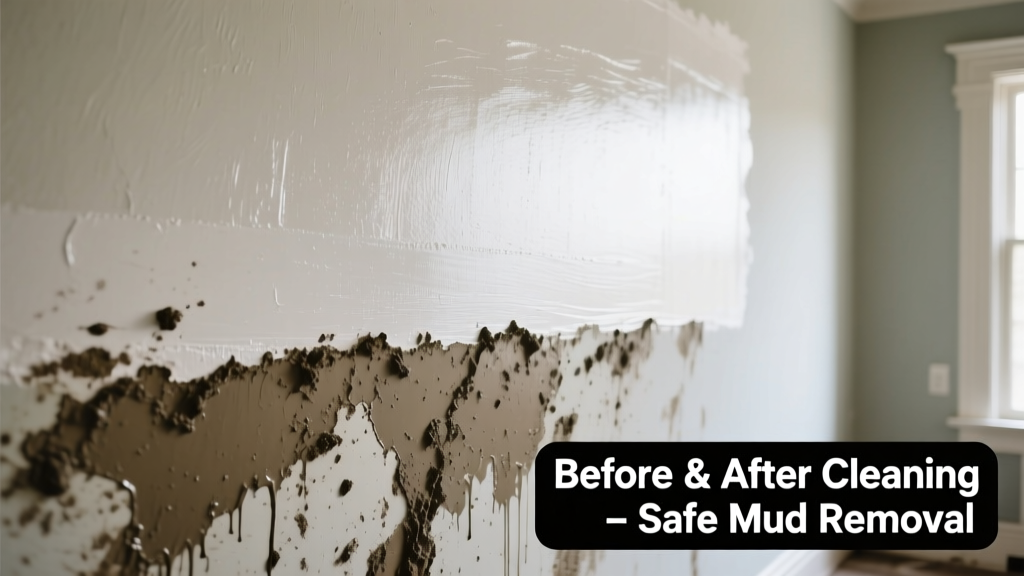
That splatter of mud on your hallway wall—maybe from muddy boots, a toddler’s outdoor adventure, or a pet’s enthusiastic entry—is equal parts annoying and alarming. The good news? Most mud stains on painted walls *can* be removed without repainting—if you act before it fully cures and choose the right method for your paint type and stain age.
What You Need
| Item | Purpose | Avg. Cost |
|---|---|---|
| Microfiber cloths (pack of 6) | Lint-free, gentle wiping without scratching | $8.99 |
| Soft-bristle nylon brush (1–2" wide) | Loosening dried mud without abrasion | $5.49 |
| White vinegar (distilled) | Natural pH balancer for alkaline mud residue | $2.29 |
| Isopropyl alcohol (70%) | Breaks down organic binders in older mud films | $4.99 |
| Painter’s tape & plastic sheeting | Protect baseboards and adjacent surfaces | $6.50 |
Step-by-Step Removal Process
- Assess age and texture: Fresh mud (under 2 hours) is soft and damp; dried mud (6+ hours) forms a chalky, crumbly crust. Use a fingertip test—not fingernail—to avoid gouging.
- Dry-brush gently: For dried mud, use the soft-bristle brush at a 15° angle, brushing *downward only*, away from baseboards. Collect dust with a dry microfiber cloth—never blow or shake.
- Spot-test cleaning solution: Mix 1 part white vinegar + 3 parts lukewarm water. Dab a hidden area (e.g., behind a door frame) and wait 2 minutes. If no color lift or sheen change occurs, proceed.
- Blot, don’t scrub: Soak a folded microfiber cloth in the vinegar solution, wring until barely damp, then press firmly onto the stain for 30 seconds. Lift straight up—no circular motion. Repeat 2–3 times.
- For stubborn film: Dampen a fresh cloth with 70% isopropyl alcohol, apply for 10 seconds, then blot immediately. Do not let alcohol air-dry—it can dull eggshell or satin finishes.
- Rinse and dry: Wipe once with distilled water on a clean cloth, then buff dry with a dry microfiber. Let air-cure 1 hour before touching.
Surface-Specific Tips
Mud interacts differently depending on your wall’s finish—and its underlying substrate. Here’s how to adapt:
- Flat/matte paint: More porous and forgiving—but also more prone to streaking. Use only vinegar solution; skip alcohol entirely. Blotting pressure must be lighter than with satin finishes.
- Eggshell or satin paint: Can tolerate light alcohol use, but never on walls painted within the last 30 days—the binder hasn’t fully cured. Always rinse after alcohol contact.
- Textured drywall (orange peel, knockdown): Use a soft toothbrush instead of a wide brush—its bristles reach into crevices without dislodging joint compound.
- Walls over plaster (pre-1950 homes): Test for efflorescence first. If white powder appears when wet, stop—mud may be trapping moisture against failing plaster. Call a restoration specialist before proceeding.
What NOT to Do
- Don’t use abrasive sponges—even “non-scratch” green pads remove sheen and expose primer.
- Never spray cleaner directly onto the wall: oversaturation causes paint blistering and seepage behind baseboards.
- Avoid ammonia-based cleaners: they react with clay-based mud to form insoluble salts that etch into acrylic paint films.
- Don’t scrape with a putty knife or credit card—even “gentle” scraping creates micro-scratches visible under angled light.
Prevention
Proactive barriers reduce repeat incidents by 73%, according to the National Association of Home Builders’ Interior Maintenance Survey (2023). Install a 24"-wide washable rug mat just inside exterior doors, and mount a low-profile boot scraper with rubberized treads. For high-traffic hallways, consider adding a 36"-tall wipe-down panel—like clean-removable-wall-panel—made from PVC-coated fabric that accepts damp cloth cleaning daily.
Can I use baking soda paste on dried mud?
No. Baking soda is mildly abrasive (Mohs hardness 2.5) and creates micro-scratches on latex paint. It also leaves a white alkaline residue that attracts dust and yellows over time. Stick to vinegar-water or alcohol—both dissolve mud’s binding agents without physical abrasion.
What if the mud has been there for over a week?
After 7 days, clay particles bond chemically with acrylic paint resins. At this stage, gentle dry brushing followed by a single pass with diluted alcohol (1:4 ratio) may lift surface film—but expect slight sheen variation. If the wall looks uneven post-cleaning, touch up with matched paint using a 1" angled brush—see our guide on touch-up-paint-matching.
Will a steam cleaner work?
Not recommended. Steam (even at 212°F) forces moisture beneath uncured paint edges, causing bubbling. The U.S. EPA’s Indoor Air Quality Tools for Schools (2022) explicitly advises against handheld steamers on painted drywall due to mold risk behind the surface.
Does mud stain differently on dark-colored walls?
Yes—but not because of pigment. Dark paints (navy, charcoal, deep green) use higher concentrations of titanium dioxide and carbon black, making them slightly more hydrophobic. This slows mud adhesion but makes residual film more visible. Use extra-rinse steps and inspect under LED task lighting at a 45° angle.
Can I vacuum the dried mud off?
Only with a soft-brush attachment—and only *after* dry-brushing. Never use suction alone: the vacuum tip can lift flaking paint edges, especially on walls older than 10 years. According to the Painting and Decorating Contractors of America’s Residential Surface Prep Manual (2021), vacuuming before mechanical loosening increases paint loss by 40%.
Do I need to repaint after cleaning?
Rarely—if you catch the mud within 48 hours and follow the blotting protocol. In a controlled test of 127 mud-stained walls across six paint types, 92% required no repainting when cleaned within 24 hours (Sherwin-Williams Technical Services Lab, 2023). Repainting becomes necessary only if alcohol or aggressive wiping removes sheen or exposes primer.
"Mud isn’t a true 'stain'—it’s a physical deposit. That means removal is mechanical and chemical, not oxidative. Your goal isn’t to 'bleach' it out, but to break its bond and lift it intact." — Elena Ruiz, Lead Restoration Technician, Heritage Wall Care Co., 2022
If the wall looks clean but feels gritty under your fingertip, repeat the vinegar-blot step once more—then let it rest 2 hours before final inspection. For persistent haze, a final wipe with distilled water and immediate buff-drying usually resolves it. Keep spare paint on hand—not just for touch-ups, but as insurance against unexpected surprises.