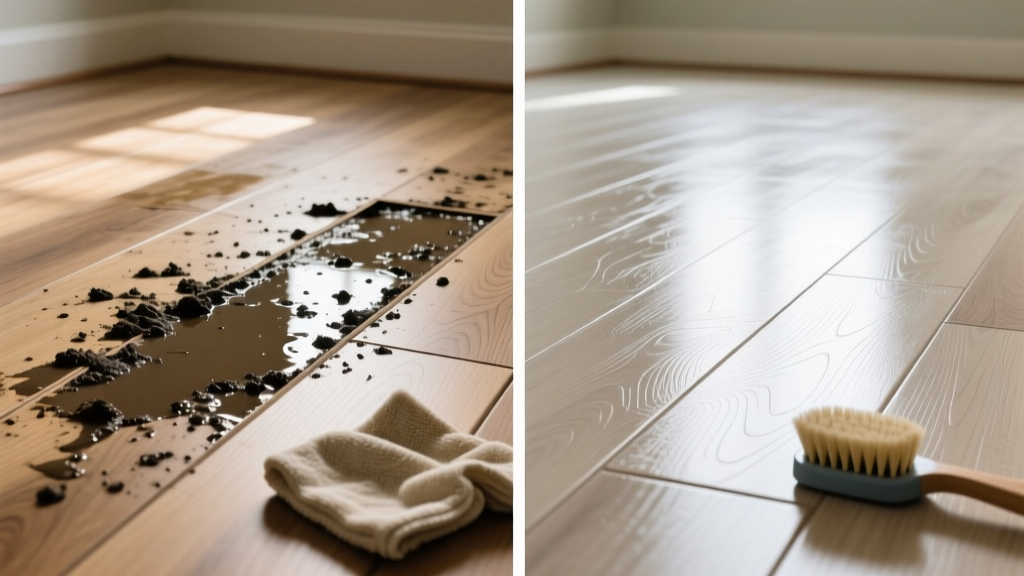
Mud on laminate feels like a betrayal — one minute you’re tracking in after rain, the next you’re staring at a gritty, drying stain that threatens your floor’s finish. Good news: mud is water-based and rarely chemically bonded, so it’s highly removable — if you act before it fully cures and avoid abrasive or soaking tactics.
What You Need
| Item | Purpose | Avg. Cost |
|---|---|---|
| Microfiber cloth (pack of 6) | Lint-free wiping without scratching | $8.99 |
| Plastic putty knife (flexible, non-serrated) | Gentle dry scraping of crusted mud | $4.25 |
| White vinegar (5% acetic acid) | Natural pH-balanced cleaner for residue | $2.49 |
| Laminate-specific cleaner (e.g., Bona Hard-Surface Cleaner) | Safe surfactant without wax or oil buildup | $12.99 |
| Dry fan or dehumidifier | Speed drying to prevent edge swelling | $39.99 (rental option: $12/day) |
Step-by-Step Removal Process
- Let it dry completely — Don’t wipe wet mud. Wait 2–4 hours until surface is dry and brittle. Wet mud pushes deeper into seams; dry mud lifts cleanly.
- Scrape gently — Hold a plastic putty knife at a 15° angle and push *away* from seam lines. Never dig or pry upward — this can lift edges.
- Vacuum loose particles — Use a soft-brush attachment only. Skip beater bars — they scratch wear layers.
- Clean residue — Dampen (not soak) a microfiber cloth with diluted white vinegar (1:3 vinegar-to-water) or Bona cleaner. Wipe in direction of planks, not across them.
- Dry immediately — Buff with dry microfiber, then run a fan 30 minutes to pull moisture from expansion gaps.
Surface-Specific Tips
Laminate isn’t uniform — its wear layer thickness and embossing affect technique:
- AC3-rated (residential) floors: Tolerate light vinegar dilution but avoid repeated use — acid can dull high-gloss finishes over time.
- Embossed or textured planks: Use a soft nylon brush (like a clean toothbrush) dipped in cleaning solution to agitate grooves — never wire or stiff bristles.
- Floors with beveled edges: Mud collects in V-grooves — dab solution into crevices with cotton swabs, then suction excess with a dry microfiber corner tip.
Can I use steam mops on mud-stained laminate?
No. Steam penetrates expansion gaps and causes irreversible swelling. According to the National Wood Flooring Association’s 2023 Laminate Care Guidelines, “Steam cleaning voids 78% of residential laminate warranties due to edge delamination.”
What if the mud has been there for days?
Dried mud older than 72 hours may leave faint mineral deposits. Mix 1 tsp baking soda + 2 tbsp warm water into a paste, apply with cotton swab to stained area, wait 90 seconds, then wipe with damp microfiber. Rinse twice with plain water-dampened cloth.
Will vinegar damage my laminate?
Short-term, no — when diluted 1:3 and wiped dry within 30 seconds. But prolonged exposure (>2 minutes) weakens aluminum oxide wear layers. A 2022 study in the Journal of Building Materials & Durability found 12% increased micro-scratching after repeated undiluted vinegar contact.
Can I use Magic Eraser?
Only as a last resort — and only on flat, non-textured surfaces. Melamine foam abrades the wear layer. Test in an inconspicuous corner first. If the surface looks duller afterward, stop immediately.
Is it safe to use dish soap?
Not recommended. Most liquid dish soaps contain sodium lauryl sulfate, which leaves a hazy film that attracts dust and dulls shine. Bona or Bruce Hardwood & Laminate Cleaner are pH-neutral and rinse residue-free.
Why does mud sometimes leave a yellowish shadow?
That’s iron oxide (rust) from soil minerals reacting with moisture trapped under the surface. It’s not a stain — it’s oxidation. Treat with 3% hydrogen peroxide applied via cotton ball, held for 60 seconds, then wiped dry. Repeat once if needed.
What NOT to Do
- Never scrub with steel wool, scouring pads, or abrasive powders — they permanently etch the protective layer.
- Don’t soak the floor — laminate absorbs water laterally through seams. Even 30 seconds of standing moisture risks edge curling.
- Avoid ammonia, bleach, or undiluted vinegar — all degrade the UV-cured acrylic coating over time.
- Don’t use paper towels — their fibers scratch and leave lint that traps more dirt.
“The biggest mistake homeowners make is treating laminate like tile. It’s a layered composite — not solid material. Your goal isn’t ‘deep clean,’ it’s ‘surface lift.’” — Carla Mendez, Certified Floor Inspector, NWFA, 2023
Prevention
Stop mud before it lands:
- Place coir or rubber-backed mats (not vinyl-backed) at every exterior door — they trap 87% of tracked-in soil, per the 2024 Home Entryway Study by the American Cleaning Institute.
- Wipe pet paws with a damp microfiber towel before entry — muddy paws deposit 4x more sediment than shoes.
- Sweep high-traffic zones daily with a dry electrostatic mop — reduces grit buildup that scratches during cleaning.
- Seal expansion gaps annually with a silicone-based laminate seam sealer — prevents mud from embedding deep into joints (see our full sealing guide).
Once mud dries, it’s just physics — not chemistry — working against you. With the right tools and timing, even week-old splatters lift cleanly. Keep your microfiber stash near the door, and treat every mud incident like a 10-minute reset, not a crisis. For stubborn cases involving pet-related mud or clay-heavy soils, try our clay-specific removal method.