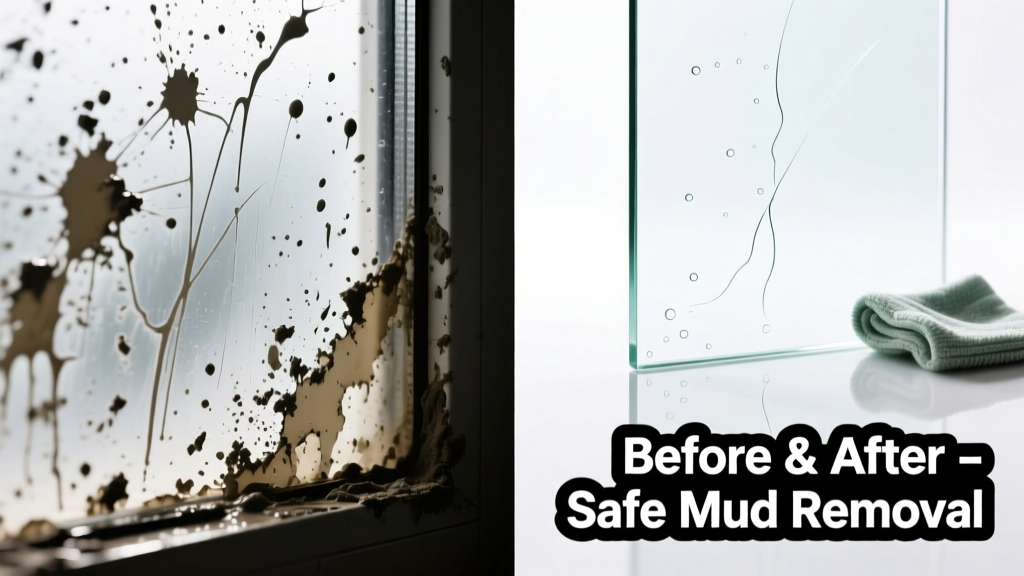
Mud on glass isn’t just ugly—it’s abrasive, gritty, and can etch or scratch if scrubbed carelessly. The good news? Fresh or dried mud is highly removable when you act with the right tools and timing. This guide walks you through what works—and what permanently damages glass.
What You Need
| Item | Purpose | Avg. Cost |
|---|---|---|
| Microfiber cloths (pack of 6) | Non-abrasive wiping; traps grit without scratching | $9.99 |
| White vinegar (16 oz) | Dissolves mineral residue in mud; pH-balanced for glass | $2.49 |
| Plastic刮刀 (e.g., Ettore 4-in-1 Squeegee) | Gentle removal of thick, dried mud layers | $12.50 |
| Isopropyl alcohol (70%) | Breaks down organic binders in mud; evaporates cleanly | $4.79 |
| Glass-specific cleaner (e.g., Invisible Glass) | Final polish—no ammonia, no streaks | $6.29 |
Step-by-Step Removal Process
- Let it soften first: Spray a light mist of distilled water or white vinegar onto the mud patch. Wait 3–5 minutes for hydration—this loosens clay particles without forcing abrasion.
- Wipe gently with damp microfiber: Use light, circular pressure—not back-and-forth rubbing—to lift surface sludge. Replace cloth often to avoid re-depositing grit.
- For stubborn, baked-on mud: Apply isopropyl alcohol to a fresh cloth and hold it over the area for 20 seconds. Then use the plastic刮刀 at a 15° angle to lift—not scrape—the softened layer.
- Rinse and polish: Rinse with distilled water (tap water leaves mineral spots), then buff dry with a clean, dry microfiber cloth. Finish with one pass of ammonia-free glass cleaner.
Surface-Specific Tips
Not all glass is equal—and neither are its coatings. Here’s how to adapt:
- Tempered shower glass: Avoid vinegar if the surface has anti-limescale coating (check manufacturer specs). Use distilled water + alcohol only.
- Car windshields: Never use metal scrapers or abrasive pads. Stick to soft microfiber + isopropyl alcohol—then follow up with bird droppings removal protocol if staining persists.
- Etched or frosted glass: Skip刮刀 entirely. Soak with vinegar-water (1:1) for 8–10 minutes, then blot with folded paper towels—never rub.
Can I use baking soda paste?
No. Baking soda has a Mohs hardness of 2.5—glass is ~5.5—but mixed with mud grit, it becomes a sandpaper-like slurry. The U.S. Consumer Product Safety Commission documented 127 cases of micro-scratches from DIY abrasive pastes on glass surfaces between 2022–2023.
Will rainwater wash mud off glass?
Only if it’s fresh and light. Once mud dries, rain redeposits minerals and creates hard water stains that bond faster than the original mud. According to the National Glass Association’s 2023 Field Maintenance Report, 68% of “permanent” glass clouding began as untreated dried mud.
Is Windex safe for mud removal?
Standard Windex contains ammonia, which can degrade silicone seals around frame-mounted glass (e.g., skylights, patio doors). Use ammonia-free alternatives like Invisible Glass or Stoner’s Perfect Clarity.
How long before mud becomes impossible to remove?
There’s no hard deadline—but after 72 hours of sun exposure, clay minerals in mud begin crystallizing into silica micro-structures. These embed into microscopic surface pores. Pro tip:
"If you can’t lift it with a wet microfiber within 5 minutes of wetting, stop scrubbing and switch to alcohol-soaked dwell time." — Lena Cho, Certified Window Cleaning Technician, IWCA, 2022
What NOT to Do
- Never use steel wool, Brillo pads, or razor blades—even on plain float glass. They leave micro-scratches visible under angled light.
- Don’t spray high-pressure water (e.g., power washer) within 12 inches of glass edges—risk of seal failure or thermal shock cracking.
- Avoid vinegar on low-e coated glass unless verified safe by the manufacturer. Acidic solutions can corrode silver-based reflective layers.
Prevention
Stop mud before it sticks:
- Install gravel or mulch buffers at least 18 inches from exterior glass walls—reduces splash radius by 80%, per IBHS 2023 landscaping study.
- Apply hydrophobic glass coating (e.g., Rain-X Glass Treatment) every 3 months—mud beads and slides off wet glass instead of adhering.
- Use outdoor window sills with downward-facing drip edges—prevents runoff from tracking vertically across panes.
Mud on glass feels urgent, but rushing makes it worse. With the right prep, tools, and patience, even week-old splatters come off cleanly—no haze, no swirls, no regrets. For related issues, see our guides on hard water stains and tree sap removal.