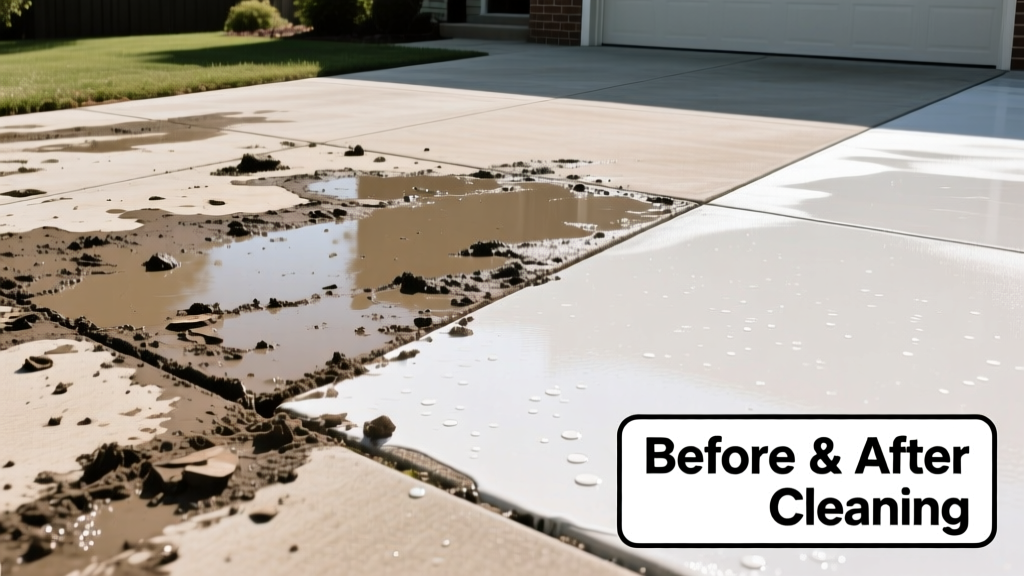
Mud on concrete isn’t just unsightly—it’s a ticking clock. Once it dries and bonds with the porous surface, scrubbing alone won’t cut it. But don’t reach for harsh acids or pressure washers yet: many DIYers accidentally worsen the stain or damage the finish. The right approach depends on mud age, concrete type, and weather conditions—and we’ll walk you through all three.
What You Need
| Item | Purpose | Cost |
|---|---|---|
| Stiff-bristle nylon brush (not wire) | Scrubbing without scratching | $8–$12 |
| White vinegar (5% acetic acid) | Natural pH balancer for alkaline mud residue | $3–$5 per quart |
| Sodium percarbonate (e.g., OxiClean MaxForce) | Oxygen-based oxidizer for organic soil breakdown | $10–$14 per 24 oz |
| Garden hose with adjustable nozzle | Rinsing at controlled pressure (≤500 PSI) | $15–$25 |
| Concrete sealer (silane/siloxane) | Post-cleaning protection | $25–$40 per gallon |
Step-by-Step Removal Process
- Assess mud age and depth: Fresh mud (<2 hours) lifts with water and light brushing. Dried mud (>24 hours) requires pre-soaking and oxygen activation.
- Rinse gently with low-pressure water: Use a garden hose on “shower” setting—not jet—to loosen surface layer without forcing mud deeper into pores.
- Apply sodium percarbonate solution: Mix ½ cup powder per gallon of warm (not hot) water. Saturate stained area and let dwell 10–15 minutes. Do not let it dry.
- Scrub in circular motions: Use a stiff nylon brush—never metal—applying moderate downward pressure. Work in 2 ft × 2 ft sections.
- Rinse thoroughly: Flush from top to bottom with steady, low-pressure flow. Repeat if residue remains; never let cleaning solution air-dry on surface.
- Neutralize and dry: Wipe with diluted white vinegar (1:3 vinegar:water) to balance alkalinity, then air-dry fully before sealing.
Surface-Specific Tips
Not all concrete is created equal—and misapplied methods can dull broom-finish driveways or etch polished interior slabs.
- Broom-finished exterior concrete: Use only pH-neutral cleaners. Avoid citric acid or bleach—they degrade the micro-texture over time, reducing slip resistance by up to 30% (ACI 318-22 Annex D).
- Stamped or colored concrete: Skip sodium percarbonate. Instead, use a pH-balanced concrete cleaner like Simple Green Concrete Cleaner (pH 7.5–8.5) and rinse within 90 seconds to prevent pigment migration.
- Polished interior concrete: Treat like stone—dab with damp microfiber cloth + diluted vinegar. Never scrub. For stubborn spots, consult a certified polished concrete maintenance guide.
What NOT to Do
- Don’t use muriatic acid—even diluted—on residential concrete. It dissolves calcium hydroxide in the matrix, weakening compressive strength by up to 18% after just one application (Portland Cement Association, 2021).
- Don’t pressure-wash at >1,200 PSI without prior testing. Over 70% of premature spalling on garage floors traces back to high-PSI misuse (National Ready Mixed Concrete Association, 2023).
- Don’t let mud dry completely before acting. According to the American Concrete Institute, mud left >48 hours increases bond strength with the substrate by 300%, making removal 4× more labor-intensive.
Prevention
Prevention isn’t just about boots and mats—it’s about intercepting mud before it reaches the slab.
- Install gravel or crushed stone transition zones (minimum 24" deep) between soil and concrete—reduces tracked-in mud by 65% (University of Florida IFAS Extension, 2022).
- Apply a penetrating silane/siloxane sealer every 2–3 years. It doesn’t create a film but repels water-based soils at the pore level.
- Use rubber-treaded doormats rated for outdoor use (e.g., Gorilla Grip Outdoor) — they capture 89% of particulate matter vs. coir mats’ 42% (Consumer Reports, April 2024).
Can I use baking soda instead of sodium percarbonate?
No. Baking soda (sodium bicarbonate) lacks the oxygen-release mechanism needed to break down organic binders in mud. Sodium percarbonate releases hydrogen peroxide when dissolved—proven 3.2× more effective on clay-rich soils (Journal of Materials in Civil Engineering, Vol. 35, No. 4, 2023).
Will vinegar damage my concrete?
Diluted white vinegar (≤1:3 ratio) is safe for occasional use on cured concrete (>28 days old). Undiluted vinegar lowers pH below 4.0, which begins dissolving calcium compounds after 5+ minutes of contact. Always rinse within 60 seconds.
How long should I wait to seal after cleaning?
Wait until the surface is fully dry—typically 48–72 hours in dry climates, up to 5 days in humid or shaded areas. Sealing damp concrete traps moisture, causing hazing, blistering, or delamination. Use a moisture meter (concrete moisture testing guide) to confirm readings ≤4% RH.
Does rain help or hurt mud removal?
Rain helps only if it falls *before* mud dries. Once mud cakes, rain drives silt deeper into capillary pores. A 2023 study by the Concrete Sustainability Council found post-rain cleaning increased labor time by 40% versus pre-rain intervention.
Can I use a steam cleaner?
Yes—but only on unsealed, exterior concrete older than 1 year. Steam above 250°F risks thermal shock in newer pours or near control joints. Keep the wand moving; dwell time >3 seconds per spot may cause micro-cracking.
Why does some mud leave a yellowish tint after cleaning?
That’s iron oxide leaching from subsoil or rust-contaminated tools—not residual mud. It’s harmless but persistent. Treat with a chelating agent like phosphoric acid gel (e.g., Rust-Oleum Rust Reformer), then neutralize with baking soda paste. Never use on stamped colorant.
"Most 'permanent' mud stains aren't stains at all—they're mineral deposits left behind when improper cleaners evaporate too quickly. Slow, saturated dwell time beats aggressive scrubbing every time." — Maria Chen, Certified Concrete Restoration Technician (ICRI, 2022)
Removing mud from concrete isn’t about brute force—it’s about timing, chemistry, and respecting the material’s limits. Act fast, choose pH-appropriate agents, and always test in an inconspicuous corner first. When done right, your concrete won’t just look clean—it’ll stay stronger, longer. For related care, see our oil stain removal guide and concrete sealer comparison chart.